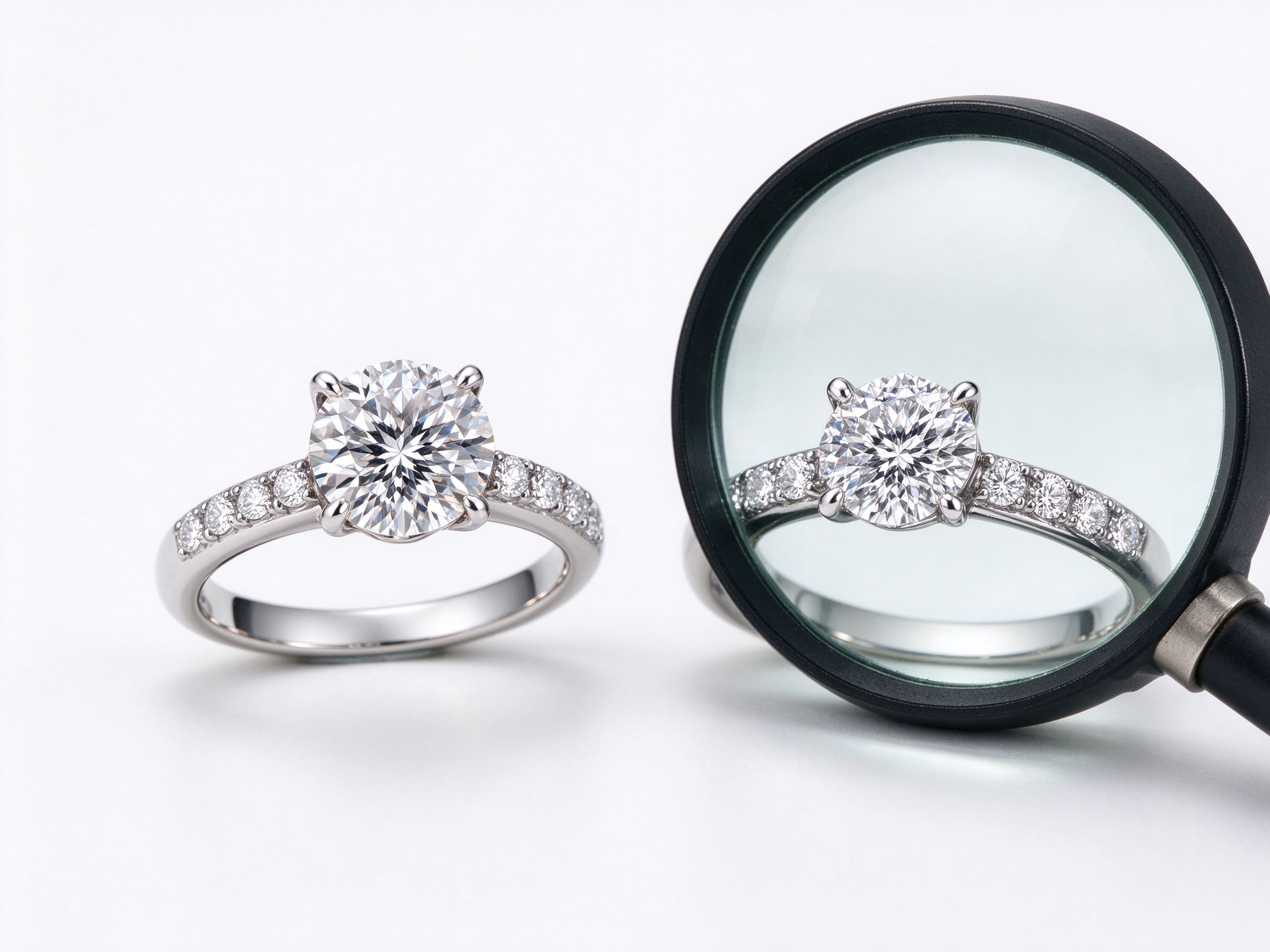
The Three Pricing Methods
There are three common approaches to pricing jewelry. Each has pros and cons. Most successful brands use a combination.
Cost-Plus Pricing
This is the simplest method: calculate your total cost, then multiply by a target margin multiple. If your cost (stone plus setting plus labor) is $100 and you want a 2.5x markup, your retail price is $250.
Cost-plus is reliable but can leave money on the table if customers are willing to pay more. It can also price you too high if your costs are above market.
Competitive Pricing
This method looks at what competitors charge for similar pieces and prices accordingly. If other brands sell 6.5mm moissanite solitaire rings for $298, you price yours at $278 or $318 depending on your positioning.
Competitive pricing keeps you in the market but can lead to price wars. Differentiate on quality, service, or brand rather than just undercutting.
Value-Based Pricing
This method prices based on the perceived value to the customer, not your cost. If your brand tells a strong ethical story, offers free resizing, and includes a certificate, customers will pay more. Value-based pricing is how premium brands achieve 4x to 6x markups.
A Practical Pricing Template
Here is a starting point for moissanite jewelry pricing:
| Piece | Land Cost | Setting Cost | Total Cost | Retail Price | Markup |
|---|---|---|---|---|---|
| 6.5mm solitaire ring | $40 | $60 | $100 | $298 | 3.0x |
| 7x9mm oval ring | $70 | $80 | $150 | $498 | 3.3x |
| 6.5mm stud earrings | $80 (pair) | $40 | $120 | $348 | 2.9x |
| 6x8mm pear pendant | $50 | $30 | $80 | $228 | 2.9x |
These are starting points. Adjust based on your brand positioning, your market, and your actual costs.
Anchoring Against Diamond Pricing
One of the most powerful pricing strategies for moissanite is anchoring. Show customers what a comparable diamond would cost, then show your moissanite price. A 1-carat diamond solitaire costs $5,000 to $8,000. Your moissanite version is $298. The contrast makes your price feel like an incredible value.
Use this anchoring in your marketing. Product descriptions should say "diamond equivalent: $6,000. Our price: $298." This frames your moissanite not as a cheap product, but as a smart alternative.
Volume Discounts for B2B Customers
If you sell wholesale to other retailers, your pricing structure needs tiers. Offer 10 percent off at 10 pieces, 20 percent off at 50 pieces, and 30 percent off at 100 pieces. This incentivizes larger orders and rewards loyal buyers.
Make sure your tiered pricing still preserves margin. Calculate your lowest possible price (cost plus minimum acceptable margin) and build your tiers from there. Do not discount below your floor.
A Detailed Cost Breakdown Example
To make pricing concrete, let us walk through a full cost breakdown for a 6.5mm round D VVS moissanite solitaire ring. This is the most common product we supply.
- Moissanite stone (6.5mm D VVS with GRA certificate): $40 landed cost
- 14k white gold setting (solitaire, 2 prong): $55 wholesale
- Band and labor (casting, finishing, polishing): $25
- Packaging (gift box, warranty card, certificate sleeve): $8
- Payment processing and shipping: $7
Total landed cost: $135.
Now apply pricing. At a 2.5x markup, retail is $338. At a 3x markup, retail is $405. At a 3.5x markup, retail is $473. Which price should you choose? It depends on your brand and market.
If you are a value-focused DTC brand, $298 to $348 is competitive. This price point converts well and still preserves a 55 to 60 percent gross margin. If you are a premium brand with strong marketing, $398 to $498 is achievable. The higher price requires better photography, better storytelling, and better customer service to justify.
Psychological Pricing Tips
Small pricing tweaks can meaningfully improve conversion. Here are tactics that work in jewelry ecommerce:
- Charm pricing: Price at $298 instead of $300. The first digit matters psychologically. $298 feels like a deal compared to $300.
- Anchoring: Show the "comparable diamond price" next to your price. "Diamond equivalent: $6,000. Our price: $298." The contrast makes your price feel like a steal.
- Tiered pricing: Offer a "basic" and "premium" version. The basic gives customers a reference point. Most customers choose the premium because it feels like the better deal.
- Free shipping threshold: Offer free shipping on orders over $300. This encourages customers to add a pair of stud earrings or a pendant to reach the threshold.
Competitive Positioning: Where to Play
You cannot be the cheapest and the best at the same time. Choose your position:
- Value position: Price at $198 to $248. Compete on price. Use F color and VVS2 stones. Keep marketing lean. Volume-driven business.
- Mid-market position: Price at $298 to $398. Compete on quality and style. Use E color and VVS stones. Invest in photography and brand. This is the sweet spot for most DTC brands.
- Premium position: Price at $498 to $898. Compete on design and customer experience. Use D color and VVS1 stones. Offer custom designs, free resizing, and a strong warranty. Margin-rich but requires marketing investment.
Most new brands should start mid-market. It has enough margin to invest in growth, and the price is accessible enough to convert. Move up to premium only when your brand justifies it.
Frequently Asked Questions: Moissanite Pricing Strategy
Q: What margin should I target? A: 60 to 70 percent gross margin is standard for DTC moissanite. This covers marketing, overhead, and profit. Wholesale pricing to retailers should be 30 to 50 percent below your retail.
Q: Should I price match my competitors? A: Not always. If your quality is better, you can charge more. If you are a new brand, price 10 to 15 percent below the market leader to gain traction.
Q: How do I know if my price is too high? A: If your conversion rate is below 1.5 percent and your ad cost per acquisition is above $80, your price may be too high. Test a lower price point and see if conversion improves.
Q: Should I offer discounts? A: Occasionally, yes. Holiday sales and first-order discounts help acquire customers. But do not discount constantly, or customers will wait for sales.
Q: How do I calculate my landed cost correctly? A: Add stone cost, setting, labor, packaging, shipping, insurance, duty, and payment fees. Divide by the number of pieces. Use this as your cost basis, not the factory price.
Calculating Your True Margin: A Worked Example
Let us walk through a full margin calculation for a moissanite solitaire ring. This is the number you need to know before you set a price.
- Moissanite stone (6.5mm D VVS, landed): $42
- 14k white gold solitaire setting (wholesale): $55
- Labor to set and finish: $20
- Packaging and warranty card: $8
- Payment processing (3 percent of $298): $9
- Shipping to customer: $5
Total cost: $139.
If you retail at $298, your gross profit is $159. That is a 53 percent gross margin. After ad spend (say $50 per sale), your net profit is $109 per ring. That is healthy.
If you retail at $198, your gross profit is $59. After $50 ad spend, net profit is $9. That is not sustainable.
This is why pricing strategy matters. A $100 difference in retail price makes the difference between a profitable business and a struggling one. Know your costs. Price with margin. Do not compete on the lowest price.
Real Price Increase: How We Raised Prices 8 Percent Without Churning
In January 2026, we raised our prices by 8 percent across all tiers. Raw material and labor costs had increased, and our margins had compressed. We were nervous about losing customers. Here is what happened.
- We notified all existing customers 30 days in advance by email.
- We explained the reason honestly: rising crystal growth and labor costs.
- We offered a 30-day window to lock in old prices for orders placed before the increase.
- We kept Tier 4 pricing (500+ pieces) at the old rate to reward volume buyers.
Results: 85 percent of our existing customers stayed. 10 percent negotiated a compromise (they accepted the increase but got a small volume discount). 5 percent left for a cheaper supplier.
The 5 percent who left were mostly price-sensitive small buyers who ordered $500 or less per year. We did not lose any of our top 20 customers. The 8 percent price increase improved our gross margin by 6 percentage points, which we reinvested in better QC and faster shipping.
The lesson: honest, well-communicated price increases do not drive away good customers. They only drive away the customers who were never profitable for you anyway. Do not be afraid to raise prices when costs demand it.
For buyers, the takeaway is the reverse: price increases happen. Build a 5 percent annual price increase into your own retail pricing model. Do not assume your wholesale costs will stay flat forever.
Key Takeaways
Pricing moissanite jewelry comes down to knowing your true cost and choosing a positioning. Your cost is not just the stone price. It is stone plus setting plus labor plus packaging plus shipping plus payment fees. Calculate landed cost before you set a price. Pricing on factory price alone will leave you under water.
Choose a position: value, mid-market, or premium. Most new brands should start mid-market at $298 to $398. This price point has enough margin to advertise and enough accessibility to convert. Do not try to be the cheapest. The cheapest moissanite on the market is a race to the bottom that nobody wins.
Use psychological pricing: charm prices at $298, anchor against diamond prices, and offer free shipping above a threshold. Test your price. If conversion is below 1.5 percent, your price may be too high. If your cost per acquisition is above $80, fix your product page before you lower your price. Margin is not just about the number. It is about the whole customer experience.
Pricing is not a one-time decision. Review it every quarter. Track conversion rate, ad cost, and gross margin. If something is not working, change it. The best pricing strategy is the one that evolves with your market and your customers.
One final note on pricing: watch what your competitors charge, but do not copy them. Your cost structure, brand story, and customer service are different. Price based on your own costs and your own value. A customer who chooses you because you are the cheapest will leave when someone cheaper comes along. A customer who chooses you because you are the best will stay. Build for the second type of customer.
Do not forget to factor in returns and exchanges when calculating your margin. A 5 percent return rate on $100,000 in annual sales is $5,000 in reverse logistics. Build a 5 percent return allowance into your pricing. It is a cost of doing business, not a surprise. Brands that plan for returns are more profitable than brands that pretend returns do not happen.
That is the whole pricing story. Keep it simple, know your costs, and revisit it quarterly. Your business will tell you what to charge.