Walk any emerald-cut solitaire into a jewelry case and the same conversation happens: it is beautiful, elegant, totally modern—and the straight wedding band leaves a gap under the pavilion. The open silhouette that makes emeralds so chic also pushes the girdle out, so a flat band can only touch at the corners. The fix is a contour, or curved, wedding band built to the emerald’s proportions. For wholesalers, that fix is a dependable reorder product hiding in plain sight.
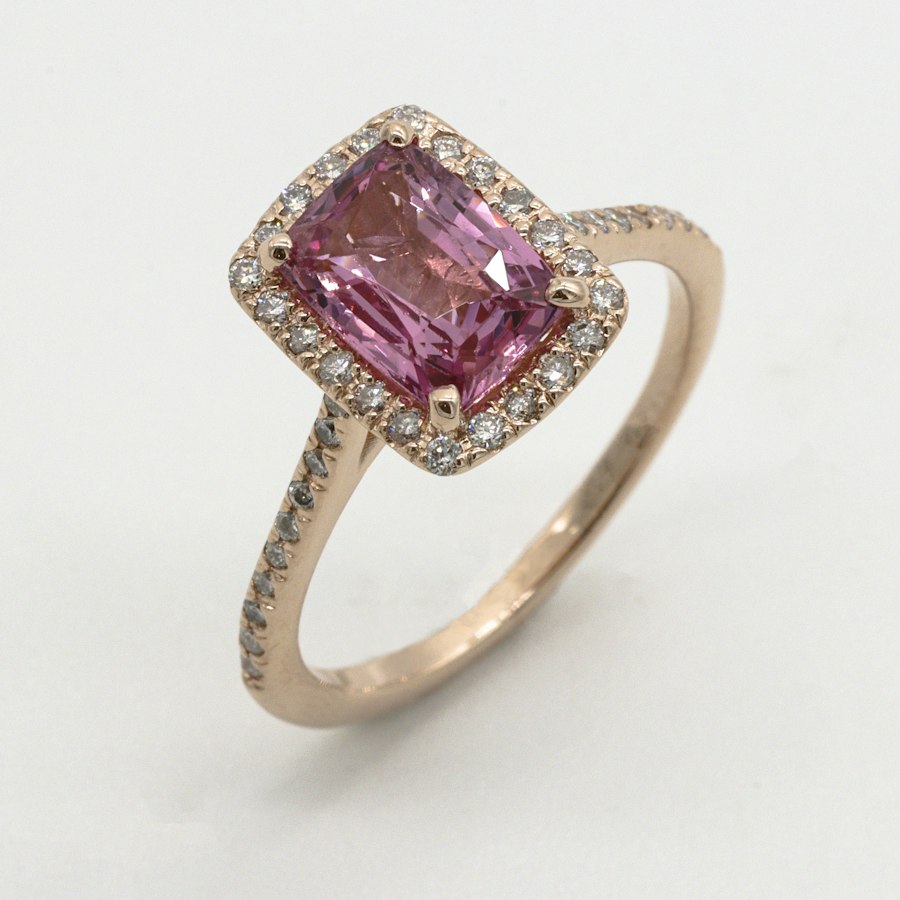
The reason this is an emerald problem specifically is the step-cut itself. Brilliant-cut stones have rounded, faceted crowns that let a band slide close; emeralds have flat, open tables and a rectangular outline that demands a shaped companion. Skip the contour and your retailers are fielding "why is there a gap?" emails forever. Build it well and you sell a matched set instead of a single ring.
Two contour shapes that cover most requests
You do not need a dozen tooling patterns. Two profiles handle the vast majority of emerald solitaires.
- Notched or U-contour: a shallow cut following the bottom edge of the emerald shank. The band rises around the solitaire base and sits flush. Best for classic, unadorned emerald rings.
- Arched or euro curve: a gentler upward arc that leaves a slim, deliberate shadow line. More comfortable to size and flattering on rings with thick shoulders.
For a visual reference on the step-cut style these bands pair with, see our emerald styling notes. The more vintage the emerald, the more a clean plain contour band complements it without competing.
Matching the curve to the actual shank
The gap problem returns when the curve is generic. A contour band must be cast to the shoulder width and base height of the emerald solitaire it accompanies, not to a template. If your emerald solitaires come in 7x9 mm and 8x10 mm heads, tool the contour for those exact shanks and label the SKU by center size. Retailers then order a matched pair, and the band arrives already shaped to the ring.
Watch the pavilion clearance. The curve should clear the culet and pavilion, not press against the stone. A band that touches the girdle risks chipping the sharp corners of an emerald-cut stone—and while moissanite is hard at roughly 9.25 Mohs, those corners are still the first place a contact mark appears.
To pave or not to pave
Plain contour bands sell for their clean lines and pair with the emerald’s minimalism. Half-eternity moissanite pave contour bands sell for the sparkle tier. Offer both: plain in silver or 10k for the value customer, pave in 14k for the bride who wants a little fire. The pave version uses small round melee—cheap at wholesale—and adds enough margin to justify the extra bench work.
One caution: keep the pave sparse on the curved section. Stones set tightly on a curve are harder to seat and loosen faster. A channel or flush-set curve wears better than a prong-pave curve on the bent part of the band.
Why this line reorders
Contour bands are a classic second-order product. A customer buys the emerald solitaire when she gets engaged; she buys the contour band for the wedding, the anniversary, or because she finally noticed the gap. That delay is good for you—it means the retailer comes back, and it means you can produce bands in runs once you know which emerald sizes move.
Start with the emerald sizes your account already reorders, pair one plain contour band and one pave contour band to each, and let sell-through guide the rest. The step-cut windowing buying guide helps you choose the center stones those bands will accompany; together they let you sell the complete set rather than half of it.
Sizing and resizing guidance to hand to retailers
Contour bands frustrate customers most at the sizing counter, so give your retailers a simple rule sheet. Because the curve is shaped to a specific solitaire, a contour band should be sized as close to the final finger size as possible before it leaves you. Resizing a curved band up or down changes the radius of the arc and can pull it away from the solitaire. Encourage retailers to measure the customer’s size on the same finger, worn over the solitaire, so the band is ordered to the paired fit rather than a bare-finger guess.
If a band does need resizing later, recommend a competent jeweller who can open and close the band without distorting the notch. A badly resized contour band is the most common reason customers return a perfectly good ring. Supplying that guidance yourself positions you as a supplier who supports the sale after it ships.
The gap is not a flaw in the emerald. It is an opportunity. Treat the contour band as a core product, not an afterthought, and your emerald line stops being a one-ring sale and becomes a matched bridal program.