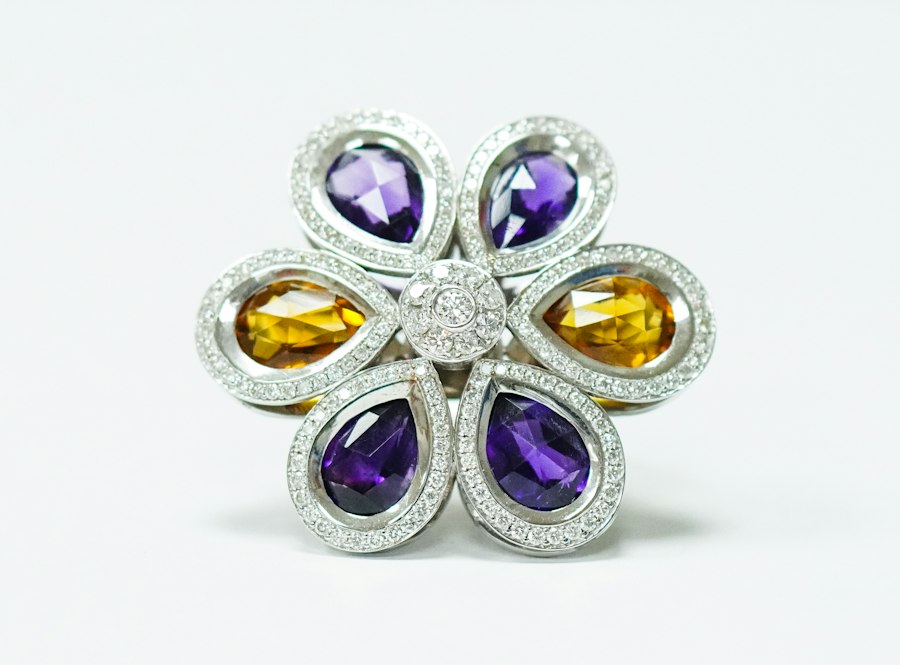
Fashion cycles are circling back to the 1970s, and the jewelry expression of that nostalgia is the vintage cluster ring: a strong center stone surrounded by a constellation of smaller accents, set low on the band. Of all the center shapes that fit this look, the marquise is the one that reads most authentically vintage. Its long, pointed silhouette was designed in eighteenth-century France to echo the shape of a smile, and it fills a cluster setting the way no round or oval can. For wholesale buyers, the cluster revival is a quiet but dependable stream of marquise orders—and it rewards those who understand the cut rather than those who treat it like an ordinary elongated stone.
Why marquise fits the cluster aesthetic
A cluster ring needs a center that carries visual weight at a small face-up size, and the marquise does this by stretching length across the finger. Its two pointed ends naturally invite a symmetrical spray of side stones—tapers, bullets or small rounds—that radiate outward, which is exactly the geometry of a vintage cluster. Set horizontally (east-west) the marquise becomes even more distinctive, echoing the retro cocktail rings that collectors now pay premium prices for. Moissanite's high fire ensures the long pavilion still throws light even when the cluster sits low and protected, which is why the cut works in a period-style setting that would leave a quieter gem looking dull.
Tip protection is non-negotiable
The marquise's pointed tips are its weak point. A sharp tip on a 9x4.5 mm stone chips on impact more easily than the rounded edge of an oval, and in a low cluster setting the tips sit close to the band where they can catch. For wholesale production this means two things. First, insist on stones where the tips are gently rounded rather than razor-sharp; your supplier can adjust the polish. Second, design the setting with full prong coverage or a thin bezel around each tip. Read more on marquise length-width, bow-tie and durability before you quote a customer the "chip-proof vintage ring" line—honesty about tip care protects your return rate.
Pairing side stones and choosing length-to-width
The cluster around the marquise is usually built from tapered baguettes or small round melee. The marquise itself should run a length-to-width ratio between 2.0 and 2.2 for the classic long, elegant look. Slender ratios over 2.4 start to look like a needle and are harder to set; stouter ratios under 1.8 lose the elongated drama the cluster is trying to create. Stock the 10x5 and 12x5.5 mm marquises in the 2.1 ratio band first. Those two sizes fit most women's cluster rings and photograph well in a low setting.
Because marquise can show a bow-tie across the center, and because a cluster setting draws the eye straight down the stone's length, reject any marquise with a strong dark band. The revival customer is buying romance, not a lesson in cut quality, and an obvious bow-tie undermines the illusion. You can review how to order custom marquise cuts when your standard stock does not meet the cluster spec.
Metal and era cues
Vintage clusters sell in yellow and rose gold more than platinum, because the warmth reads period. A milgrain edge, a slight gallery engraving and a low profile complete the look. The marquise center in white moissanite contrasts beautifully against warm gold, which is the visual recipe that goes viral. Keep your stock of marquise centers flexible on metal so the same stone can flow into a yellow-gold cluster today and a rose-gold one next quarter.
Why moissanite fits a low cluster setting
Vintage clusters sit the stone close to the hand, which means the pavilion is partly hidden by the gallery. A softer or duller gem would look dark tucked into that low setting. Moissanite's strong refractive index keeps light bouncing through the long pavilion even when the stone is set low, so the marquise stays bright from the side and the top. This is a practical reason the cut works in cluster production, not just an aesthetic one. Diamond alternatives that rely on an open setting fail here; moissanite does not. For a bench that is building period-style rings in volume, that reliability cuts down on redo work.
Reading the revival as a buyer
This is not a flash-in-the-pan trend. Vintage-inspired jewelry has held steady for years, and the cluster ring is the segment that resurfaces with every retro cycle. Buy the marquise stones your cluster line actually uses—do not overstock exotic sizes—and pair them with the side stones your bench already sets. Done well, the marquise cluster becomes a signature piece that customers recognize, which is worth more than a margin on any single ring.