Walk into any bridal boutique and the ring on the influencer's hand is rarely a bare solitaire. It is an elongated oval center wrapped in a halo of tiny stones, often with split shoulders, milgrain edges, or a bypass shank. That vintage cluster look is one of the most repeatable styles in the oval-cut moissanite catalog, and it is built almost entirely from two components: the oval center and the melee that surrounds it.
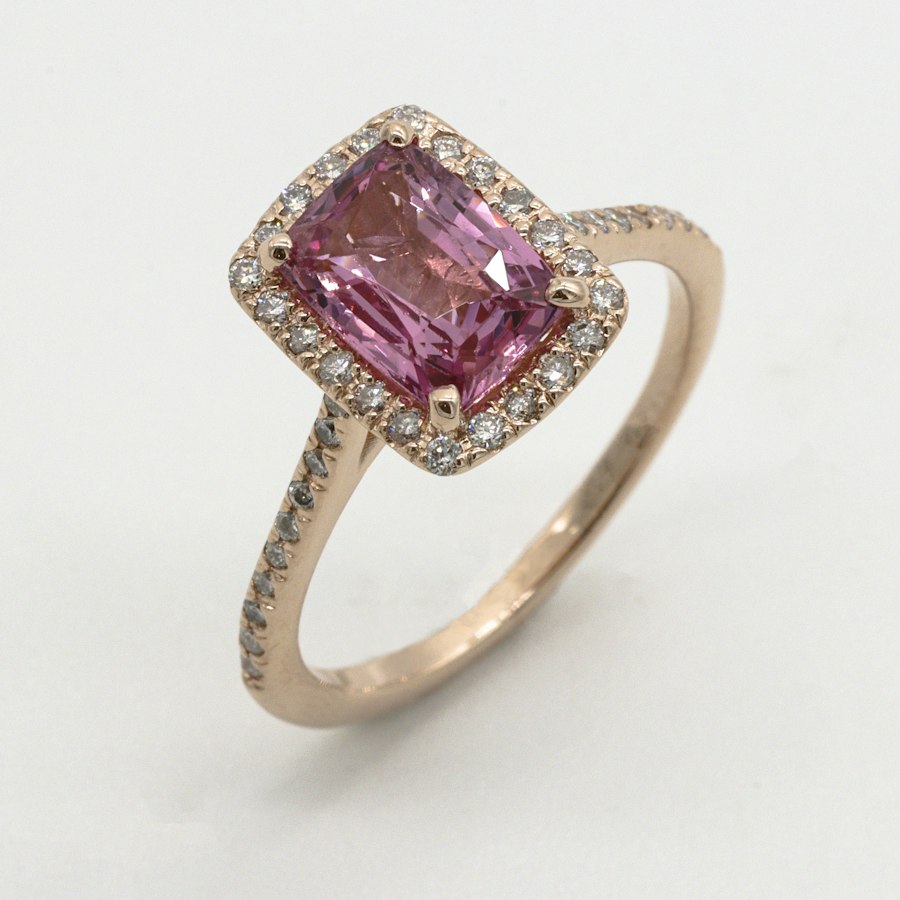
The reason this configuration works so well with moissanite is that the oval already flatters the finger with its length, and the halo amplifies the perceived size without forcing you to stock a center stone you cannot move. A 9x7mm oval sitting inside a well-proportioned halo reads like a ring that should cost twice as much. That is the value story your retail buyers can actually sell.
Stock the oval centers by length-to-width ratio
Oval moissanite is not one shape; it is a family of proportions. A narrow 1.7:1 oval reads sleek and elongating, while a fuller 1.3:1 oval looks rounder and softer. Vintage cluster designs tend to favor the fuller end of the range, because the halo needs a center that does not look pinched inside it. Read more on this in the oval length-to-width ratio stocking guide. For cluster work, stick to 9x7mm and 10x8mm centers as your backbone; those two sizes cover most custom requests and photograph beautifully on model hands.
Watch the bow-tie. Any oval cut shows a faint dark band across the center, and moissanite is no exception. In a cluster ring, the halo draws the eye outward, which actually helps hide a mild bow-tie. That is one reason ovals work so well in this setting: the setting does some of the quality-lifting for you.
The halo melee is where the order lives or dies
A cluster ring is only as good as its surrounding stones. If the melee is dull, yellow, or mismatched, the whole ring reads costume. Stock round brilliant melee in 1.3mm to 2mm sizes, all in matching D-E-F near-colorless moissanite, so the halo reads as one continuous band of white light. This is exactly the problem covered in matching melee and side stones, and the principle is identical for an oval halo: consistency across the accent stones matters more than perfection in any single one.
Face-up consistency across a parcel
When you order oval centers in bulk for cluster production, you are building a line, not a one-off. Your buyers will order three, then ten, then thirty of the same cluster. If each new parcel of 9x7mm ovals looks slightly different in color or spread, your production jeweler wastes hours adjusting settings. The short read on managing this is in bulk oval parcel face-up consistency: hold a sample, photograph it, and require future parcels to match that reference.
Metal and setting choices that sell
Vintage clusters sell best in warm or mixed tones. Yellow gold softens the look, rose gold makes it romantic, and platinum or white gold keeps it modern. The halo itself is usually pave or bead-set, which maximizes the number of tiny stones visible. Milgrain edging on the shank is a low-cost detail that instantly signals "vintage" to the buyer browsing your catalog. Pair the cluster ring with a matching straight band to open the bridal-set ticket; tennis and matching-line production logic applies the same way to wedding bands as it does to bracelets.
Margin math on a cluster
The beauty of the cluster model for a wholesaler is that it lets you sell a premium-looking product at a mid-tier stone cost. The oval center carries the price, the melee adds perceived value cheaply, and the setting labor is repeated across every unit. Buyers who price a cluster ring at two to three times their finished cost report strong attachment rates from customers who came in expecting a diamond and left with something that fires harder under showroom lights. Oval moissanite's refractive index sits around 2.65 to 2.69, well above diamond, which means the halo catches and splits light even in weak retail lighting. Build the cluster line around that strength, and the vintage bridal buyer you want will find you.
How buyers order this in practice
The typical cluster order starts small. A retailer buys two finished-style rings to photograph, then reorders the loose oval centers to build their own. Keep that in mind when you quote: offer the center stone alone, the center plus a melee pack, and a finished-set reference. The retailer who sees all three options buys more, because she can match the offer to her own workflow rather than guessing. Cluster production rewards the supplier who makes the next order obvious.