Oval moissanite is the shape that made "affordable center stone" feel like a luxury purchase. Its elongated silhouette lengthens the finger, and at a given price point it delivers more visible face-up area than a round of the same budget. But wholesalers who order ovals as a single undifferentiated block of stock are leaving money on the table, because the oval market splits cleanly into two customer mindsets that rarely overlap: the solitaire buyer and the halo buyer.
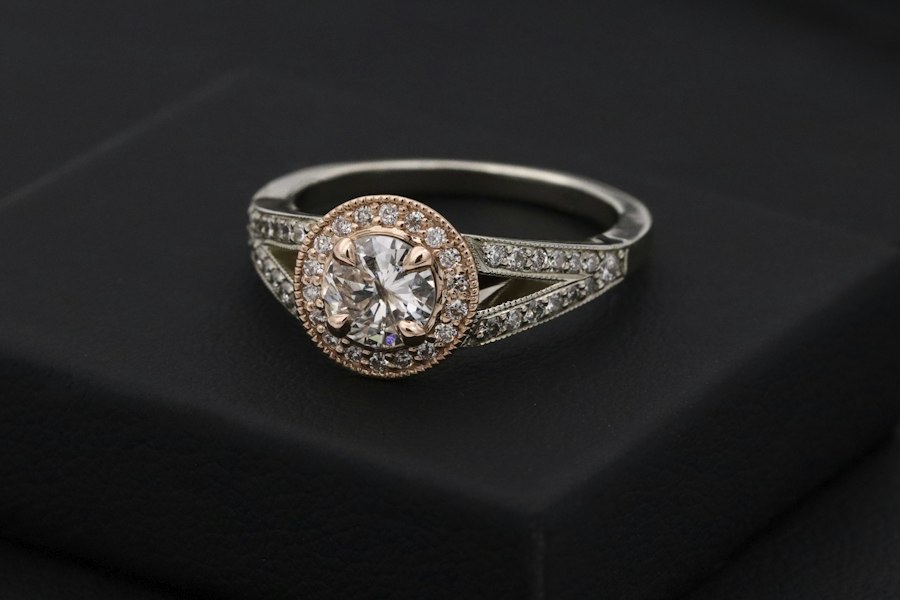
The solitaire oval customer wants the shape itself to do the work. A clean six-prong or four-prong mounting, a plain band, and nothing competing for attention. The halo oval customer wants maximum sparkle and maximum apparent size, and is willing to add a ring of melee to get it. If your case holds only one of these, you are turning away half the demand. The question is the ratio.
Why the solitaire oval still anchors the category
Solitaire ovals are the default bridal search. The elongated oval flatters most hand shapes, and because moissanite's fire is higher than diamond's, a well-proportioned oval solitaire looks lively without any extra stones. Wholesale buyers should stock solitaire ovals first because they are the widest-appeal entry point and the easiest to photograph and describe. The main QC watch item on ovals is the bow-tie darkening across the center; read our breakdown of bow-tie and cut proportions before approving large parcels.
Stock solitaires by millimeter, not carat. An 8x6mm oval is the most-requested everyday size, with 9x7mm and 10x8mm as the upgrade tier. Keep your length-to-width ratios consistent within a parcel so the solitaires you pull for a customer all share the same proportions.
What the halo oval buyer actually wants
The halo customer is buying two things: perceived size and sparkle density. A halo around an oval turns an 8x6mm center into a ring that reads like a 10x8mm or larger from across the counter. That psychological size boost is powerful at retail, and it is why halo ovals carry a higher ticket even when the center stone is the same cost.
For wholesale, the halo means you need matching melee. Round brilliant pavé is the conventional halo accent, and buying that melee pre-matched in color keeps the halo from looking like an afterthought. If you run a production line, pair oval halo centers with a consistent melee size (typically 1.3mm to 1.5mm) so every halo ring you build looks the same on the bench.
Margin and turnover trade-offs
A solitaire oval is a simpler production job: one stone, one mounting, one setting labor charge. It turns faster because it is easier to sell and easier to size. A halo oval takes more setup time, requires melee inventory, and carries a higher price that narrows the customer pool. The payoff is a stronger per-ring margin and a more distinctive piece that is harder to price-compare against a big-box competitor.
A practical stock split for an independent jeweler is roughly two-thirds solitaire oval inventory and one-third halo, adjusted toward halo in markets where statement rings sell. Watch your reorder data: if halo ovals turn within six weeks, deepen them; if they sit, you over-ordered.
Metal and color pairing
Oval moissanite in D-to-F colorless grade reads clean in white gold or platinum, and warm yellow or rose gold brings out a softer, retro-modern look that pairs naturally with a halo. Do not force a single metal across both styles. Solitaires tend to sell best in white metal for a modern bridal client, while halo ovals have strong demand in yellow gold for customers chasing a vintage feel. Our oval metal and setting combos note covers this in more detail.
Building the mix without guessing
Start your oval program with a solitaire core in the three most-moved sizes, add a small halo-ready center stock plus matched melee, and let sales pull the mix forward. Because oval moissanite is durable (9.25 Mohs) and requires no special care beyond occasional cleaning, both solitaire and halo pieces make reliable repeat sellers rather than one-off curiosity purchases.
Reading your own retail data
If you are unsure where to start the split, look at last year's oval sales rather than guessing. Pull every oval ring you sold and sort it by mounting: solitaires in one column, halos in another. The ratio that actually sold in your market beats any national trend report. Many independent jewelers are surprised to find that halo ovals carry a higher average ticket even though they sell in smaller numbers, which means a modest halo stock can punch above its weight in gross margin. Do not let a single standout sale skew the picture — average across at least a dozen pieces before you rebalance the next buy.
The oval category rewards buyers who respect that it is two product lines wearing one shape. Stock the solitaire for volume, build the halo for margin, and reorder based on which customer is actually walking through your door.