
Engagement ring fashion moves in small increments, and the hidden halo is one of those increments that quietly did the most business in the last two years. On an oval moissanite it works especially well: the center stone keeps its clean, elongated silhouette from straight on, and a ring of tiny melee peeks out only when the hand tilts — at a dinner table, under a ring shot, in a proposal photo. Retail customers describe it as “quiet” and “unexpected,” which is a shorthand for “it looks expensive without looking costume.” For a wholesale buyer, that is a ring you want in stock before the customer asks, because she rarely knows she wants it until she sees it on her own hand.
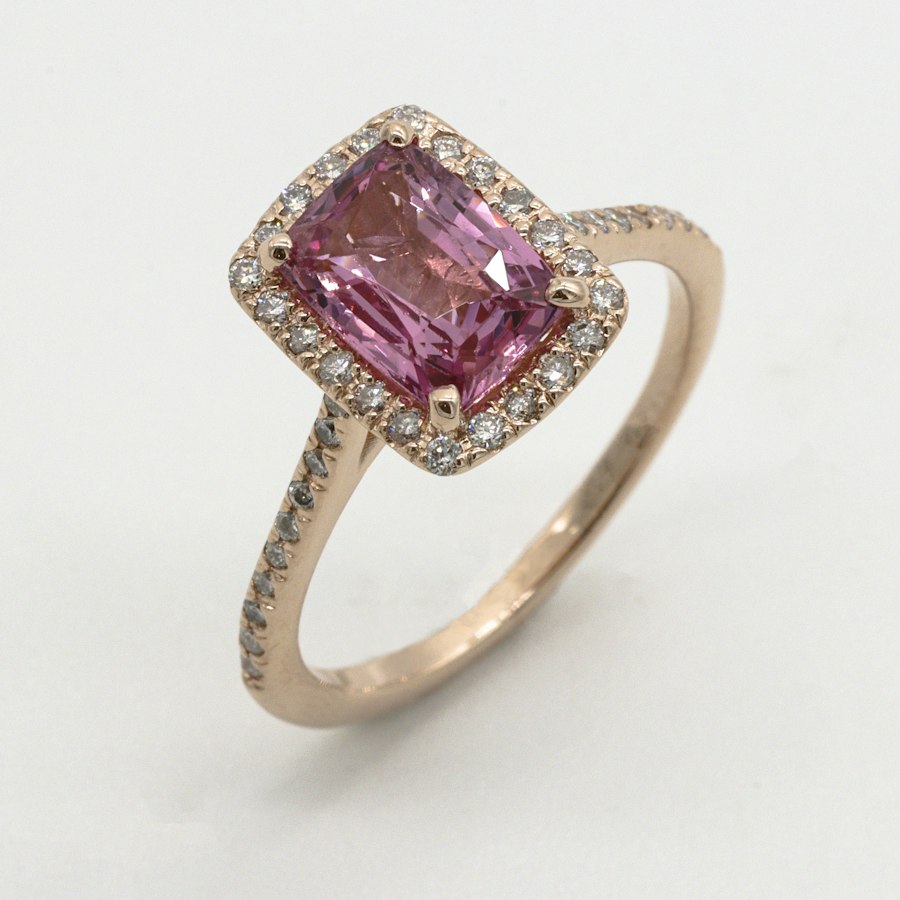
The construction is straightforward but easy to get wrong. A thin rim of pavé melee runs just under the oval girdle, often on a slightly lowered seat so the halo does not show as a bright white border face-up. The center oval is held by four prongs, usually north-south. Because the halo sits lower, the whole ring sits a touch higher off the finger than a solitaire, which is fine for most customers but worth noting for anyone who stacks bands every day. The setting also slightly narrows the usable finger contact, so size half-step matters more than on a flat solitaire.
Cost drivers stack in a predictable order. First, the center oval. Buy it to the length-to-width ratio that suits your market — our oval L:W stocking guide covers the 1.3–1.5 sweet spot that reads elongated without looking thin. Second, the melee: 1.0mm to 1.3mm round brilliants, near-colorless, VVS, consistent in face-up whiteness across the halo. Melee inconsistency is the single most common QC failure on hidden halos, because a single warm or dark stone is visible as a speck around the rim. Third, the mounting labor — setting small melee under an overhang is slower than a top halo, so expect a higher mount fee and price accordingly.
On the margin question that every buyer asks: a hidden halo oval generally commands a 10–20% retail premium over the same oval as a plain solitaire, for roughly a 15–25% increase in your all-in cost. That is a healthy spread, but it is not free money. The premium depends on the center stone looking intentional, and ovals carry a known bow-tie effect that shows more obviously once you add a bright ring of white melee around it. If your oval has a visible dark bow-tie, the halo will frame it like a spotlight. Pick center stones with a light-to-moderate bow-tie — never a heavy one — for hidden halo builds.
What to actually stock. We recommend starting with two center sizes in near-colorless DEF: a 8x6mm and a 9x7mm oval, pre-set in white gold or platinum-toned mounts in both a four-prong and a cathedral-shank variant. Keep one yellow-gold sample as a display piece even if you do not stock it deep, because yellow-gold hidden halos photograph beautifully and pull a different customer. Avoid overstocking 10x8 and larger at first; those are special-order sizes and tie up cash. Read the trade-off in loose stone versus finished jewelry margin before deciding whether to hold pre-set rings or keep loose ovals plus mount blanks.
Returns and QC. The hidden halo is a service item long-term: melee stones come loose, and a bench needs access under the rim to tighten them. When you quote the ring, quietly reserve a small service allowance. Inspect incoming mounts under a loupe for loose pavé before you sell through — a wobbly side stone is the fastest way to undo a strong first impression. And photograph every ring from a three-quarter angle, not just straight on, because that angle is where the halo does its selling. Your product page and your in-case sample should show the same ring, or you will see return rates climb.
Treat the hidden halo oval as your “quiet upgrade” SKU: not your cheapest oval, not your flashiest, but the one that converts the customer who walked in expecting a solitaire and left wanting something with a little more to it. Stock shallow, reorder fast, and keep the center-stone quality high — the halo forgives nothing underneath it.
One more production note before you commit: the hidden halo relies on clean melee, and clean melee is where cost usually leaks. Do not buy the cheapest side-stone parcel on offer. If three or four of the tiny stones in a halo look warm or cloudy, the whole ring reads as a bargain, and the premium you were counting on evaporates. Budget for VS-clarity, near-colorless melee from a single batch, and ask your supplier to pull the halo stones from one parcel rather than mixing two. The few extra dollars per ring protect a retail price point that is worth far more. When you place the reorder, photograph the actual ring you stocked, not a stock render — customers who see the real melee color in the listing return far fewer rings than those who expect flawless white and find something slightly softer.