The round brilliant is the engine of almost every loose-moissanite program. It is the shape customers describe first, the shape that photographs cleanest, and the shape a new jeweler orders when they are unsure what else will sell. Yet once a buyer moves past the stone itself and starts thinking about finished or semi-finished stock, a small decision starts to drive turn rate: four prongs or six prongs on the head? The choice looks cosmetic, but for a wholesale supplier it changes labor cost, return rates, repair traffic, and which end customers a finished ring actually fits.
What the prong count actually does on a round stone
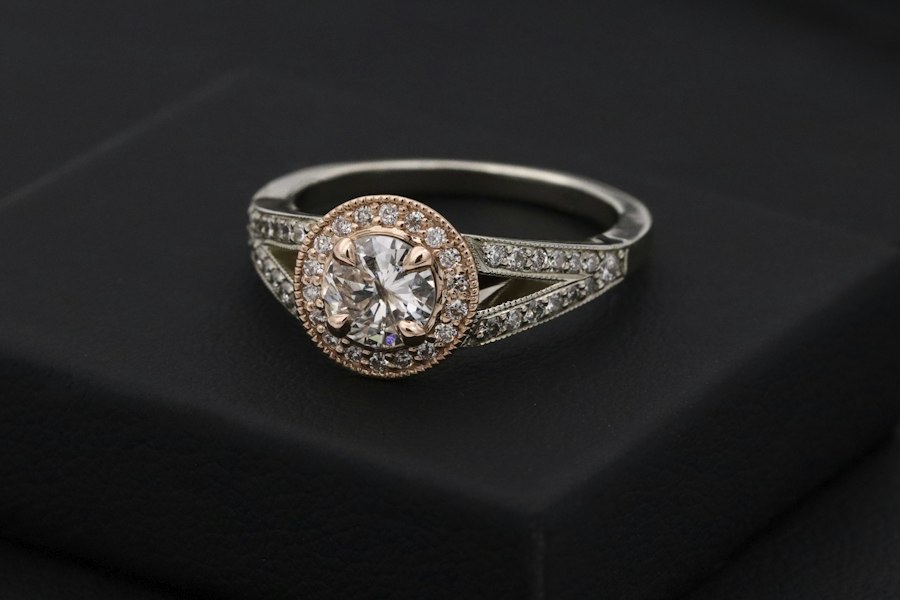
A round brilliant moissanite cut in standard 57-facet proportions behaves like a round diamond optically, with a refractive index around 2.65 to 2.69 and noticeably more fire than diamond. Because the girdle on a well-made round is relatively thin, the prongs are the only thing holding a 6.5mm or 8mm stone in daily wear. Four prongs put more of the pavilion open to light and let the stone read slightly larger face-up, but they concentrate force on four contact points. Six prongs spread that force and cover more of the girdle, which matters if the ring will be worn daily by someone who works with their hands.
For the end customer this is a styling conversation. For the jeweler buying from you, it is a warranty conversation. A four-prong head that loosens after a year comes back to the bench. A six-prong head that loosens less often means fewer return visits and lower after-sale labor.
Which buyer asks for which
Four-prong settings skew toward the modern, minimalist buyer: solitaire stacks, low-profile comfort-fit bands, and the look that dominated Pinterest and Instagram engagement boards through the mid-2020s. Customers who want the stone to be the whole story, who skip a halo-style accent entirely, and who prefer a clean top-down view usually ask for four prongs. They also tend to size smaller, 5.5mm to 6.5mm, where the open head reads brightest.
Six-prong settings skew toward classic and heirloom buyers. The six-prong solitaire is still the most recognizable engagement silhouette in North America, and customers who want "something that looks like my grandmother's" almost always picture six prongs. They also buy larger stones, 7.5mm and up, where the extra prong coverage protects a bigger investment.
Cost and margin math
Bench labor on a six-prong head runs roughly 15 to 25 percent higher than a four-prong equivalent, because the setter has to seat six tiny tips instead of four and check each one for contact. For a finished-ring wholesaler, that gap shows up in your cost-plus sheet. It does not, however, show up proportionally in retail price. Most end customers cannot tell a six-prong head from a four-prong head in a case photo, so the retail price gap is narrower than the labor gap. That means the six-prong SKU carries slightly thinner built-in margin if you price both rings the same way.
The practical answer for most suppliers is not to pick one. Stock both in your core sizes, but weight the ratio toward the side your local market already buys. A wholesaler shipping to the U.S. Midwest and Canada can run closer to 60/40 in favor of six-prong. A wholesaler shipping to urban DTC brands and younger buyers can invert that.
Repair and re-tipping as a hidden revenue line
Jewelers who buy loose stones from you will often bring finished settings back for re-tipping years later. A round brilliant moissanite is 9.25 on the Mohs scale, second only to diamond among common gemstones, so the stone itself rarely fails. The failure point is almost always the prong tip wearing thin from hand contact. Six-prong heads distribute that wear, so a ring that started on a six-prong head may need one re-tipping in its life instead of two. That is good for your retail customer's reputation, and it is a reason to mention the difference on a quote rather than hide it.
How to order the right mix
If you are building a starter round brilliant program, treat 5mm, 5.5mm, 6mm, 6.5mm, 7mm, 8mm, and 9mm as the moving sizes. Stock four-prong heads in the smaller sizes where the open look dominates, and six-prong heads in the larger sizes where protection dominates. A useful starting split is two four-prong heads for every six-prong head below 7mm, and roughly one-to-one above 7mm. Pair every head size with matching loose stones so a jeweler can pick a setting and a stone from the same parcel and leave with a finished unit.
For buyers comparing shapes, the round remains the default because it is the easiest to sell without education. Pair this program with a short reference on ideal round proportions so the retail side can answer the questions their customers will actually ask. When you source loose rounds, remember that moissanite is traded by millimeter, not carat weight, and that a 6.5mm round sits at roughly one carat equivalent. That mismatch between carat language and millimeter reality trips up new buyers more than any setting question.