If you run a bench, a custom shop or an e-commerce jewelry line, you already know that the center stone gets all the attention. The melee underneath it does the actual work. Round brilliant moissanite is the shape most buyers reach for when they need hundreds of small, uniform stones for pavé, micro-pavé, halos and accent rows, and buying that stock well is a different problem from picking a single engagement stone. Get the melee wrong and even a beautiful center reads like a craft project. Get it right and the whole piece looks expensive without anyone being able to say why.
Why round brilliant is the default for accent work
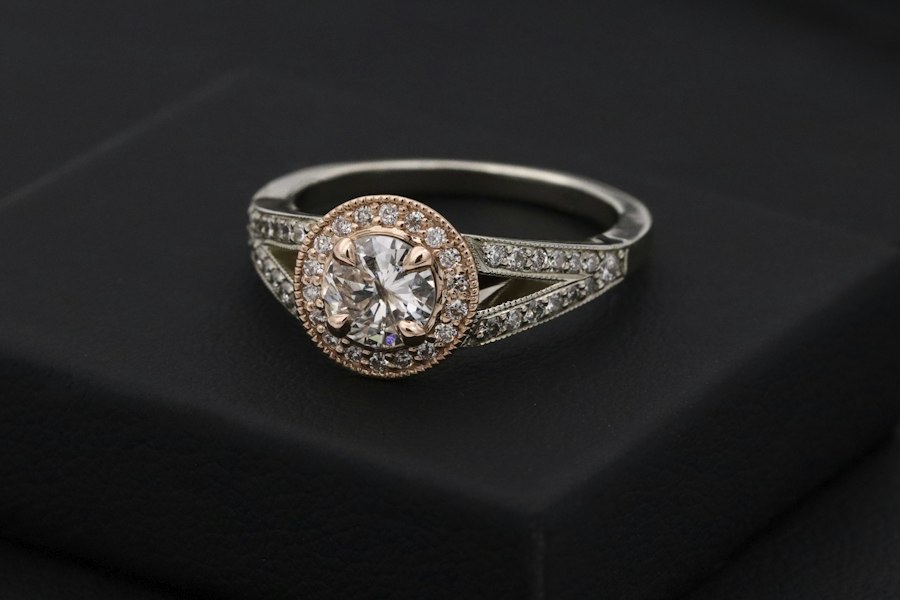
The round brilliant is the most mechanically forgiving shape to set. Its evenly distributed crown, predictable girdle and round outline let a setter bead, burnish or prong it consistently, stone after stone. For production work, consistency beats character. Round moissanite melee also takes light the same way across a row, so a halo reads as one continuous band of sparkle rather than a collection of mismatched dots. A setter can lean into rhythm and speed, which is where bench margin actually comes from.
Moissanite's physical properties help here. At 9.25 on the Mohs scale, moissanite resists the abrasion that dulls softer simulants over time, which matters for pavé stones that take daily knocks against handbags, keyboards and countertops. Its refractive index of roughly 2.65 is higher than diamond's 2.42, so even a 1.3mm stone still returns visible fire instead of going flat on the finger. Cheaper simulants look lively on the display card and dead after a month of wear; moissanite melee keeps its edge because the material itself is doing the work.
Buy melee by the millimeter, not by eye
Small round stones are sold by diameter in millimeters, and the common band runs from about 1.0mm to 3.0mm. A 1.3mm stone sits in micro-pavé; a 2.0mm to 2.5mm stone works as a side stone beside a center. When you order, specify an exact size plus an acceptable tolerance, typically a few hundredths of a millimeter. A parcel of "1.5mm" stones that actually spans 1.42mm to 1.58mm will leave you with a lopsided row and a setter who hates you.
- 1.0–1.5mm: micro-pavé and detail work; stock the broadest depth here because it turns fastest.
- 1.6–2.2mm: classic side-stone and halo range; your core reorder band.
- 2.3–3.0mm: larger accents and solitaire upgrades; buy lighter and reorder on demand.
Color and clarity in a melee parcel
Because small stones are grouped in rows, color consistency inside one parcel matters more than any single stone's grade. Stock DEF color melee for white gold, platinum and silver work, where a faint warm cast would show between stones. Clarity in melee is generally VVS to VS range at the sizes we set, and the inclusions are small enough that they rarely matter visually; what does matter is that no stone has a window or a heavy dark girdle. Run a quick face-up sweep on a white tray the day the parcel arrives, and pull any outlier before it gets mixed into the stock.
Match the parcel to your existing line
A hidden trap is reordering. A new parcel of "the same" 1.5mm melee from a later production run can sit a touch warmer or brighter than the drawer you already have. When you build a piece that mixes old and new stock side by side, the mismatch shows. Where possible, reorder melee from the same production batch, or photograph your existing stock and ask the supplier to match it. For pieces that will carry a row of stones, it is worth buying a little extra of the same parcel up front so future repairs and ring-size upsells match the original.
Tier pricing and reorder logic
Suppliers price melee by the hundred or the thousand, and the per-piece cost drops as the parcel climbs. The mistake buyers make is buying one giant parcel of a single size. Instead, hold a standing cushion of your fast sizes—say six to ten pieces of 1.3mm and 1.8mm—and reorder the long tail in small lots. This keeps cash flowing and avoids the 1.0mm stone you will never use. Read more on how tier breaks work in our moissanite MOQ and tier pricing breakdown, and compare sizing cushions in stocking round brilliant sizes for margins.
Common questions buyers ask
Can I mix melee from different suppliers? It is possible but risky; light behavior and cut quality differ between sources, so a row will show the seam. Keep one trusted source for each size band. How much should I hold? Start with a small cushion of your three fastest sizes and grow from actual reorders rather than guesses. Over-buying a slow size ties up cash that could be working in the fast ones.
Round brilliant melee is not glamorous, but it is what makes your finished pieces look intentional. Buy it matched, measure it on arrival, protect batch consistency, and reorder the sizes that actually leave the bench.