The prong count question comes up on every solitaire order
When a retail customer picks a round brilliant moissanite solitaire, the conversation usually starts with carat weight and ring size, but it ends with the prong. Four prongs versus six prongs is not a cosmetic footnote; it changes how the stone faces up, how the ring wears, and how much return work you can expect a year later. As a B2B supplier shipping loose round moissanite to small jewelers, we watch which prong counts move and which come back for resetting. This guide breaks the decision down so you can stock both without overcommitting either.
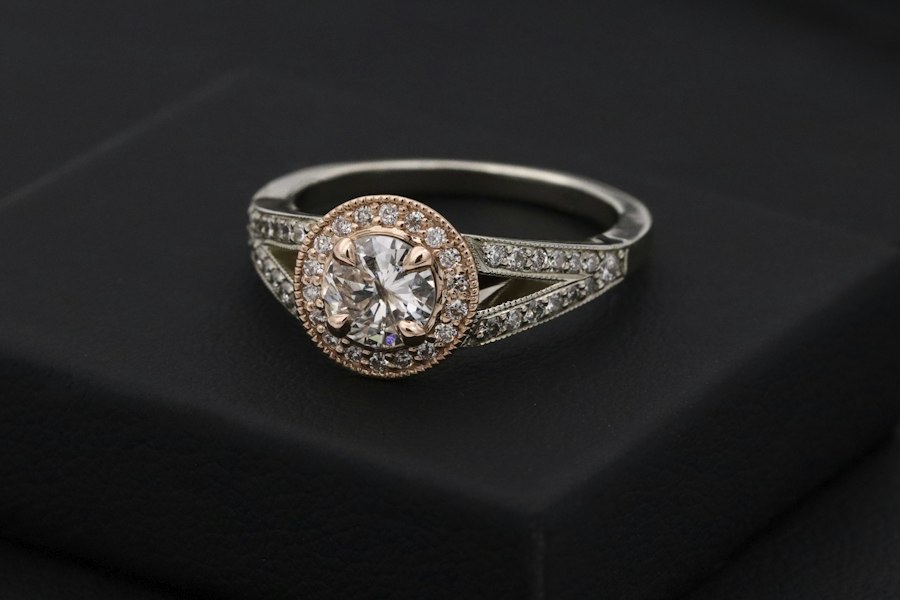
What four prongs actually do for the face-up look
A four-prong head covers roughly a third less of the crown than a six-prong head. On a round brilliant that means more open table, more light entering the star and upper-girdle facets, and a slightly larger-looking stone on the finger. Many buyers associate the four-prong solitaire with a brighter, airier presentation, and on high-color DEF material the extra open facet area makes the fire easier to photograph. For studios selling primarily online, that matters: four-prong solitaires read larger and more luminous in flat lay product shots.
The trade-off is coverage. Four prongs leave more of the girdle exposed between settings. On a well-cut round moissanite the girdle is typically faceted thin to medium, so exposure is rarely a structural risk, but a ring worn daily on an active hand will see the exposed girdle catch on surfaces. Moissanite ranks 9.25 on the Mohs scale, second only to diamond, so chipping is uncommon, yet the girdle edge remains the most fragile line in any cut.
Why six prongs still dominate bridal counters
Six prongs spread contact over a wider arc of the girdle, which distributes daily knocks across more metal tips rather than concentrating force on four points. That is the reason six-prong heads remain the default on bridal solitaires: a customer buying an engagement ring wants peace of mind, and six visible prongs signal security even though the practical difference in retention is smaller than marketing suggests. Six prongs also read as more traditional, which helps with older buyers and with clients who picture a diamond-style solitaire they have seen in family photographs.
The cost is visual mass. Six prongs shade more of the crown, so the same millimeter stone looks fractionally smaller and denser. On smaller rounds under 6.5 mm the difference is minor; on stones above 8 mm the extra metal starts to compete with the stone for attention. Many jewelers solve this by pairing six prongs with a thinner, tapered head that keeps the look light.
Stocking logic: split, do not guess
Across the orders we see, the fastest-moving solitaire configuration is a four-prong head in 14K yellow or rose gold at the 6.5 to 7.5 mm range, paired with a slim plain band. The six-prong head moves best in white metals, especially platinum-look sterling and white gold, where the brighter metal already supports a more formal look. If you are opening a solitaire line for the first time, start with a 60/40 split toward four prongs in warm metal and six prongs in white metal, then adjust after a reorder cycle.
Avoid the mistake of carrying both prong counts in every millimeter. Pick three hero sizes. For most independent jewelers those are 6.5 mm, 7.5 mm, and 8 mm rounds. Anything outside that range should be made to order rather than held in inventory, because slow-moving solitaires tie up both metal and certified stone capital. You can read more on size-tier inventory in our round brilliant size stocking guide.
Setting and QC notes
Wholesale heads vary in seat depth, and round moissanite girdles are cut thinner than diamond equivalents. A head that seats a diamond cleanly can leave a moissanite sitting too high or too low. Ask your caster for a head measured to your stone girdle thickness, and check that the prongs are rounded and burnished after setting rather than left sharp. Sharp prong tips are the single most common reason a solitaire comes back for a free prong re-tip inside the warranty window. A quick walkthrough of what to inspect on incoming loose stones lives in our 10x loupe QC checklist.
Margin implications of prong choice
The prong decision also quietly affects your cost of goods. Four-prong heads use slightly less metal and set a touch faster, so the mounting cost is a few dollars lower. That difference is small per ring, but it compounds across a reorder run of fifty solitaires. Six-prong heads cost more to set because each extra prong needs its own seat and burnish pass, and the caster charges a premium for heads built to a thinner tapered profile. Price the six-prong version accordingly; do not sell both heads at the same retail margin and wonder why one reorders better than the other.
Many studios solve this by making the prong count a paid upgrade rather than a free option. The four-prong is the listed price; the six-prong is a small upcharge that customers accept because it signals security. That framing works because buyers perceive six prongs as a feature, not a standard choice. Track which way your own customers lean over two quarters, then adjust the head order split. The right ratio is the one your repeat buyers actually choose, not the one bridal tradition assumes.
The short version for buyers
Four prongs for a brighter, larger-looking, modern solitaire in warm metal. Six prongs for a traditional, secure, bridal-coded ring in white metal. Stock three sizes, keep the split weighted to four prongs, and use made-to-order for anything outside the hero range. That formula keeps your solitaire cabinet moving without letting slow stock sit on the shelf.