
Stud earrings quietly outsell engagement rings in many independent jewelry businesses, and round brilliant moissanite is the stone that makes them work. A clean 5mm, 6.5mm or 7.5mm round in a near-colorless grade reads as a classic stud at a price point that moves. The wholesale decision that actually moves margin, though, is not the stone grade. It is whether you mount those rounds in a four-prong basket or a full bezel. Both sell. They sell to different customers, at different margins, and they fail in different ways.
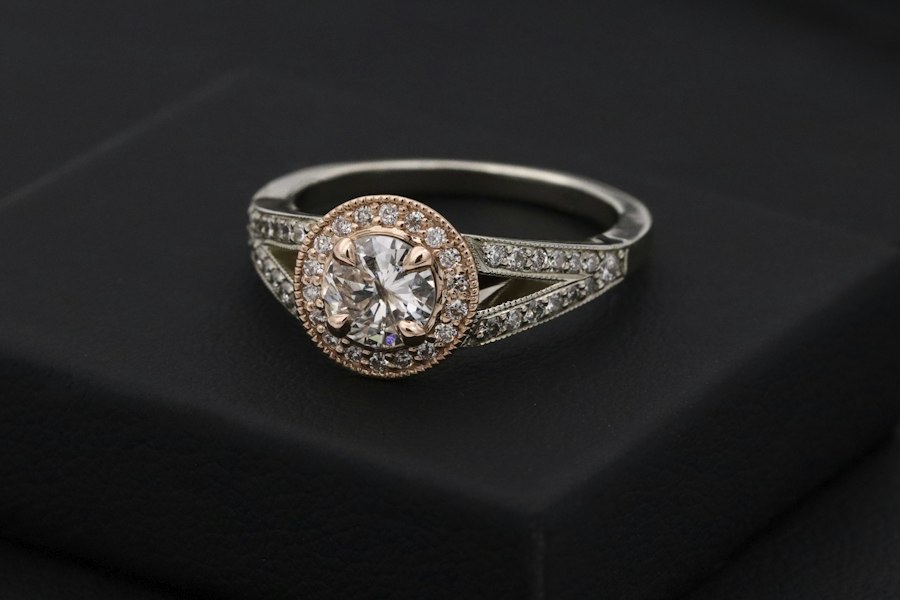
The four-prong basket is the default for a reason. Four narrow prongs leave the crown almost fully exposed, so the round brilliant’s 57-facet pattern and higher-than-diamond dispersion show up clearly every time the wearer turns her head. For a stone that trades on fire and sparkle, that exposure matters. Wholesale mount cost is also lower, because a basket uses less metal and sets faster than a bezel. That combination — more visible brilliance and less labor — is why most entry and mid-range stud lines start here.
The trade-off is the tips. Round brilliants are the most shape-tolerant cut we stock, but pronged studs take knocks against door frames, phone screens and pillowcases. Thin prongs bend, and a bent prong on one stud quickly becomes a lost stone. Retail customers do not blame their lifestyle; they blame the setting. In practice, a small share of pronged studs come back within a warranty window for re-tipping or re-setting. Factor that service cost into your landed price, and build a re-tip-friendly relationship with your bench jeweler. If you buy finished mounts rather than loose stone plus setting, ask your supplier which prong gauge they use — a heavier 1.0mm prong outlasts a fine 0.7mm one with almost no visual penalty at 5mm and up.
Bezel-set studs solve the durability problem by wrapping the girdle in a continuous band of metal. The stone sits protected, the profile sits flatter against the ear, and the design reads as modern and architectural rather than traditional. Wholesale metal cost is higher, and setting takes longer, because the bezel has to be burnished evenly around a round girdle without folding over the crown edge. Done badly, a bezel covers the outer crown facets and kills the sparkle that justifies buying moissanite in the first place. Done well, a slim 0.6mm bezel leaves most of the crown open and the stone still fires.
Who should stock which? The four-prong basket fits a bridal-gift, birthday and everyday-elegance customer who wants the brightest, most recognizable stud and accepts the occasional service visit. It is also the better margin story when you upsell into 6.5mm and 7.5mm sizes, because the open crown makes the stone look its largest. The bezel fits a second city — the traveler, the nurse, the gym member, the minimalist — who wants something she never has to think about. Bezel studs also photograph cleaner for product pages, which matters if you sell DTC.
On the stone itself, keep the same discipline we recommend in the round brilliant wholesale buying guide: buy by millimeter rather than obsessing over carat, and hold near-colorless DEF grades in the sizes that actually turn. Studs are a repeat-order business, so a SKU that sold six pairs last quarter deserves a standing reorder before it goes to zero. Use the MOQ tier pricing structure to keep your unit cost down on the sizes that repeat, and reserve smaller runs for bezel experiments while you learn your own market.
One operational point worth raising before you place a parcel: studs are sold and returned in pairs. Buy matched rounds from the same parcel so the face-up color and size read identically, and check them under a 10x loupe for girdle chips before setting. A chip hidden under a bezel never surfaces; a chip caught by a prong tip does. The bezel mount is slightly forgiving of a minor girdle imperfection, which is another small reason it can absorb a fraction of near-eye-clean stock at a better cost — while pronged studs want cleaner stones out of the gate.
Net result for the buyer: lead with four-prong studs in 5mm, 6.5mm and 7mm as your bread-and-butter, and add a narrow bezel line in the same sizes as a premium, service-light alternative. Price the bezel 15–25% higher at retail and it usually holds, because the customer buying it is paying for peace of mind, not sparkle per dollar. Keep both lines in sterling silver and 10k gold at minimum, watch your prong gauge, and reorder what turns — that loop, more than any single grade decision, is what builds a profitable stud program.