If your showroom carries only one bridal silhouette, it is almost certainly the round brilliant solitaire. Among solitaires, the six-prong head is the version that customers picture when they say "engagement ring." As a wholesale buyer, you do not have to love the design, but you do have to produce it profitably. This guide walks through how to plan a six-prong round moissanite solitaire run, what the mounting tolerances actually are, and where the margin usually hides.
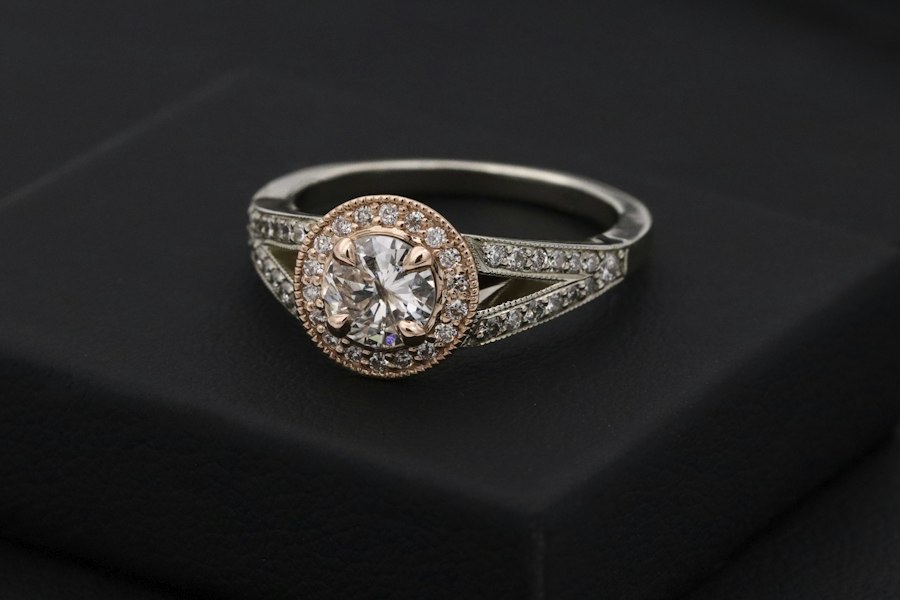
The six-prong head survives because it solves two problems at once. Six narrow prongs distribute the mechanical load of daily wear more evenly than four, which matters on a 6.5mm center stone that a customer will wear every day. The prongs also sit between the crown facets rather than across them, so more of the table and star facets stay visible. On a round brilliant, that visibility is what sells the stone at face-up distance. Four prongs can look bolder and more modern, but six prongs read safe, classic, and slightly larger from across a counter.
Moissanite sits at 9.25 on the Mohs scale, second only to diamond among gemstones, so the stone itself is not the weak point in a solitaire. The weak point is always the prong. Round brilliant moissanite has a sharp girdle, and the head must be cut to a seat that matches the actual mm diameter of the stone rather than a nominal carat weight. A 6.5mm moissanite measured with a digital caliper may run 6.48 or 6.54, and that 0.06mm difference is enough to make a poorly cast head rock. When you source loose round moissanite for solitaire runs, buy by mm, not by carat, and ask your supplier for the measured diameter of each stone in the parcel. We cover this sizing discipline in our round brilliant proportions reference, and the same logic applies to mounting production.
Choosing the right head and metal gauge
A wholesale solitaire run usually starts with a standard cast head in 14K gold or sterling silver. For a 6.5mm center, a head with 1.2mm prongs is durable enough for everyday wear without looking heavy. Go thinner than 1.0mm and the prongs will peg over within a year of a customer bumping the ring on a desk or a steering wheel. Go thicker than 1.4mm and the head starts to swallow the stone, defeating the whole point of buying a 6.5mm round that reads like a larger diamond equivalent.
The shank matters almost as much as the head. A 2.0mm half-round shank is the sweet spot for a women's solitaire: slim enough to stack, sturdy enough to resize once. If you plan to offer the ring in yellow, rose, and white gold, order the shank in the same width across all three. Customers who compare yellow and white versions side by side notice a 0.2mm shank difference immediately, and it reads as a mismatch rather than a metal choice.
Sizing the run without overbuying
The temptation is to cast a full run in sizes 4 through 9 and every metal. That ties up more capital than most independent jewelers should carry on a single silhouette. A leaner approach is to stock a working set: sizes 5, 6, 7, and 8 in white gold, with 6 and 7 in yellow and rose. Size 4 and size 9 stay made-to-order, set within three to five business days once the customer commits. The center stones follow the same logic. Most solitaire demand clusters at 5mm (about 0.50ct diamond equivalent), 6.5mm (about 1.00ct de), and 8mm (about 2.00ct de). Those three diameters cover the large majority of retail transactions.
Moissanite's advantage at wholesale is that a 6.5mm near-colorless stone costs a fraction of a comparable diamond, which lets you stock real inventory instead of showing models. Read through how to size round brilliant stock by margin and reorder speed before you place your first production PO. The reorder data from that framework will tell you which diameters actually turn on your floor.
QC steps that prevent returns
Before a solitaire leaves your bench, check four things. First, the stone must sit dead level in the seat; wobble under firm thumb pressure means the seat needs recutting. Second, each prong must be rounded and polished over the girdle, never left sharp, because a sharp prong catches silk and hair. Third, the ring must not spin on a mandrel, which signals an oval shank from uneven casting. Fourth, and most often missed, the culet must not show through the basket as a dark dot. On a well-cut round brilliant moissanite the culet is tiny, but a deep stone will peek through and look like a flaw to a customer comparing it to a diamond.
Pricing the finished solitaire
A finished six-prong solitaire should carry a healthier margin than loose stone sales alone. The customer is not just buying a gemstone; they are buying a ready-to-engage ring that avoids a four-week custom wait. Price the mounting, the stone, and the setting labor as three line items on your internal cost sheet, then mark the assembled piece to the local bridal market. For retailers working with us directly, the round brilliant wholesale buying guide lists the standard mm-to-de mapping and the parcel tiers that keep a solitaire line profitable.
Done right, the six-prong solitaire is not a creative risk. It is the bread-and-butter SKU that funds the more adventurous cuts on your display. Stock the right three diameters, protect the prongs, and let the stone do the talking.