The solitaire is not going away, but the way customers want to wear it is quietly shifting. A large share of the engagement rings being sold in 2026 are small, low-profile, and easy to wear every day: a low bezel, a knife-edge band, or a thread-set stone held by a fine rim of metal. For a wholesale buyer, that shift matters because it changes the exact round brilliant loose moissanite you should be stocking. A stone built for a prong head and a stone built for a hand-made bezel are not the same purchase.
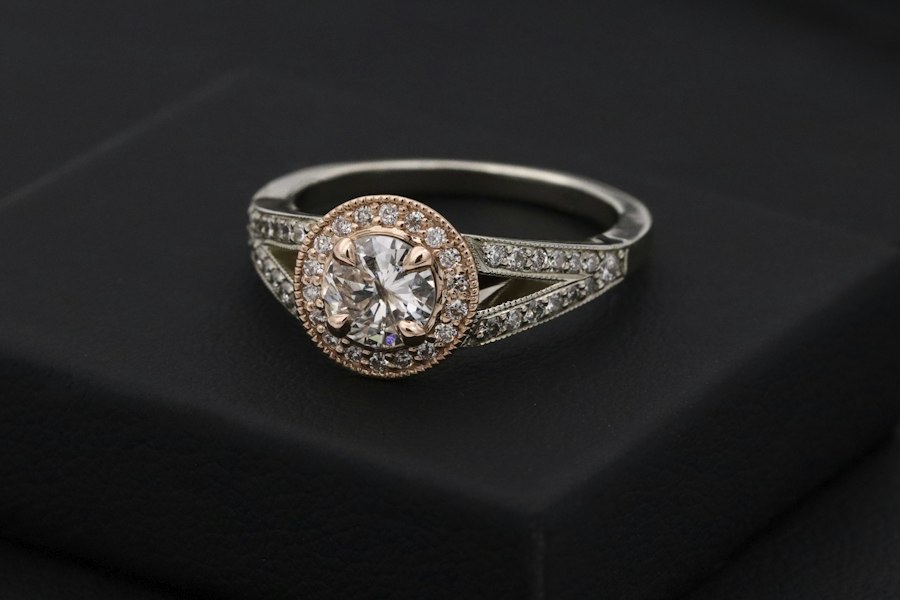
Thread-set and bezel settings reward stones with predictable geometry. Unlike a prong basket, which forgives a slightly uneven girdle by gripping four or six points, a bezel wraps the entire circumference. If the girdle is wavy, if the table is off-center, or if the culet punches through the seat, the finished ring shows it. Your setter will spend extra time grinding the seat, and that labor eats the margin you worked for on the stone cost.
Spec the stone to the setting, not just the carat
Round brilliant moissanite is sold by the millimeter in wholesale parcels, which is exactly how a bench jeweler thinks. For a 6.5 mm bezel solitaire you want a stone that measures a true 6.45 to 6.55 mm, with a girdle that reads thin to medium rather than thick. Thick girdles look chunky inside a fine bezel and force the rim wide, which ruins the clean line customers are paying for. Ask your supplier for a girdle note on the invoice, or sort the parcel yourself before it reaches the setter.
Depth percentage matters more here than in a prong setting. For low-profile bezels, an overall depth in the high 50s to low 60s keeps the stone sitting shallow. Stones cut too deep raise the head, push the culet below the ring shank, and either poke through the band or require a heavy basket underneath. Either way, the ring stops looking minimalist.
Clarity and color for a rim that hides nothing
A bezel covers the girdle, but it does not hide inclusions under the table. Because these rings are worn close to the hand and often photographed on the ring finger, expect customers to inspect the center stone under magnification in a bright store. Stick to eye-clean VS-to-VVS clarity and D-E-F color for the core line. Moissanite is typically eye-clean by nature, but comparing two parcels side by side still shows greenish or grayish cast in lower grades, and that tint is obvious once a stone is locked inside warm rose gold.
MOQ strategy for a small-batch minimalist line
Most buyers overbuy the hero size and starve the surrounding sizes. A bezel line usually needs a depth chart: 4 mm, 5 mm, 6.5 mm, 7.5 mm, and 8 mm. Rather than twenty of one size, take eight stones of each of the three most common diameters and test which reorders. Because moissanite reorders are fast and MOQ tiers drop sharply at volume, you can replenish quickly without tying cash in slow stock. Pair the center rounds with a small matching melee stock for the occasional accented version.
Setter-friendly QC checklist
- Flat, parallel girdle so the bezel wall seats evenly around the whole stone.
- Centered table and symmetric crown, checked face-up under a light.
- Culet not broken; a chipped culet shows through a thin bezel seat.
- Consistent mm within the parcel so every ring in the run sits the same.
- GRA certificate matched to each stone for resale transparency; read how the GRA number maps to the parcel.
Why moissanite suits this low-profile setting
Moissanite's hardness and stability make it a natural for a setting that hugs the finger. At 9.25 on the Mohs scale it resists the scratches that come from daily contact with desks, handbags, and door handles, and it does not need the cautious handling a softer stone demands. Because it is lab-created and typically eye-clean, a bezel line can count on consistent stock parcel after parcel rather than sorting natural stones for clarity variation. The higher refractive index also means a low-set stone still reads bright; unlike some softer gems that look dim when held flush, moissanite keeps its fire even when seated close to the skin. That combination durability, consistency, and sparkle in a shallow seat is why minimalist bezel production has become one of the strongest uses for loose round moissanite rather than finished mounts.
The payoff of sourcing the right rounds is a setting process that does not fight the stone. Setters move faster on clean, consistent parcels, the finished rings sit low and clean, and customers who wear them daily come back to stack a matching band. That repeat business is where a minimalist line earns its keep, and it starts with buying stones built to be held by metal rather than by prongs.