The emerald cut is the cut of quiet luxury. Instead of a riot of facets, it carries broad, parallel step facets and a wide table. In diamond buying it is the cut that makes color and inclusions visible, and in moissanite the same logic applies. An emerald-cut moissanite does not sparkle the way a round does; it reflects light in long, horizontal flashes and reads as clean, architectural and expensive. That look sells a specific customer, and it sells poorly to the customer who wants maximum fire.
Why step-cut behaves differently
Step facets are arranged in concentric rows rather than radiating outward. Light enters the table and reflects back in bands rather than scattering into colored flashes. The trade-off is that the center of the stone can look see-through, a condition the trade calls "windowing." On a well-proportioned emerald cut, windowing is minimal. On a shallow one, the center looks like a hole, and no amount of setting fixes it.
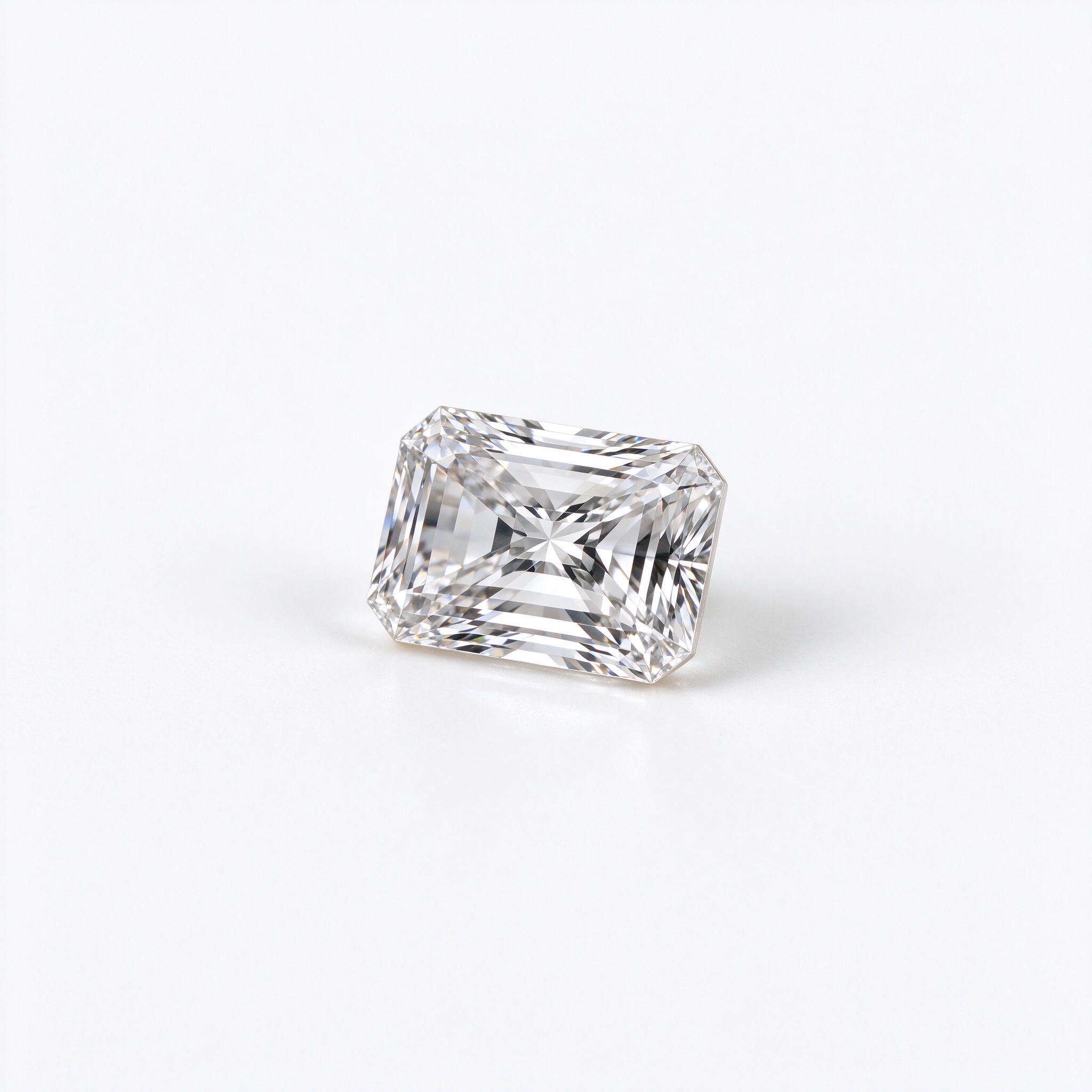
Proportions that avoid a window
The crown height and pavilion depth have to sit in a tight band. We stock emerald cuts with pavilion depths between 12 and 16 percent of the width and crown angles near 40 degrees. Stones outside that band either window badly or go too dark. The length-to-width ratio usually lands at 1.30:1 to 1.45:1 for a classic emerald, or closer to 1.50:1 for a slim, modern version.
Clarity is not optional here
Because the table is wide and the facets are broad, every inclusion, every feather, every carbon spot shows. We sell emerald-cut moissanite in VVS1 only for stock. Lower clarities exist in the trade, but they look dirty in an emerald cut even when they would be invisible in a round. This is the one cut where "eye-clean" is not enough; you need actual VVS1 grading. All stock emeralds carry a GRA certificate and a matching girdle inscription.
Face-up size and wholesale price
| Dimensions (mm) | Ratio | Diamond equivalent | Wholesale band (USD, D-F VVS1, GRA) |
|---|---|---|---|
| 5x7 | 1.40:1 | ~0.7 ct | $20 - $34 |
| 6x8 | 1.33:1 | ~1.0 ct | $32 - $52 |
| 7x9 | 1.29:1 | ~1.5 ct | $50 - $80 |
| 8x10 | 1.25:1 | ~2.0 ct | $75 - $120 |
| 9x11 | 1.22:1 | ~3.0 ct | $120 - $190 |
| 10x12 | 1.20:1 | ~4.0 ct | $180 - $280 |
Setting tips
Emerald cuts have four corners, and corners chip. The standard setting uses prongs at all four corners plus a pair along the long sides. A bezel that wraps the whole stone is a strong option for daily wear because it protects the girdle, but it hides the step-facet silhouette and is better reserved for pendants. Halo settings around an emerald cut are divisive: they add fire where the stone has none, which some customers love and others feel ruins the clean line.
- Solitaire, four-corner prongs: the default, best for rings that see light wear.
- Bezel: daily-wear friendly, better on pendants than rings.
- Hidden halo / pavé under-gallery: adds fire without changing the silhouette, a current retail favorite.
- Side stones: tapered baguettes or trillion-cut accents echo the geometry.
Metal pairs
Platinum and 18k white gold are the classic pairing; the cool metal makes the D-F stone read as ice. Yellow gold emerald cuts are having a moment because the warm metal gives the step cut an Art Deco mood. We have seen strong reorders on emerald-cut solitaires in 14k yellow gold with a thin pavé band, a combination that photographs well on editorial feeds.
Who buys emerald cuts
Customers who want understated, customers who work in professional settings where a loud sparkler reads wrong, and customers who already own a round or oval and want something architectural for a second ring. It is rarely the first engagement-ring choice for customers under 30 who have only seen round engagement rings on social media; those customers need to be shown the stone in hand before they commit.
Durability
Moissanite at 9.25 Mohs is hard enough, but the four corners of an emerald cut are the chip points. We specify medium-to-thick girdles and corner prongs on every stock stone. Step-cut moissanite can also show abrasion at the girdle after years of wear, because the girdle on an emerald is often unpolished. That is cosmetic, not structural, and re-polishing restores it.
Cleaning and upkeep
Step cuts show grime faster than brilliant cuts, because the broad facets smear when oily. A dusty emerald-cut moissanite looks smaller and quieter than a clean one, and customers sometimes misread that as a weak stone. Counsel end customers to wash the stone in warm soapy water with a soft brush every two weeks, especially under the pavilion where lotion builds up. Ultrasonic cleaning is safe on unset stones but should be avoided on mounted emeralds, because vibration can work pavé prongs loose on the halo settings that this cut often wears.
Filter the loose stone catalog to Emerald Cut to see current dimensions.