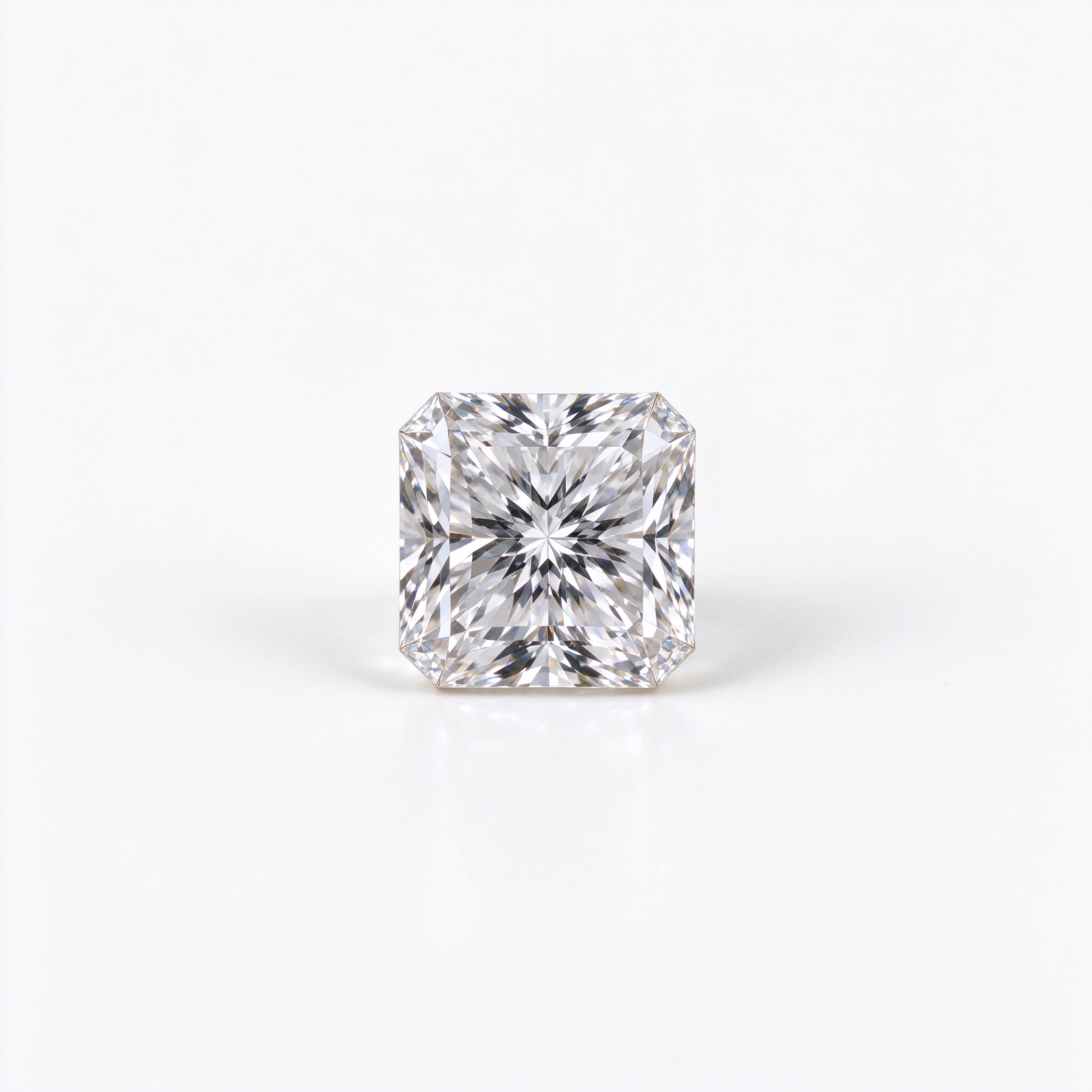
An Asscher cut moissanite sits on a tray and looks like a stone that belongs in a display case with a four-figure diamond price. Boutiques in Vienna and Copenhagen have told us that the Asscher is their highest-per-square-inch stock: it pulls design-forward customers into the shop, it photographs beautifully, and the wholesale moissanite price leaves room for a retail margin that round stock cannot match.
This guide explains what the Asscher actually is, how it differs from an emerald cut, and the margin structure that makes it one of the most profitable shapes to stock.
What an Asscher cut actually is
The Asscher cut is a square step cut: a square version of the emerald cut with parallel rectangular step facets running down the pavilion and a small open table. It was first patented in 1902 by the Asscher Diamond Company in Amsterdam, and the style is closely associated with Art Deco jewellery of the 1920s and 1930s.
Modern Asscher-style moissanite typically carries 70–74 facets. The visual signature is a strong X pattern of step reflections running across the table, with crisp parallel lines and a calm, mirror-like face. It is not a sparkle cut; it is a geometry cut. Customers who choose it want the architectural square, not maximum fire.
The moissanite optical properties matter here: because moissanite's dispersion (about 0.104) is more than double diamond's, step facets on an Asscher moissanite flash subtle colour along the mirror edges. Done well, this reads as richness; done poorly on a shallow stone, it reads as noise. Proportion control is everything.
Asscher vs emerald cut: which to stock
The two cuts are related but sell to different customers, and you should stock both deliberately. The Asscher is square with a length-to-width ratio near 1.00, 70–74 facets and a strong X reflection, and it sells to Art Deco and geometric buyers. The emerald cut is rectangular at 1.30–1.55, carries 50–58 facets with horizontal bands, and sells to minimalist and elongated buyers. Both carry high percentage margin.
A common error is to buy an Asscher parcel expecting the same turnover as an oval. Asscher demand is narrower but more loyal; a customer who wants an Asscher rarely substitutes. Our reorder rate on Asscher parcels runs about 1.6x per year versus 1.2x for rounds, because the customer who wants this look has usually shopped elsewhere and failed to find it.
Proportion tolerances for Asscher stock
Because the Asscher is a step cut, it shows inclusions and windows the same way an emerald does. Hold the same tight standard. Square alignment must be within 1%, because an off-square Asscher reads as a rectangle and confuses the customer expecting the iconic 1920s square. The stone must be eye-clean from 30 cm, since step facets mirror inclusions across the table and a VS-grade stone with a black spot through the table is a return. Depth should stay 60–70%; shallow Asschers window and deep ones look small for their weight. Corners need protection, same as emerald: V-prong or bezel corners, because the sharp square corners chip during resizing.
A 1.5ct equivalent Asscher measures roughly 6.5 mm square. Stock the 1.0–1.5ct bracket for engagement; the 2ct-plus bracket is a bespoke order and should not be overstocked.
Why the wholesale moissanite price matters here
The Asscher look in fine jewellery is normally sold at price points that only a small share of customers reach. Moissanite lets boutiques offer the same silhouette at roughly 10–15% of the equivalent fine-jewellery price, which changes the retail conversation entirely. The customer who could not justify a four-figure Asscher diamond buys an accessible moissanite Asscher and tells three friends.
That price structure is the margin story for the boutique: wholesale cost is low enough that retail price remains accessible, while percentage margin on the piece is among the highest in the shop. Accounts that open an Asscher line typically see step-cut attach rates climb from under 5% to over 15% within two quarters. Pair the line with emerald clarity stock for the step-curious customer, and with chunky cushions for the vintage buyer who wants a little more sparkle.
Frequently Asked Questions
What is the difference between an Asscher and an emerald cut?
Both are step cuts. The Asscher is square with a strong X reflection; the emerald is rectangular with horizontal bands. They sell to different customers: geometric/Art Deco versus minimalist/elongated.
Why is the Asscher cut profitable for boutiques?
It carries high percentage margin because demand is narrow and loyal; customers who want an Asscher rarely substitute, and moissanite pricing makes the piece accessible enough to sell through.
What size Asscher moissanite should I stock?
The 1.0–1.5ct bracket (about 5.5–6.5 mm square) is the sweet spot for engagement. Keep one larger stone as a showcase; do not overstock 2ct-plus pieces.
Do Asscher stones show inclusions?
Yes, more than brilliants. Step facets mirror inclusions across the table, so every Asscher should be eye-clean from 30 cm under retail light.
What setting suits an Asscher cut?
Platinum or 18k yellow gold with V-prong corner protection, or a bezel. Baguette side stones extend the square lines; round melee around an Asscher creates a visual fight.
Request an Asscher sample parcel: 3 stones (5.5, 6.0 and 6.5 mm square), eye-clean-tested, GRA-certified. Apply for wholesale pricing to see the tiered margin structure, or read the princess corner-protection guide if you also stock square brilliants.