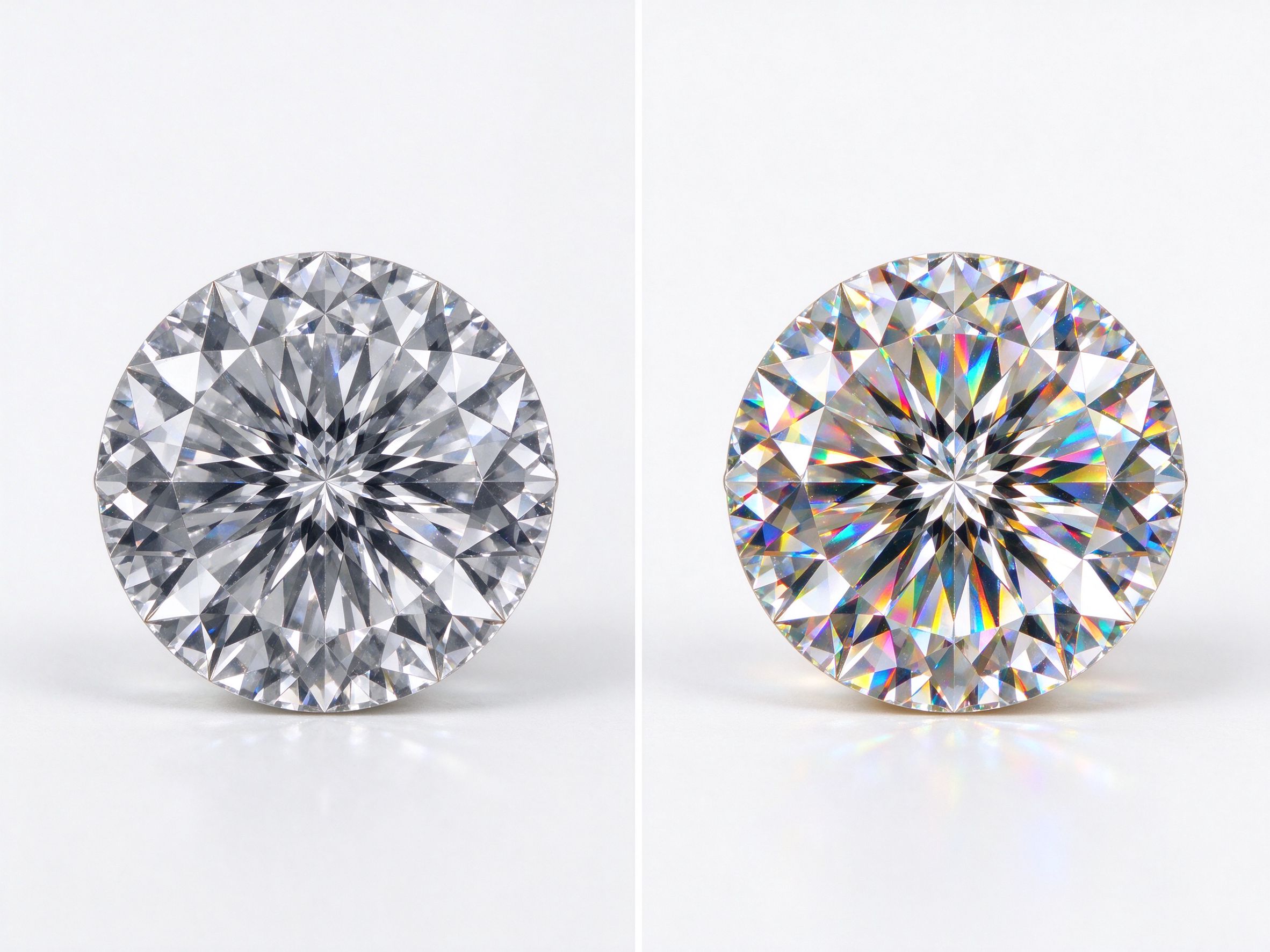
Clients ask us constantly whether moissanite looks like a diamond. The honest answer: it looks brighter and more colorful than a diamond, because the numbers say so. Here is the side-by-side, bench version.
The optical numbers
| Property | Moissanite | Diamond |
|---|---|---|
| Refractive index | 2.65 | 2.42 |
| Dispersion (fire) | 0.104 | 0.044 |
| Mohs hardness | 9.25 | 10 |
| Specific gravity | 3.22 | 3.52 |
What that actually means on the finger
Refractive index 2.65 vs 2.42 means moissanite bends and returns more light, so it looks brighter and more lively under ordinary room light. Dispersion 0.104 vs 0.044 means roughly twice the fire - the rainbow flashes you see. Some people love that; purists who prefer a quieter white sparkle may find it too much. There is no right answer, just the look your client wants.
Hardness: 9.25 is enough
Diamond is 10, moissanite is 9.25 on Mohs. In real wear, both resist scratches far above anything else on the market. Moissanite is daily-wear safe for rings, earrings and pendants. It can be chipped by a hard knock on the girdle, the same as any faceted stone, so normal setting and wear care applies.
Price: the real reason buyers switch
A well-cut 1ct moissanite with GRA certificate costs a small fraction of a comparable 1ct natural diamond. For a jeweler, that means you can offer a 2ct look at a 1ct budget, or offer bridal pieces at a price point your client can actually say yes to.
One thing to know
Moissanite is not a diamond. It is a separate, lab-grown gemstone with its own identity and its own GRA grading. We never sell it as diamond; we sell it as what it is - a brighter, harder-than-most, value-for-money center stone.