Radiant earrings are a smaller category than oval or pearl drops, but they are growing. The cut reads modern and architectural, and it gives a customer who wants something square but not bridal a middle option. As with any matched pair, the sale lives or dies on how close the two stones read. This is how we pair radiant moissanite for earring work.
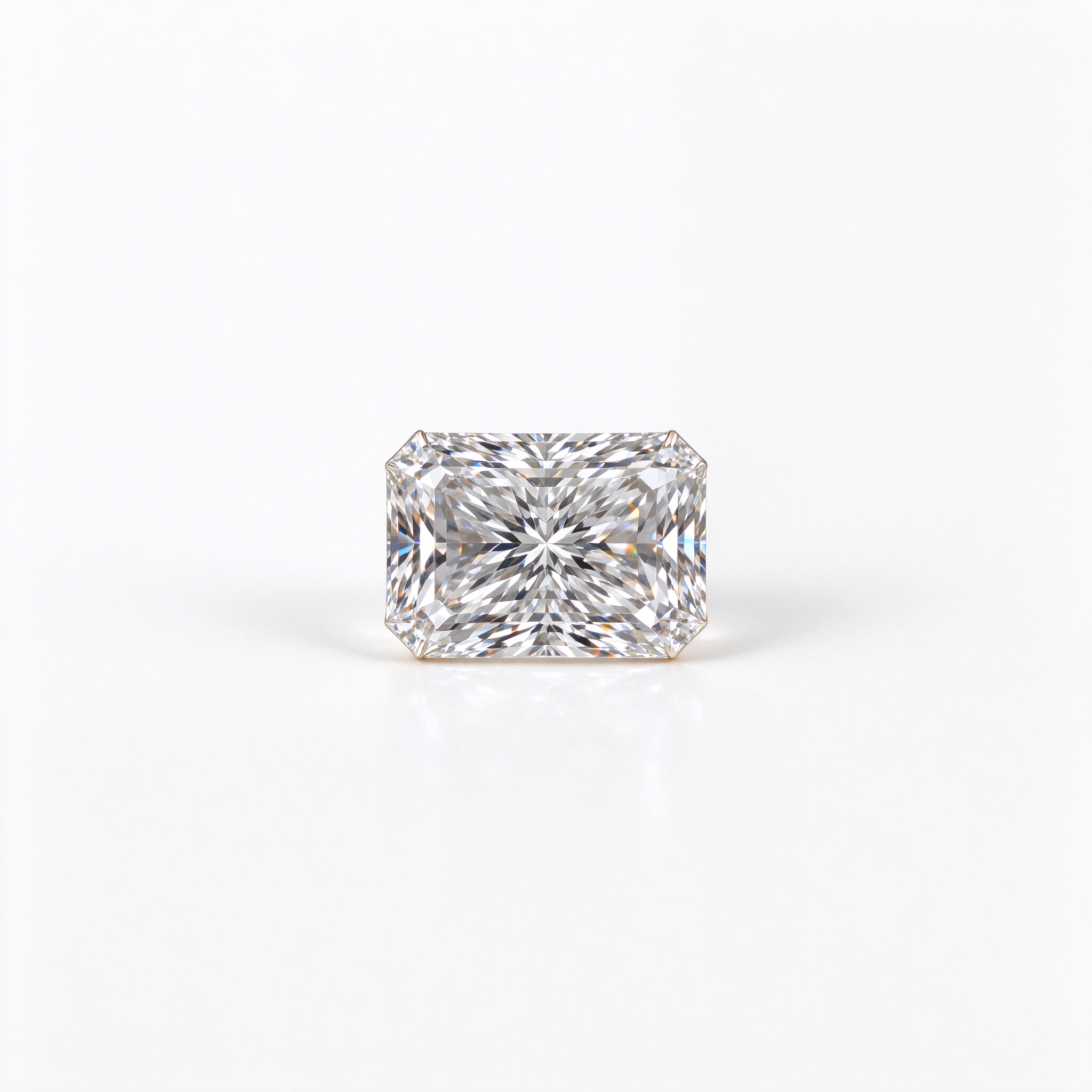
Square versus rectangular pairs
Radiants come near-square (1.00:1) and rectangular (1.10:1 to 1.30:1). For earrings, the near-square radiant is the mainstream choice, because it reads balanced on the lobe. The rectangular radiant suits a drop earring, where the long axis can sit vertically. Decide the shape before ordering, because a pair pulled from a mixed tray will mix the two and look mismatched.
The matching tolerances
| Attribute | Tolerance for a matched pair |
|---|---|
| Width | within 0.10 mm |
| Length | within 0.10 mm |
| Ratio | within 0.03 |
| Face-up tone | same parcel |
| Fire level | matched by eye |
Same parcel, always
Two radiants of the same mm size cut from different rough can face up with slightly different brightness, because the cropped-corner facet pattern is sensitive to proportion. We pair earring radiants from the same cutting parcel and mark the parcel number on the label. When you reorder, ask for the same lot; if it is exhausted, photograph the new pair against the old one before accepting. A customer who buys one radiant stud and comes back for the matching pair six months later will notice the difference.
Setting orientation
For studs, the radiant sits square in a basket, and the two earrings are mirror images only in the sense that the left and right baskets are set to balance. For drops, the radiant hangs with the long axis vertical. The cropped corners take prongs cleanly, which is an advantage over a princess cut: no sharp corners need wrapping. A four-prong setting on the cropped corners holds the radiant securely, and a bezel works for a daily-wear stud.
Pricing pairs
A matched radiant pair costs a small premium over two loose stones, because the matching step takes time. A 6x6 matched pair runs roughly double the single-stone price plus a small match-up charge. Price the pair at about 1.8 times the single-stone retail rather than double, which encourages the pair purchase. Keep one spare stone of the common size for breakages; a customer who loses one stud wants a match, not a new set.
Product photography for radiant pairs
Radiant studs sell on the photo, because the customer compares the two stones directly. Shoot the pair side by side on a neutral background, then on the lobe, because the customer wants to see both the match and the scale. A pair that looks mismatched in a photo will not sell, even if the stones are within tolerance; the photo has to show them as one design. Keep the lighting even, because a side-lit photo can make one stone look brighter than the other and spook the buyer.
Who buys radiant earrings
Three buyer groups. Customers who want square studs but found the princess too sharp-edged. Customers who like the radiant ring and want matching earrings. And customers looking for a right-hand earring that reads modern rather than bridal. It is a smaller line than oval drops, but the buyers who want it do not compare it to anything else, which protects the price point. Keep a matched 6x6 pair and a 7x7 pair in stock; order larger sizes to demand.
Storing a matched pair
A matched pair should live in a single labeled bag, not in the general loose tray. Once the two stones are separated, they are hard to re-pair, because the match was done by eye. Label the bag with both stones' dimensions and the parcel number, and note that they are a pair. When a customer buys one stud as a single, set aside the matching stone and keep it paired in the bag; it sells faster as a pair later than as a loose single. The whole point of pairing is that the two stones are worth more together than apart.
Treat the bag as a single SKU on your tray, and it will sell as a pair rather than being split by a careless pick.
One bag, one SKU, one sale.
Keep one spare radiant of the common size for breakages, because a customer who loses one stud wants a matching replacement rather than a new pair. The spare costs little and saves the sale on a return visit.
- Same parcel for both stones in a pair.
- Near-square for studs, rectangular for drops.
- Label the pair bag and keep the spare inside it.
Note the spare in the pair bag so the next person knows it is there.
A labeled bag keeps the pair together and the spare identifiable.
Matched radiant pairs are in the loose stone catalog under Radiant Cut.