If you open our loose stone catalog and sort by volume, the round brilliant sits at the top. Roughly six out of ten loose moissanite stones HOLYCOME ships in a month are round, and that share has held for years. It is the cut buyers already understand, the cut that photographs predictably, and the cut that needs the least explanation at the counter. For a wholesaler building a repeatable inventory, it is also the easiest shape to stock because demand is continuous rather than seasonal.
What the cut is actually doing
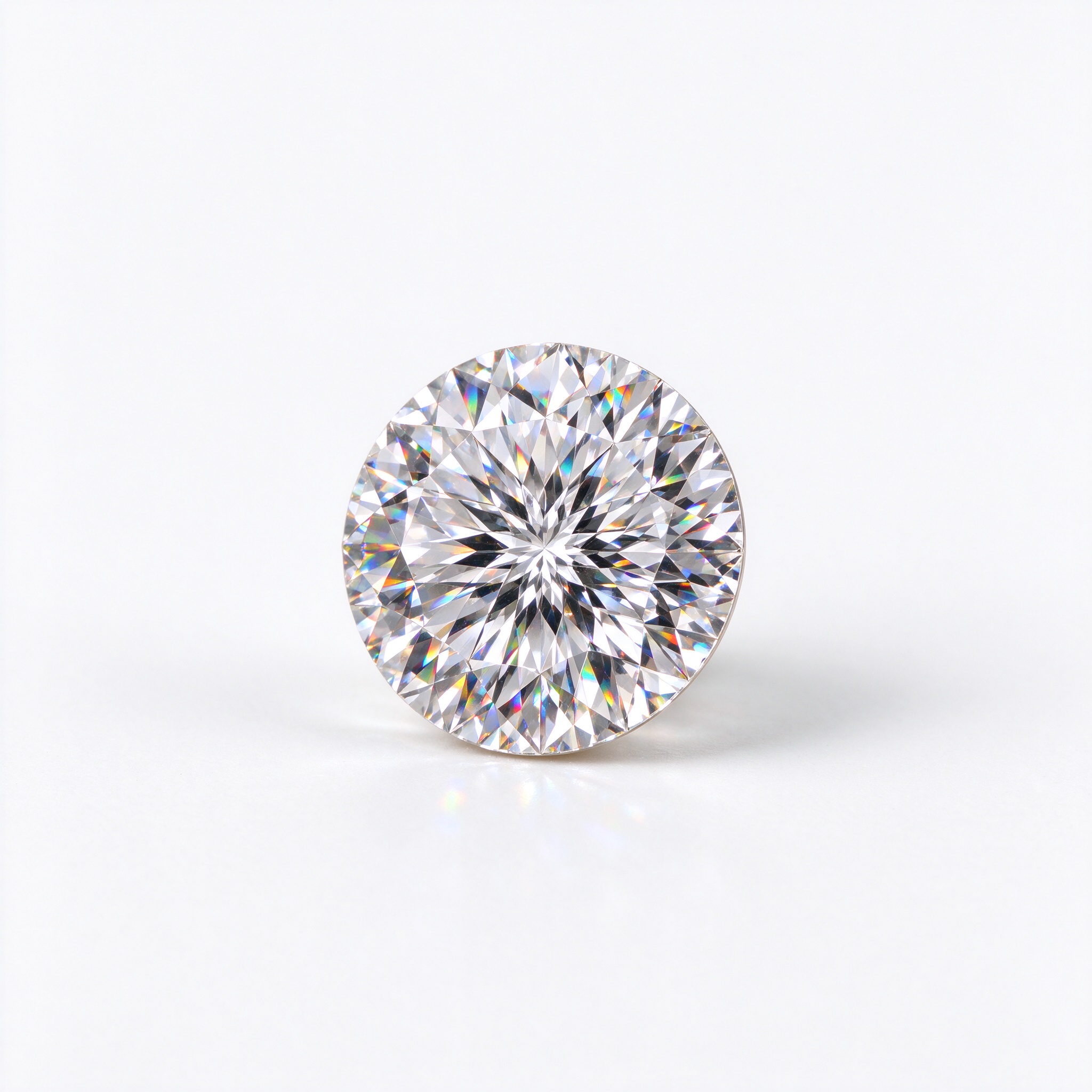
A standard round brilliant carries 57 facets, rising to 58 once a tiny culet is added. The proportions that make it read well in moissanite sit close to the diamond ideal: a crown around 34.5 degrees and a pavilion near 40.75 degrees. Moissanite has a refractive index of about 2.65, higher than diamond's 2.42, and a dispersion figure near 0.104, more than double diamond's. That is why a well-cut round moissanite throws more colored fire than a same-sized diamond, and why cutting too deep or too shallow wastes that advantage in a dark, dead center.
At HOLYCOME we grade factory rounds to a narrow proportion band before they enter stock. Stones that window or go too dark face-up are diverted to lower price tiers rather than passed as VVS1, because a wholesale buyer who receives a face-up weak stone will not reorder.
Face-up size: mm is what matters
Moissanite is sold by millimeter, not by carat weight, because its specific gravity differs from diamond. Buyers consistently compare the face-up diameter to a diamond equivalent. The mapping below is the one our sales team quotes on the floor.
| Diameter (mm) | Diamond equivalent | Typical face-up impression | Wholesale band (USD, D-F VVS1, GRA) |
|---|---|---|---|
| 5.0 | ~0.25 ct | dainty, accent-sized | $6 - $11 |
| 6.5 | ~1.0 ct | classic solitaire head | $18 - $32 |
| 7.5 | ~1.5 ct | noticeable on size 6 finger | $32 - $52 |
| 8.0 | ~2.0 ct | premium solitaire range | $45 - $75 |
| 9.0 | ~3.0 ct | statement, halo-friendly | $80 - $130 |
| 10.0 | ~4.0 ct | high-jewelry face-up | $140 - $220 |
Settings that sell and that protect the stone
The round brilliant tolerates more setting styles than any other cut, but not all of them wear equally well.
- Four- or six-prong solitaire remains the default. Six prongs spread contact and reduce the chance of a corner or girdle knock loosening the stone.
- Halo buys face-up diameter cheaply: a 6.5mm center in a 1.5mm pavé halo reads like an 8mm stone on the hand, which is why halo settings pair naturally with entry-priced rounds.
- Bezel shields the girdle for an active customer, but it hides fire at the rim; reserve it for matte, modern collections.
- Pavé shank adds cost per piece without changing the center stone conversation, so stock it in mid-tier rings only.
Metal pairs
White metals carry the most fire. Rhodium-plated sterling silver and 18k white gold make a D-F round read brightest, though the plating wears in roughly six to twelve months on rings. Yellow gold softens the fire into a warmer, more vintage look and is the better seller for customers who dislike a stark white stone. Rose gold pairs cleanly with round moissanite because the body-color of a near-colorless stone does not fight the pink. Platinum is the premium option, but most retail customers settle at 14k or 18k for price reasons.
Who the round sells to
The buyer who walks in asking for "a diamond look" almost always wants a round. It is the safest engagement-ring SKU, the standard stud-earring center, and the default for pendant bezels. Retailers carrying a single loose-shape line should make rounds 50 to 60 percent of that line by count.
Durability in daily wear
Moissanite measures 9.25 on the Mohs scale, between corundum and diamond, so it resists scratching well enough for daily rings. The failure points are mechanical rather than abrasion: a thin girdle can chip on impact, and a pointed pavilion tip can crack if the stone is dropped hard. We specify medium to slightly thick girdles on stock rounds and avoid extremely thin or faceted girdles for solitaire settings. Clean with warm soapy water; ultrasonic and steam cleaning are safe on intact stones but should be avoided once a stone is set in a prong-heavy mounting, because loose prongs can vibrate further.
Wholesale pricing logic
Price climbs non-linearly with diameter. Doubling the diameter from 6.5 to 10.0mm multiplies the stone's price by roughly seven to nine times, not by four, because large clean rough is rarer. Reorder the 6.5 and 8.0mm sizes most often; treat 9.0mm and above as made-to-order unless a customer has confirmed demand. Every stock round ships with a GRA certificate and a laser-inscribed girdle matching the certificate number.
Rounds in studs and pendants
Not every round leaves the factory in a solitaire. The 5.0 and 6.5mm sizes are the workhorses of stud earrings, sold in matched pairs from the same parcel so the two stones face up identically. For pendant bezels, 6.5mm and 7.5mm move fastest; a bezel that wraps the girdle needs a stone with a slightly thick girdle to seat cleanly, which is how we grade studs and bezels from the solitaire float.