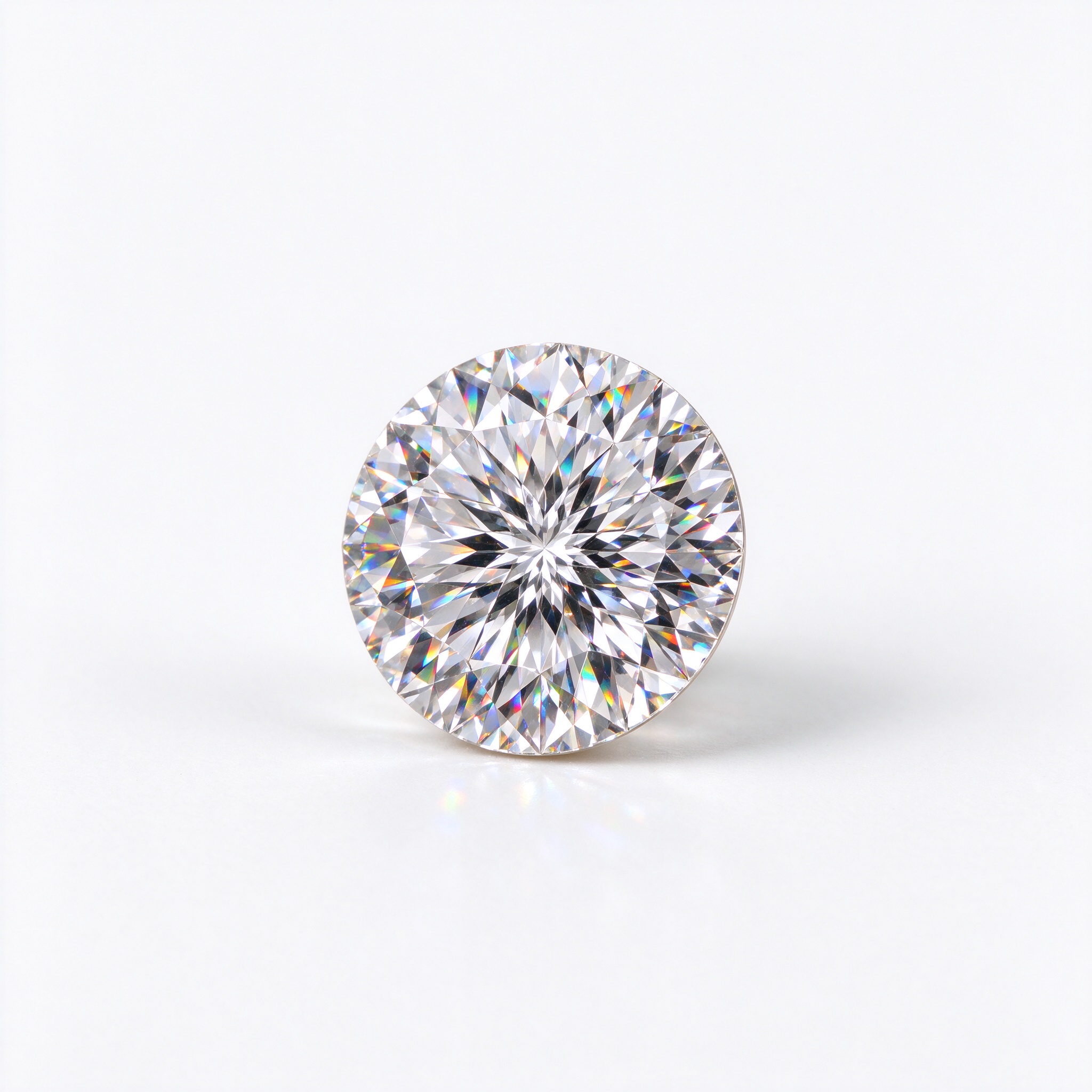
A jewelry manufacturer in the Midwest ordered a 500-piece round brilliant moissanite lot at a rock-bottom per-stone price, intending to feed a stud earring program. When the stones arrived, 12% of them were 0.3 mm off the nominal diameter, a gap wide enough that matched pairs would not sit level in the mounts. Re-cutting the settings ate the entire margin on that run. Bulk round brilliant is the most common moissanite purchase, and it is also the one where sloppy proportion control hides best, because every round stone looks fine at arm's length.
Round brilliant is the workhorse of a wholesale moissanite program: solitaires, studs, pavé accents, three-stone centers. Buying it in bulk only pays off if the lot is consistent across diameter, depth and face-up size. Below is the standard we hold our round lots to.
The cost of skipping proportion checks
A 1 ct round brilliant moissanite at 6.5 mm is the benchmark. Drift to 6.3 mm and a ring sized for 6.5 mm looks undersized; drift to 6.7 mm and the stone binds in the seat. Industry-normal bulk lots are sampled lightly, often by a handful of pieces per bag. Best-practice lots measure every stone on a digital caliper and bin by actual diameter, not by nominal weight.
| Inspection point | Industry typical | Our standard |
|---|---|---|
| Diameter check | Sample per bag | Every stone measured, binned |
| Depth / table% | Trust supplier grade | Spot-profiled per SKU |
| Color in face-up daylight | Under office LED | D65 daylight lamp + dark background |
| GRA report match | One report per lot | Number traced per stone |
The payback shows up in returns. Suppliers who sample lightly see loose-stone rejects in the 3-5% range once the bench sorts the parcel. A 100% measured lot typically lands under 1%.
What a good bulk round lot actually contains
Round brilliant cuts follow the standard 57-facet brilliant arrangement, and the numbers that separate a lively stone from a dull one are the crown angle, the pavilion angle, the table percentage and the total depth. For moissanite, which is harder than sapphire at 9.25 on the Mohs scale and already double-refractive, a well-cut round throws a tighter, more consistent sparkle than a shallow or over-deep cut.
- Target table 55-62% and total depth 58-63% for a balanced, eye-clean round.
- Color graded D-F; any face-up gray or green cast is culled, not sold as a discount tier.
- Size tiers stocked from 2 mm accents up to 9 mm solitaire centers, so pavé and center programs draw from one consistent supply.
- GRA certification per stone, laser-inscribed, report number recorded on the packing list.
Ordering by buyer profile
Stud and earring buyers. Buy in matched diameter pairs within 0.05 mm. The 12% mismatch problem above is solved by binning, not by sorting after delivery. Open with 3 mm, 4 mm and 5 mm tiers.
Solitaire and engagement retailers. Depth and table matter more than exact diameter, because customers compare the stone to diamonds in your case. Stock 5 mm, 6.5 mm and 8 mm, and ask for a proportion sheet per tier.
Private-label pavé programs. Buy accent stones in one locked lot of 100+ pieces so a pendant line and a band line share identical facet behavior. Repeat orders pull from the same cut sheet, and our DDP export terms keep customs documentation clean for EU and US reorders.
Frequently Asked Questions
What size is a 1 carat equivalent round moissanite?
A 1 ct equivalent round brilliant moissanite measures about 6.5 mm in diameter, matching the visual spread of a 1 ct diamond. Bulk lots should be binned to that measured diameter, not just labeled by weight.
How is round moissanite certified?
Each wholesale round stone ships with a GRA report and a matching laser inscription on the girdle. GRA documents the stone's dimensions, cut grade and carat weight; always trace the number before accepting a lot.
What MOQ applies to bulk round orders?
Most bulk round lots open at 20 pieces per size tier. Mixed-size orders across tiers qualify for the next price break once the total reaches 100 pieces.
Do round moissanite stones chip in prong settings?
Rounds are the most prong-friendly shape because they have no sharp corners. Still, every pre-set stone should pass a 1.5 kg prong-pull test before it reaches a customer.
Can I get matched pairs for stud earrings?
Yes. Specify matched-pair packing at order time; pairs are binned within 0.05 mm diameter and matched for face-up color under daylight lighting.
The takeaways
- Measure every stone in a bulk round lot; sampling is where mismatch hides.
- Hold table 55-62% and depth 58-63% for lively, consistent rounds.
- Bin by measured diameter, not nominal carat, especially for stud pairs.
- Trace every GRA number; one report per lot is not enough.
Request a sample parcel: MOQ 20 pcs in your chosen size tiers, ships in 5 business days. See the full round brilliant collection, compare bulk pricing tiers, or visit the buying guides.