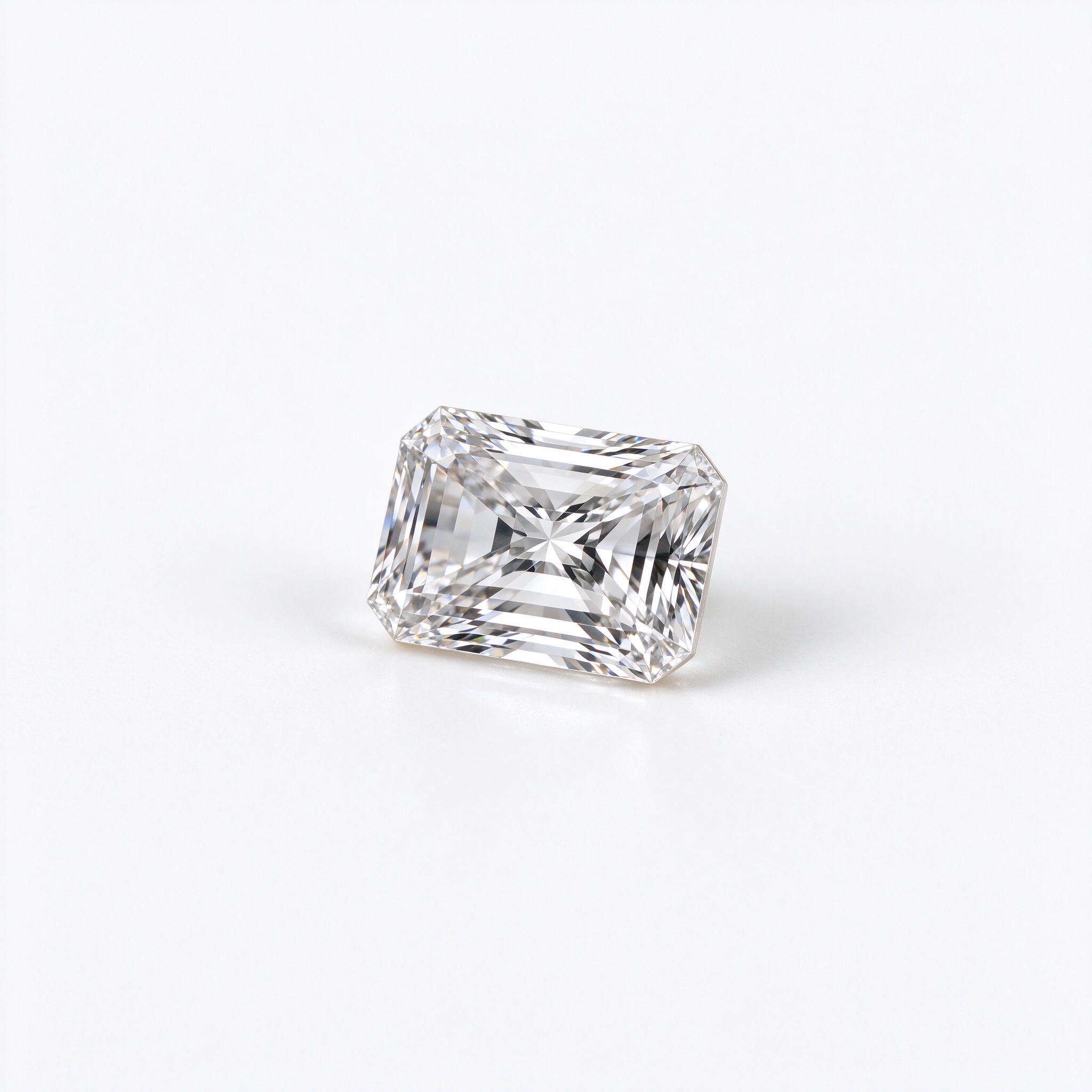
A luxury boutique in Chicago returned a parcel of emerald cut moissanite with one note: "these look like glass." The stones were graded eye-clean on paper, but under the store's display lighting the open step-cut pavilion showed faint clouding that a brilliant cut would have masked. Emerald cut punishes mediocre clarity more than any other shape, because its long step facets act like windows rather than mirrors. Sourcing it in bulk without a tighter clarity standard is how a buyer ends up with inventory that photographs flat and sells slowly.
Why step cuts need a higher clarity bar
A round or brilliant fancy cut scatters light so evenly that inclusions hide in the fire. An emerald cut does the opposite: parallel step facets push light through, so any cloud, feather, or dark spot sits on a stage. The trade buyers call "windowing" — a dark or washed-out center — happens when the pavilion angles are off, and it is hard to hide in a solitaire.
| Parameter | Brilliant cut tolerance | Emerald cut required |
|---|---|---|
| Clarity standard | VS-equivalent, some included | Eye-clean under direct light, no clouding |
| Windowing | Harder to detect | Checked loose on white, both sides |
| Corner condition | Less critical | Chipped corners rejected outright |
| Polish | Good acceptable | Very good minimum for mirror lines |
What we publish on an emerald parcel
Every emerald cut ships at Mohs 9.25, DEF color, GRA certified with matching girdle inscription. The shape-specific standards go further:
- Clarity graded eye-clean under a 10x loupe and direct overhead light, with any internal cloud flagged before packing.
- Windowing checked on both table and pavilion; stones with a washed center are pulled, not discounted and passed through.
- Corners inspected under magnification — chipped or abraded corners are rejected, because emerald corners are the most vulnerable point in a mounting.
- Length-to-width ratio logged, usually between 1.30 and 1.50 for the modern emerald look, with a square option for the Asscher-adjacent buyer.
Our incoming acceptance on emerald parcels runs tighter than the open-market norm because we test windowing under two light sources. Stones that pass in a bright factory bay often fail under a soft retail spotlight, which is exactly where the complaint originates.
Who should source emerald cuts, and how
An opening buyer should treat emerald as a specialist lane, not a volume lane. Order 15 to 20 pieces in the 1.00 to 2.00 band and pair them with slim solitaire or bezel mounts that let the step lines speak. Do not push emerald into a halo — the halo competes with the mirror facets and dilutes the look.
A high-end boutique serving a city clientele can stock deeper into the 2.00 to 3.00 band, where the art-deco and old-money aesthetic commands ticket. Our DDP export to the US and EU settles duty before arrival, and reorders on an approved proportion ship in five business days. Because emerald is lower-volume, holding a small safety stock of matched proportions protects custom orders from substitution.
Private-label buyers should request a documented clarity standard in writing — not just "eye clean," but the specific light source and loupe condition we inspect under. That document becomes the basis for any RMA dispute and usually brings emerald defect returns under 1.5 percent.
Frequently Asked Questions
Do emerald cuts sparkle less than rounds?
They sparkle differently. Emeralds show broad flashes of light and mirror-like step lines rather than the scattered fire of a round. That is the aesthetic shoppers ask for; it is not a defect.
What clarity grade should I buy in bulk?
Buy eye-clean under direct light, not just on paper. Inclusions that hide in a brilliant cut are visible in an emerald, so the bar is effectively one notch higher than the certificate suggests.
How do I prevent chipped corners after sale?
Choose settings that protect the corners — bezel, or prongs that sit over the point rather than beside it. On incoming inspection, reject any stone with an already abraded corner.
Does windowing mean the stone is bad?
Some windowing is natural to step cuts. A small, soft window reads as part of the style; a dark, washed-out center that looks dull should be rejected.
What MOQ fits an emerald test order?
15 to 20 pieces in one carat band is enough to read demand. Emerald is a slow, high-ticket lane, so deep stock before the shape sells is a capital mistake.
What to take away
- Emerald cuts show inclusions and windowing that brilliant cuts hide — tighten the clarity bar.
- Inspect corners and reject abrasions before mounting.
- Pair with slim solitaire or bezel mounts, not halos.
- Lock the clarity inspection standard in writing for private-label RMAs.
Request an emerald sample parcel with documented clarity checks: MOQ 15 pcs, ships in 5 business days. Browse the emerald cut collection, read the step-cut guide, or open a wholesale account for loose emerald DDP terms.