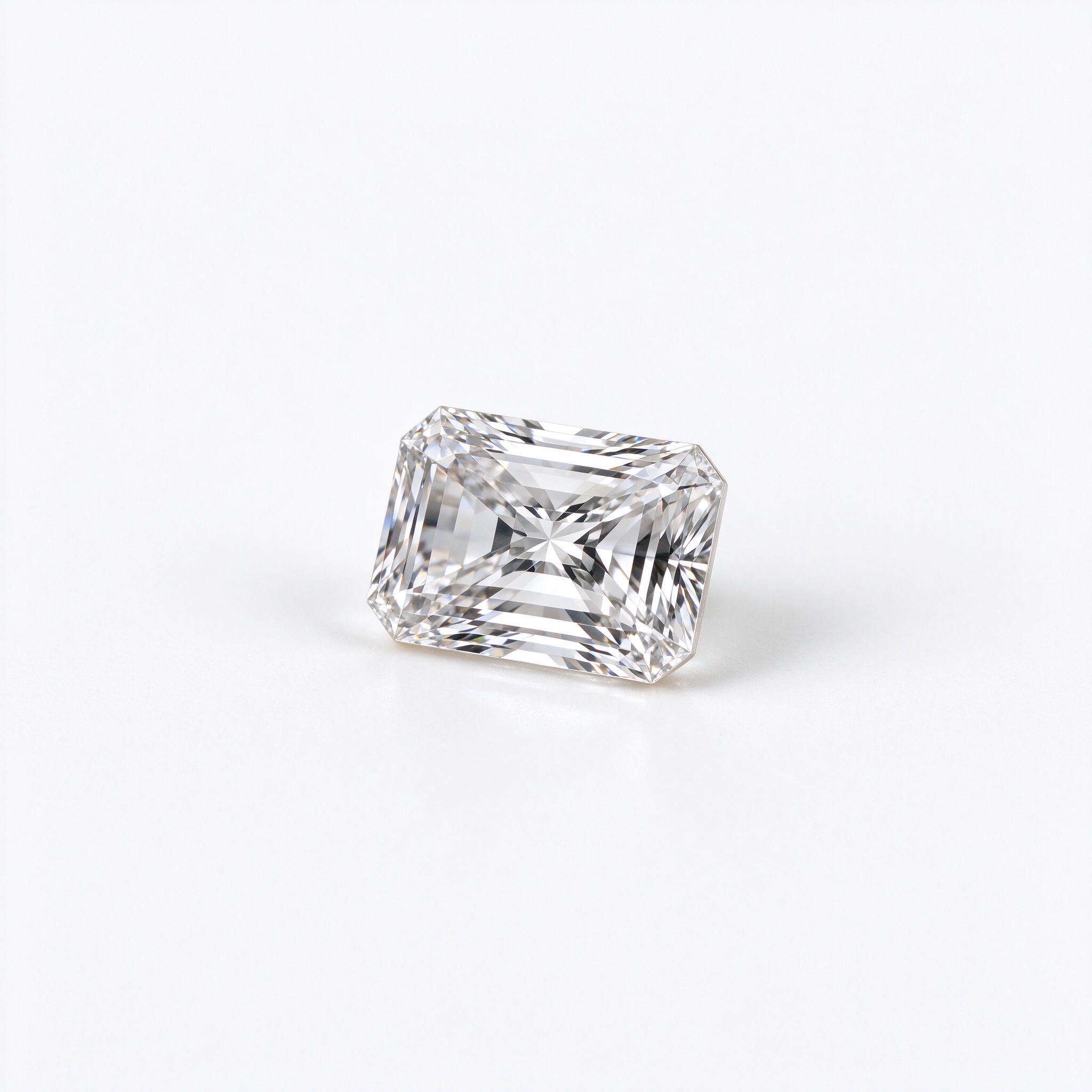
A Dallas jeweler ordered emerald cut moissanite from a new vendor and was proud of the price—until a client turned a ring to the light and pointed out a dark feather visible through the big open table. In a round brilliant, that inclusion hides in the facets. In an emerald cut, the step facets are windows, so clarity shows. The stone came back. This is what bulk emerald cut buying should actually control, and why the cheap parcel was cheap for a reason.
Why step cuts punish lower clarity
An emerald cut is a step cut: broad, flat facets arranged like stairs, with a large open table. There is nowhere for an inclusion to hide. That makes clarity the single most important spec—more than color, more than cut grade. Moissanite’s 9.25 Mohs hardness helps, because the large table polishes to a glassy finish that holds up, but the same flat surface scratches show and inclusions read clearly.
| Emerald spec | What the cheap parcel did | Our bulk standard |
|---|---|---|
| Clarity | SI-grade sold as VVS | VVS minimum, eye-clean under 10x |
| Table transparency | Feathers visible through table | Table area 100% clean |
| Culet | Culet chip under the pavilion | No culet to very small, edge-checked |
| Polish | Scratched step facets | Hand-polished, no visible abrasion |
Our emerald cut bulk process
We ship emerald cuts in VVS clarity as the default bridal tier, with the table and crown facets inspected specifically for eye-cleanliness. Color is near-colorless D–F; the open table makes a faint green cast more visible than in a round, so we hold the whiter end. The step-facet pattern is checked for crisp, parallel rows—a wavy or uneven row is rejected. Moissanite’s hardness means the girdle takes a clean polish, and we avoid heavily faceted girdles that show under bezel settings.
- Clarity: VVS minimum, table area eye-clean.
- Color: D–F near-colorless, whiter than our round default.
- L/W ratio: 1.30:1–1.40:1 classic step-cut rectangle.
- Polish: hand-finished step facets, inspected under loupe.
- Cert: GRA per stone above 3mm.
Buying emeralds by your market
New to step cuts: Start at 10 stones, 1.0–1.5ct. Emerald cut buyer is deliberate—usually a client who wants understated, architectural design. A small test tells you if your market is interested before you scale. MOQ 10 pieces.
Boutique with a modern vintage line: Lock a lot and hold VVS across the range. Emerald cut clients are comparison shoppers; consistency between stones is what earns the reorder. We reserve cutting lots per account.
Private label / high-jewelry: We supply emerald cuts in bezel and halo mounts, DDP to US/EU, with GRA and IGI documentation support. Our process is third-party audited and has exported consistently since 2016. RMA window is 30 days for any clarity defect visible through the table.
Frequently Asked Questions
What clarity do I need in an emerald cut moissanite?
VVS is the practical minimum. The open table makes inclusions visible, so anything below VS will read as ‘dirty’ to a trained client even if it is technically eye-clean loose.
Why does emerald cut moissanite cost more per carat?
Step cutting wastes more rough and demands a cleaner starting material. The table must be flawless, so more stones are rejected during sorting—that rejection cost is baked into the price.
Does emerald cut moissanite sparkle less than round?
It reflects light differently—more of a glassy, hall-of-mirrors flash than a round’s fire. That is the desired look for step-cut buyers, not a flaw.
What setting suits an emerald cut?
Bezel, east-west bezel and clean solitaire mounts show off the geometry. Pavé halos also work, but keep the table unobstructed.
Can you match emerald cuts for side-stone pairs?
Yes, small emerald cuts are matched by weight and clarity for side-stone suites, with a matching sheet per parcel.
Why a high reject rate is actually good news
It sounds backwards, but with emerald cuts the supplier who rejects more rough is the supplier who will cost you less. Step cutting starts with a clean crystal; if the cutter skips rejected material, the inclusions land in your finished stone instead. On our emerald lots, roughly 30% of the starting rough does not make it into a bridal parcel because of feathers in the table or uneven step rows. That rejection is already priced into the per-stone cost, and it is why a cheaper quote looks cheap—it is shipping the stones we threw away. Ask your supplier what their outgoing rejection rate is for step cuts specifically. A number under 20% usually means inclusions are reaching you. We photograph rejected stones and keep the log, so a high-jewelry account can audit it. For a boutique, the practical test is simple: turn a sample to the light, look straight down through the table. If you see anything moving, send the lot back.
Takeaways
- Clarity is the spec that matters most—demand VVS.
- Insist on an eye-clean table area, not just a cert grade.
- Default to D–F color; the open table shows color.
- Expect to pay more—step cutting wastes rough.
Request a sample parcel: MOQ 10 pcs, ships in 5 business days. Browse the emerald cut collection, read the step-cut buying guide, or see bulk pricing.