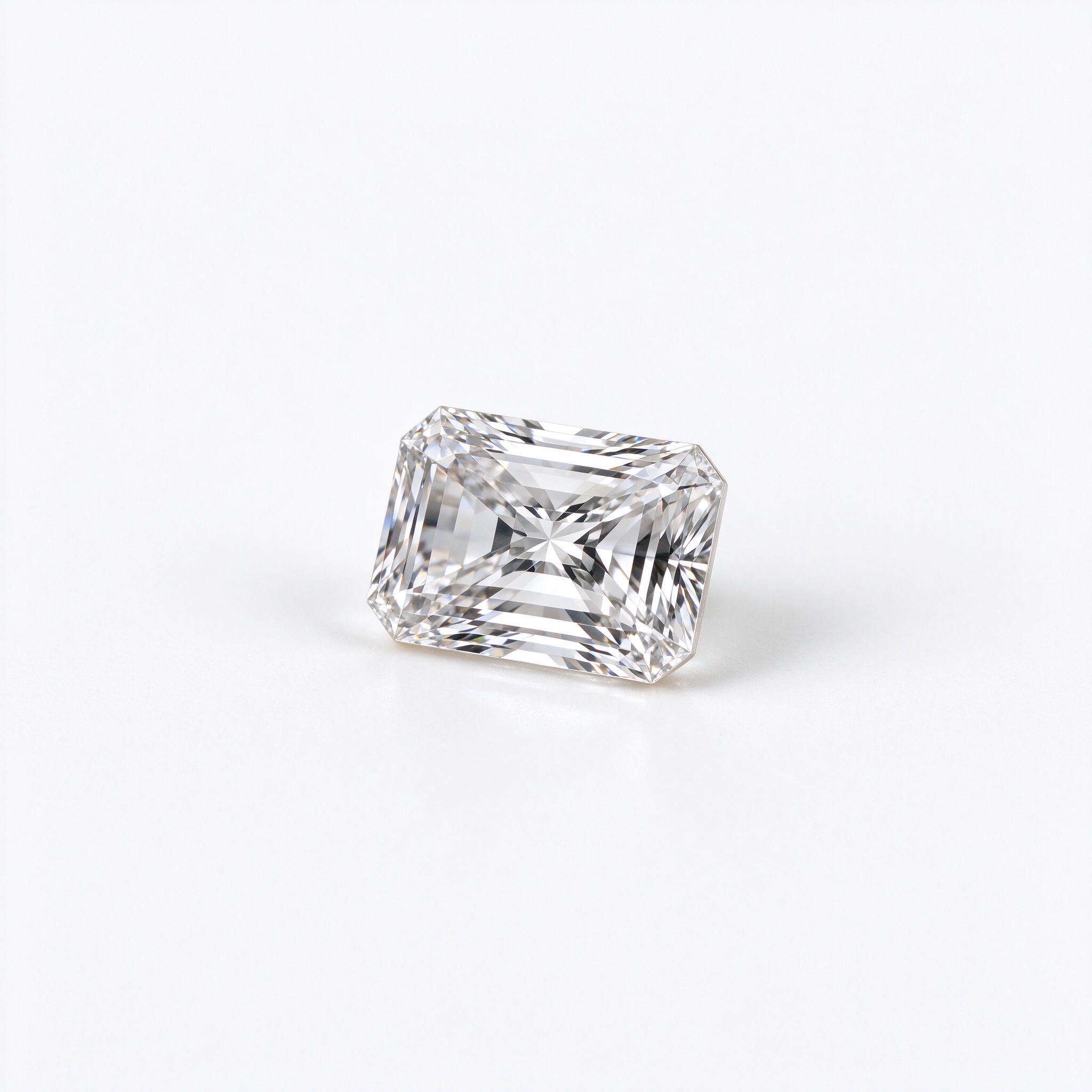
The step-cut buyer is a different customer
Emerald cut moissanite does not sell on sparkle. It sells on the rectangle, the open table, and the mirror-like step facets that travel across the top of the stone. Wholesale buyers who treat it like a round brilliant with different geometry get returns; buyers who understand the customer profile get steady reorders.
The retail demand concentrates in three groups: minimalist engagement buyers who want a stone that reads architectural rather than bridal, men who want a wide rectangular signet-style ring, and designers building Art Deco and 1990s revival collections. None of these shoppers walk in asking for maximum fire. They ask for a clean, wide, unmistakably rectangular face.
Face-up size perception
Emerald cut moissanite spreads well. A 1.5 carat equivalent emerald cut typically measures 8.5 to 9 mm by 6.5 to 7 mm, which reads larger on the finger than a round of the same weight. But the perception has a catch: step facets do not hide the girdle, and a shallow-cut emerald shows a dark outline around the table when held at an angle. Customers notice this in a window display. The stone looks wide on paper but thin in hand if proportions are off.
When buying parcels, ask for mm dimensions rather than carat weight alone. The face-up look is the product. A 9 by 7 mm stone in a clean proportion sells faster than a 10 by 8 mm stone that windows badly. Train your retail staff to show the stone flat under a soft light, where step facets read as horizontal mirrors; under harsh overhead light, a marginal cut looks far worse than it really is.
Metal and setting pairing
Emerald cut moissanite pairs cleanly with platinum and 18k yellow gold. Platinum makes the step facets look like cool mirrors; yellow gold warms the open table and softens the gray that a poorly cut stone can show. White gold works, but rhodium plating balances the cooler tone only until the first re-plate, after which the stone and band read as two different temperatures. Bezel settings and flush east-west mounts suit the rectangular geometry better than cathedral heads, which pinch the corners visually.
Side stones should be step-cut too. Baguettes in a three-stone, or a straight row of tapered baguettes, extend the line of the cut. Round melee around an emerald cut creates a visual fight between brilliant and step light play; most boutiques that tried it have switched to baguette or half-moon accents. A thin hidden halo of tiny rounds can add width without changing the character, but keep it narrow.
Inventory pitfalls
The biggest wholesale mistake is stocking cheap emerald cut moissanite with visible windowing or bowing. Moissanite is doubly refractive, and a shallow step-cut pavilion shows through the table as a pale ghost. This is the number one reason emerald cut stones get returned. The second mistake is overstocking sizes above 2 carat equivalent: the demand is real but narrow, and slow-moving large emeralds tie up cash that round and oval stock turns every month.
A third pitfall is corner damage. Emerald cut corners are unprotected in a standard solitaire. Stock with a slight V-prong or bezel corner protection, and expect to replace unprotected corners that chip during a resize. Buyers ordering loose stones should ask whether the supplier's corners are reinforced and whether the girdle is finished rather than bruted. A rough girdle on a step cut catches light as a dull line around the stone, which customers interpret as a defect.
Another detail the step-cut buyer notices is the absence of fire. Moissanite has higher dispersion than a diamond, which means a brilliant-cut moissanite can flash rainbow color that some purists find too much. In an emerald cut, that dispersion is controlled by the step facets, so the stone reads as white light and mirroring rather than fire. This is a selling point for the architectural buyer and a reason the cut is often chosen over a round by customers who want a calmer, more deliberate stone.
Who buys, and what to ask the supplier
The buyer walking in for an emerald cut usually already has a setting in mind, whether that is a vintage-style bezel, a modern east-west mount, or a men's signet. They are comparison-shopping the cut, not the brand. Wholesale accounts should stock a depth of sizes between 7 by 5 mm and 9 by 7 mm, keep one showcase stone at 10 by 8 mm for the window, and avoid going deeper than 2 carat equivalent unless a specific client orders it.
Ask the supplier for proportion data: table percentage, depth percentage, and whether the stone is cut to a modern step-cut standard or an older deeper proportion. Modern shallow steps look bigger but window; deeper steps look smaller but tighter. The right middle is where most repeat retail sits. Pair the stock with moissanite rings in platinum and yellow gold mounts, and the emerald cut segment will carry itself through bridal season and into the men's signet trade.