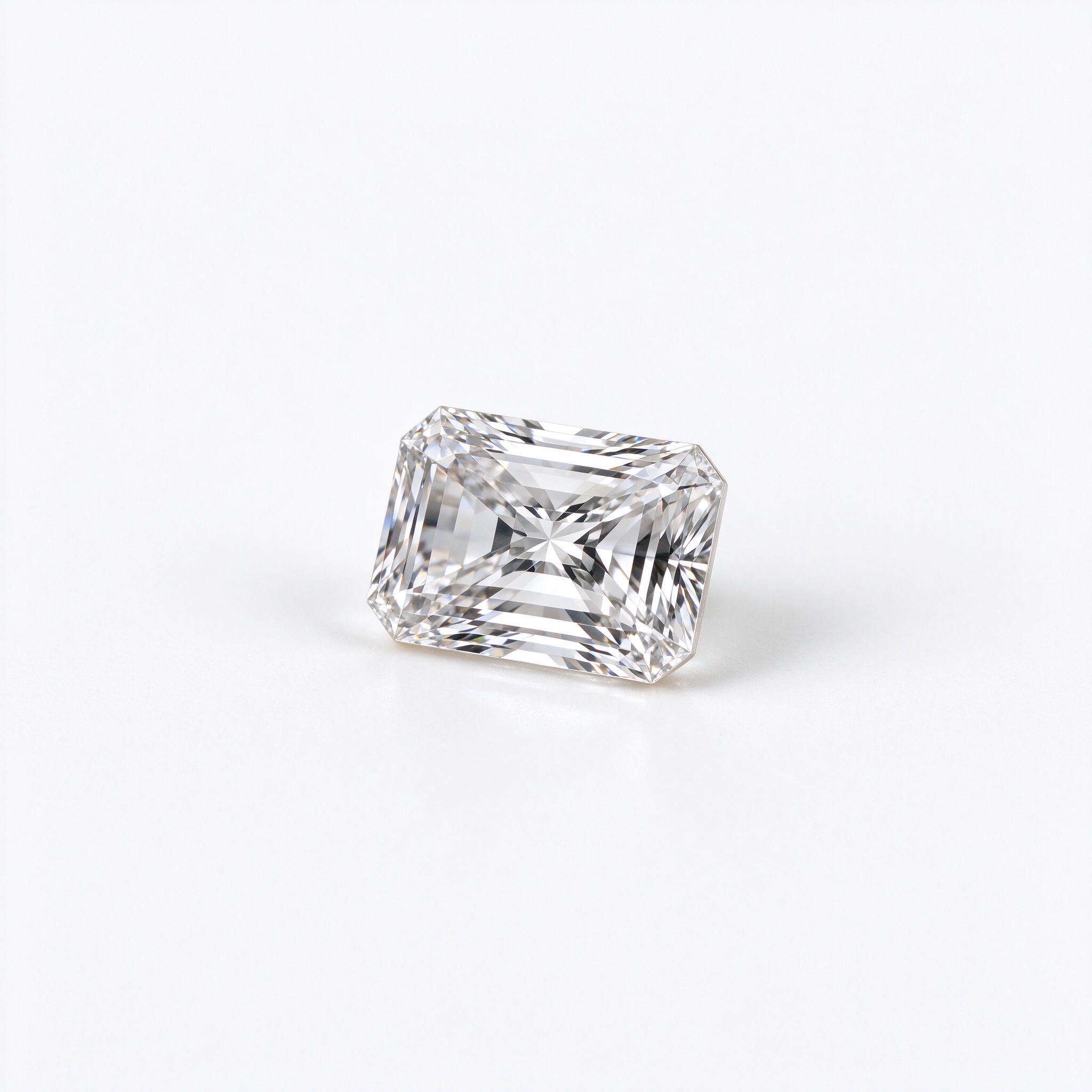
An emerald cut moissanite is sold as a stone, but most of the returns and the complaints wholesale buyers hear come from the setting, specifically from how the wedding band meets the engagement ring. The emerald's wide table, stepped facets, and open pavilion create a profile that does not sit flush against a straight band the way a round brilliant in a six-prong does. If you stock emerald cut inventory without thinking through the band pairing, you are setting yourself up for customers who come back saying their two rings do not touch.
Why the profile matters
A round brilliant sits high on its prongs and tapers in at the basket, which leaves natural clearance underneath for a band to slide up beside it. An emerald cut is usually set lower, in a bezel or four-prong, with the girdle running close to the finger. The pavilion of an emerald is also broader and less tapered than a brilliant's. The result is that the engagement ring's basket takes up more radial space at the height where a wedding band sits. A straight band pushed up against it will hit the basket on one or both sides, leaving a visible gap that the customer's eye fixes on immediately.
Three pairing options for emerald cut
The first option is the flush-fit or contour band. The inner edge of the wedding band is shaped to match the curve of the engagement ring's basket, so the two rings sit together with no gap. This is the cleanest look and the most requested by buyers who are building a bridal set. The tradeoff is that the contour band is custom-shaped to a specific setting, so it cannot be swapped out later without re-profiling.
The second option is a pointed or V-shaped band designed to nest into the open end of an emerald cut that is set lengthwise across the finger. This works best for emeralds set east-west, less well for north-south solitaires. It is a strong look for customers who want a band that reads as a separate piece rather than a matched set.
The third option is a straight band worn with a deliberate gap. A thinner band (1.5 to 2mm) in a channel or pavé sits next to the emerald setting, and the gap is accepted as a design choice. This is the most flexible for the customer, who can rotate or replace the band over the years. It also happens to be the easiest to stock, because a straight band is a standard SKU rather than a custom profile.
What to tell your bench setters
If you are selling loose emerald cut stones, flag the band question on the order form. The most common setter mistake is closing the prongs too tightly against the girdle, which raises the basket and makes a contour band necessary when a straight band would have worked. For a straight-band-friendly emerald setting, specify a slightly raised basket with open shoulders, leaving 1.8mm of clearance at the pinch point. Document the profile and send it to the customer before they order the band, because a contour band made without that drawing is the number one source of refits in this category. A second common setter error is seating the emerald too shallow, which makes the girdle flush with the top of the prongs and leaves no room for a band to slide up beside the stone. Flag both on the work order so the setter does not improvise.
East-west versus north-south settings
Emeralds set east-west (long axis across the finger) read wider and more modern, and they take a V-shaped or pointed band more cleanly because the open end of the stone faces the knuckle. Emeralds set north-south (long axis along the finger) read longer and more traditional, and they take a straight contour band more cleanly. The choice changes the band SKU, so decide which orientation you are stocking before you order the contour band inventory. Most boutiques stock both orientations in a small depth, because the customer's preference is aesthetic and hard to predict.
Metal and width decisions
Emerald cut moissanite reads best next to a band that does not compete with its long horizontal lines. A band wider than 2.5mm visually overwhelms a stone under 2ct; a band narrower than 1.5mm looks flimsy against a 3ct emerald. For yellow gold settings, most buyers choose a 2mm half-round band. For white gold or platinum, a 2mm pavé band with channel-set stones reads clean and does not introduce sparkle that fights the step-facet reflection. Avoid a band with its own large stones; the emerald's table is already the visual anchor.
What to ask the supplier
When you open an emerald line, ask the factory whether they supply matching contour bands for each setting, and whether the band profile can be shipped as a drawing with the ring. Ask whether the stone is sold loose or pre-set in a setting that is band-friendly. If you are building a bridal set SKU, ask for the combined weight and the combined width at the widest point; that is the measurement customers will use to judge whether the set fits their finger.
Buyers who want to compare how step cuts pair with bands should also look at our moissanite rings across the emerald and asscher profiles, because the same contour logic applies once you move from emerald to asscher.