The step-cut buyer is the most demanding clarity customer in the jewellery store. A boutique in Amsterdam opened a parcel of emerald moissanite at VS clarity and three stones came back with visible dark specks under the shop window light. Emerald cuts do not hide inclusions; they frame them. Buying emerald stock without a tighter clarity standard is the fastest way to build a returns pile.
This guide explains how step-cut reflection works, why clarity standards must be tighter for emerald than for round, and the windowing risk that separates a cheap stone from a fine look.
How step-cut reflection is different from brilliant fire
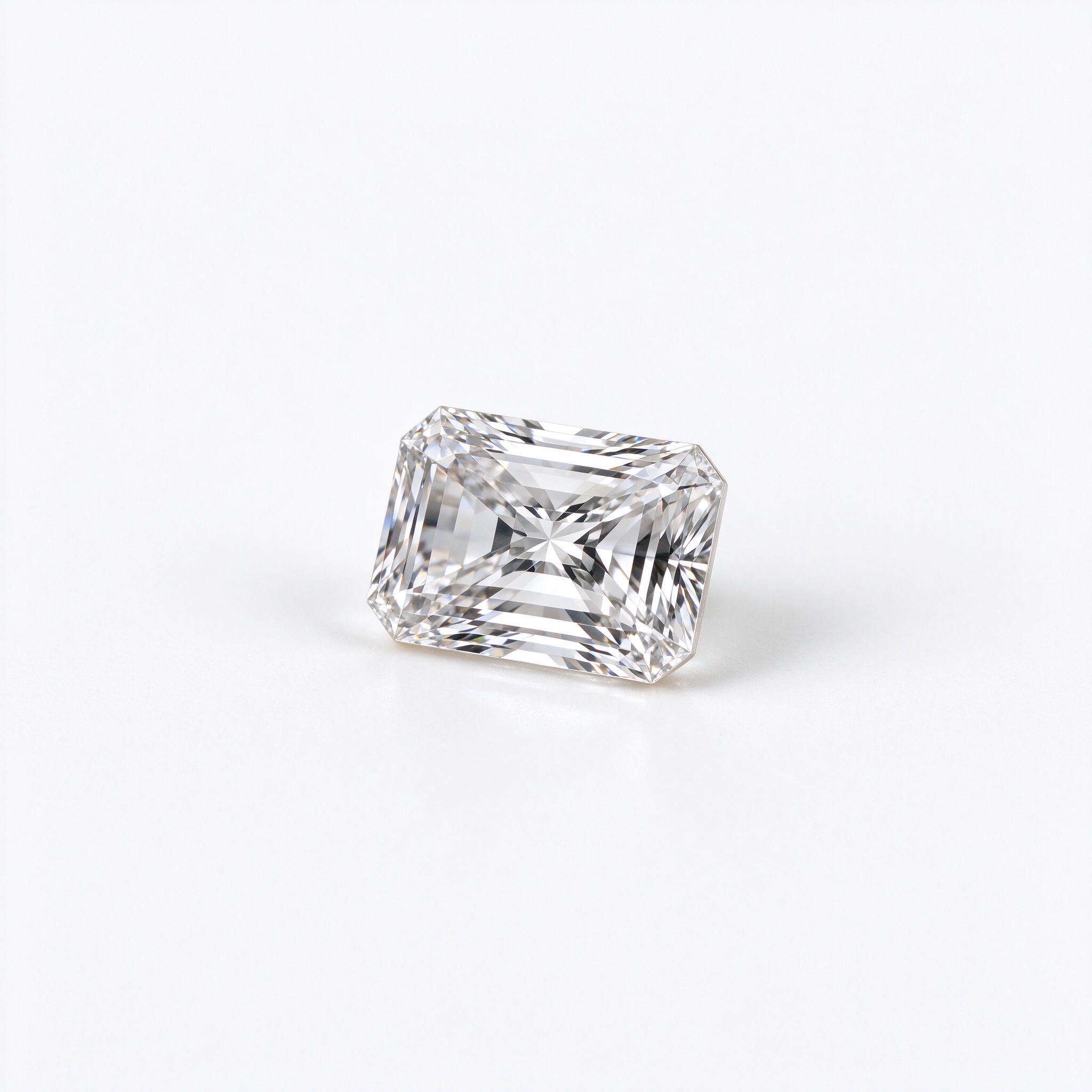
A round brilliant is built from triangular and kite facets that scatter light into small sparkles. An emerald cut is built from parallel rectangular step facets running down the pavilion, culminating in a large open table. The result is not sparkle; it is mirroring. Light enters the table and reflects off the step facets in horizontal bands that travel across the stone.
That mirror effect has two consequences. First, the stone reads calm, architectural and modern, which is exactly why it sells to the minimalist buyer. Second, any inclusion, dark spot or feather inside the stone is reflected across the table rather than camouflaged by scattered facets. The same stone that would be eye-clean in a round brilliant can read as visibly flawed in an emerald cut.
Because moissanite dispersion is high (about 0.104), step facets on a well-cut emerald also flash subtle colour along the mirror edges, which most customers read as sophistication rather than excess. The diamond optical properties reference explains why this mirror-style reflection is prized in fine step cuts, and the same physics applies to moissanite.
Clarity standard for bulk emerald parcels
We hold emerald parcels to a tighter in-house clarity band than our brilliant stock. Every stone must be eye-clean from 30 cm under overhead retail light, not just from the pavilion side, because that is the standard a customer applies at the counter. No dark inclusions may be visible through the table; clouds and feathers hidden below the girdle are acceptable, but black spots anywhere in the table quadrants are not. And no windowing: a shallow-cut emerald shows a pale transparent patch through the table, which is the number one return reason for step cuts.
The trade often sells emerald moissanite at the same clarity label as round stock. Wholesale buyers should insist on the eye-clean-from-30cm test on every stone, not on the certificate label alone. GRA and similar reports cover lab clarity grades; they do not guarantee the step-cut visual result.
Proportion tolerances that control windowing
Emerald proportions control whether the stone mirrors or windows. Our parcel inspection holds a table of 60–68%, because too large a table looks flat and too small a table leaves a dark centre. Depth should be 60–70%; too shallow windows and too deep looks small face-up. The length-to-width ratio should sit 1.30–1.55; too wide reads square and too narrow reads as a slim line. Crown angle should be 30–38 degrees; a low crown gives weak mirroring.
A 1.5ct equivalent emerald cut should measure roughly 8.5 by 6.5 mm. Stones that measure 9 by 7 mm at the same weight are likely shallow and windowing; stones that measure 8 by 6 mm are likely deep and dark. Ask for mm dimensions alongside carat weight on every pack sheet.
Metal, setting and corner protection
Emerald cuts pair cleanly with platinum and 18k yellow gold. Platinum makes the step facets read as cool mirrors; yellow gold warms the table and softens any gray from a slightly deep cut. Side stones should be step-cut too: baguettes or half-moons extend the rectangle line, while round melee around an emerald creates a visual fight between mirror and sparkle.
Corners are unprotected in a standard solitaire. Stock emeralds with V-prong corner protection or bezel settings, and expect to replace unprotected corners that chip during resizing. The same logic applies to the Asscher square step cut, which shares the corner vulnerability. Accounts pairing step cuts with side stones should also read the radiant ratio guide, because the radiant is the brilliant-cut compromise for customers who want step lines with sparkle.
Frequently Asked Questions
Why does an emerald cut show inclusions that a round hides?
Step facets reflect light in wide horizontal bands rather than scattering it into small sparkles. Inclusions are mirrored across the table instead of being camouflaged, so the stone must be cleaner to look the same.
What clarity grade do I need for emerald moissanite?
Insist on eye-clean from 30 cm under retail lighting. Certificate clarity labels do not predict step-cut appearance reliably; test every stone face-up.
What is windowing in an emerald cut?
A pale transparent patch through the table caused by shallow pavilion angles. It is the leading reason step-cut stones are returned and should be rejected from bulk stock.
What proportions prevent windowing?
Depth 60–70%, table 60–68%, crown angle 30–38 degrees. Outside this band, either the stone windows or it looks dark and small.
Do emerald moissanite stones need corner protection?
Yes. Unprotected corners chip during resizing and wear. V-prong corner protection or a bezel setting is the standard.
Request an emerald sample parcel: 3 stones in the 8x6 to 9x7 mm bracket, eye-clean-from-30cm tested, window-free. Open wholesale terms for tiered step-cut pricing, or read the Asscher square step-cut guide to extend your step-cut range.