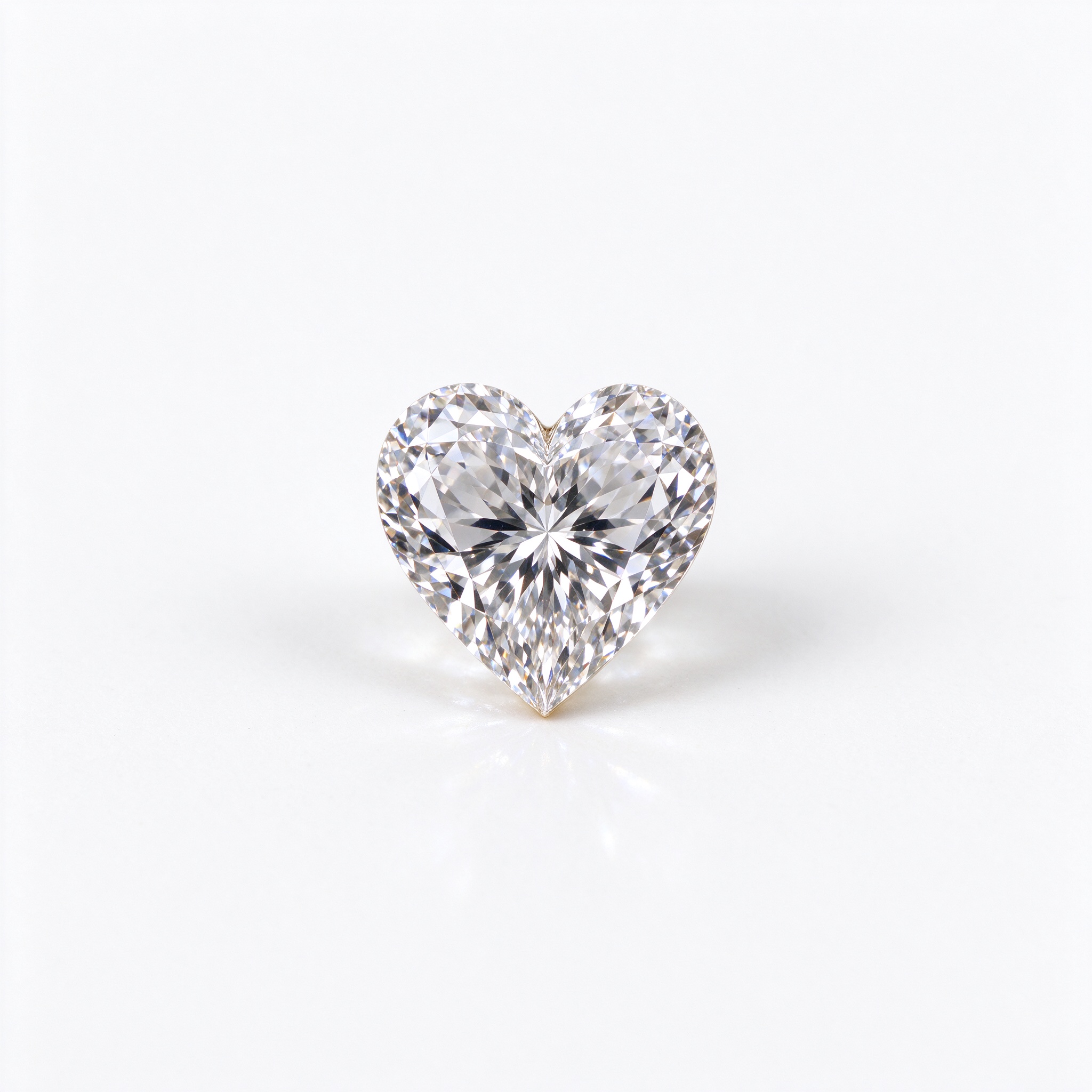
The heart cut is the only shape where the customer's eye checks for symmetry before it checks for sparkle. A boutique in Porto once had a heart moissanite returned because the two sides did not match. The stone was certified, color-sorted and within trade symmetry norms, but the left lobe was 0.8 mm wider than the right. On a heart, that is the whole story.
Heart moissanite demand concentrates in gifting (Valentine, anniversary, push presents) and in self-purchase studs. This guide covers the symmetry tolerance that makes or sells a heart, and the matching-pair workflow for stud inventory.
What makes a heart cut good at a glance
A heart moissanite has three visible features, and all three must read balanced. The two lobes must be of equal height and width; a difference over 0.5 mm on a 6 mm stone is noticeable. The central cleft, the notch at the top, must sit on the vertical centre line: too shallow and the stone reads round, too deep and it reads like a spade. The pointed tip at the bottom must align on the same vertical centre line as the cleft.
Wholesale tolerance we hold: lobe difference under 3% of total width, cleft on centre within 1% of width, tip on centre within 1%. These are tighter than generic trade grading, because the heart buyer's eye is specifically trained by social media to look at symmetry.
Because moissanite is doubly refractive (RI 2.65–2.69 per the reference data), facet edges show doubled when magnified. In a heart cut this tends to soften lobe edges under magnification, which works in the buyer's favour: minor symmetry differences disappear in normal viewing, while major ones remain obvious.
Length-to-width ratio for hearts
The heart is roughly a square shape with a cleft at the top. The sweet spot is a length-to-width ratio of 0.95–1.05, which reads as a balanced heart close to square. Below 0.90 the stone reads wide and flat, close to a spade; above 1.10 it reads tall and narrow, close to a teardrop. Size brackets: the 5–6 mm heart (about 0.5–0.7ct) sells as pendants and studs; the 7–8 mm heart (about 1.0–1.2ct) sells as engagement and statement pendants. Heart engagement demand is real but seasonal; plan stock around Q1 and Q4 gifting peaks.
Matching pairs for studs
Most heart moissanite moves through stud earrings. A matched pair must agree on four measures. Width must be within 0.15 mm. Color must be the same D–F grade. The symmetry direction should be mirror-image, not identical. Cleft depth must be within 0.2 mm.
Note the mirror-image point: a left-lobe-heavy heart and a right-lobe-heavy heart are not defective; they mirror each other in a pair. Pairing identical stones in studs can actually look off. Ask the supplier to label stones as L or R orientation before packing. This is the detail most boutique buyers miss in their first heart stud order.
Gifting season and setting pairing
Heart demand spikes around Valentine's Day, graduation and December. Stock timing matters: a heart parcel that arrives in mid-January sells through February; one that arrives in March sits until Q4. Plan purchase orders accordingly.
Settings: hearts pair well with yellow gold and rose gold, which soften the shape's already romantic character. Bezel settings protect the cleft and tip; pavé halos around a heart read busy and usually reduce demand. Pendants are the fastest channel for heart stock; rings are slower but carry higher per-unit margin. Cross-sell with pear shapes for customers who want an elongated romantic silhouette, and with oval face-up size for the larger-budget self-purchase buyer. For EU-facing accounts, remember that skin-contact jewellery is regulated under the REACH nickel restriction; pairing moissanite hearts with compliant 925 sterling or gold mounts keeps you aligned with EU REACH nickel limits, which staff should mention when selling to European gift buyers.
Frequently Asked Questions
What symmetry tolerance makes a good heart cut?
Lobe difference under 3% of width, cleft and tip on the centre line within 1%. Looser tolerances are noticeable to buyers and drive returns.
Can heart moissanite be sold as engagement rings?
Yes, but demand is narrower and seasonal. Most heart volume is pendants and studs; stock rings as a high-margin niche line.
How do I match heart studs?
Pair by width (within 0.15 mm), color grade and mirror-image orientation. Identical-stone pairs can look lopsided; ask the supplier to label stones L or R.
What size heart moissanite sells fastest?
The 5–6 mm bracket sells through studs and pendants fastest; the 7–8 mm bracket is the engagement and statement-pendant size.
When should I order heart stock?
Plan parcels to arrive 4–6 weeks before Valentine's Day and before Q4. Heart stock ordered outside gifting season ties up cash.
Request a heart sample: 4 stones (two matched pairs in 5 and 6 mm), symmetry-tested, GRA-certified. Open wholesale terms for seasonal gifting pricing, or read the marquise ratio guide to extend your romantic-shape range.