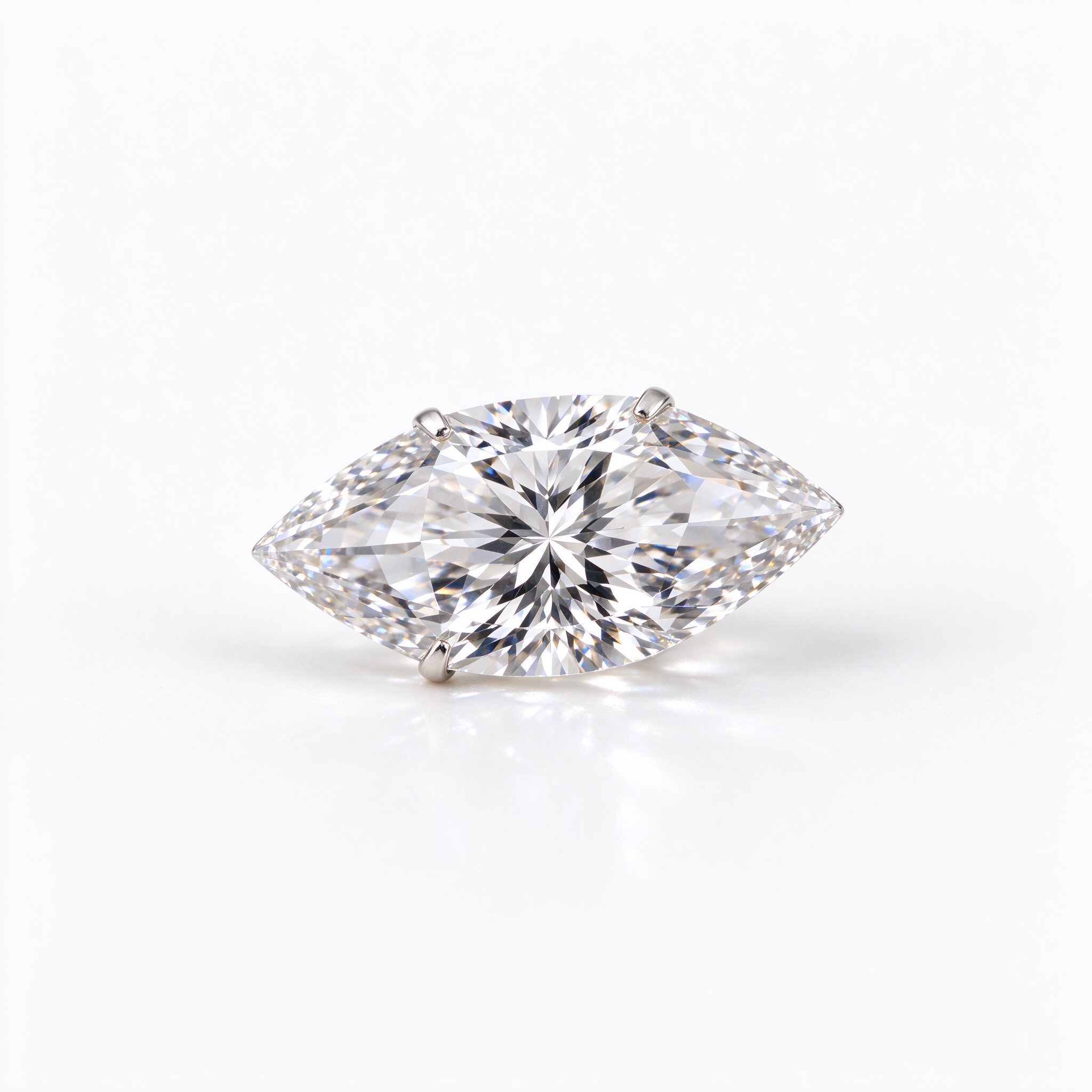
The marquise is one of the most dramatic solitaires on the market, and it is also the hardest ring to pair with a wedding band. A straight band slid next to a marquise solitaire leaves a visible gap at both pointed tips. Clients notice immediately, and that gap is the reason many marquise bridal sets go back to the bench. Wholesale buyers building marquise sets need to think about the band before they sell the solitaire.
Why the Marquise Leaves a Gap
A marquise is a long, narrow, pointed-oval shape. Its tips sit far out along the finger, and the head holding it lifts the stone above the band. A straight wedding band runs across the finger at a constant height; where the marquise tip overhangs, there is empty space between the band and the ring shank. The gap is not a flaw in either piece - it is geometry. It becomes a flaw only when the set was sold as if it would sit flush.
The Curved (Contour) Band Solution
The standard fix is a curved or contour wedding band: a band with a small arc cut into one edge to hug the solitaire's profile. For a marquise, the curve needs to accommodate both the tip overhang and the stone's lift. A well-made contour band sits flush against the solitaire shank with no visible gap.
Wholesale buyers should stock marquise-compatible contour bands, not generic curved bands. A band cut for an oval solitaire does not fit a marquise's pointed tips. The curve profile has to match the marquise head.
Pairing Two Cuts in One Set
Mixed-cut bridal sets - a marquise engagement ring paired with a band that uses a different cut - are a growing segment. The combinations that work:
- Marquise + pavé round band - small round brilliants on the contour band add sparkle without competing with the long solitaire. The round facets contrast cleanly with the marquise's pointed silhouette.
- Marquise + straight baguette band - baguettes on the band echo the marquise's elongated lines; a modern, architectural set.
- Marquise + contour band with small marquise accents - tiny marquise-shaped stones on the band repeat the main cut for a coordinated look.
The key is contrast in shape but coordination in scale. A band loaded with large stones fights the marquise; a band with small, evenly spaced accents complements it.
What to Avoid
- A straight, non-contour band sold as a marquise set - the gap is the complaint.
- A band with its own large center stone - it competes with the solitaire and looks crowded.
- Mixed metals without telling the client - yellow gold marquise with a white band reads mismatched unless it is deliberate.
- Overly tight stacking - the band needs room to slide next to a tall marquise head; a band that forces contact risks chipping the tip.
Tip Protection in a Set
The marquise's pointed tips are vulnerable, just as the princess's corners are. In a bridal set, the tips are also the point closest to the wedding band. A contour band that presses against the tip can chip it over time. The band should sit against the shank, not the stone. When buying sets, check that the band clears the tip by a small margin rather than touching it. This is a bench detail that prevents returns years later.
Pricing the Set
A marquise solitaire plus a custom contour band costs more than a solitaire plus a straight band, because the band is shaped rather than stocked straight. Wholesale buyers should price the set accordingly and explain to clients why. The curved band is not an upsell; it is the part that makes the set actually fit. Clients who understand the geometry accept the price.
Sizing a Marquise Set
Sizing a marquise solitaire changes the head geometry. When the shank is sized down, the shoulders tighten and the head can tilt, pulling one tip closer to the band. A set that sat flush at the original size can develop a gap after a resize. Bench jewelers should size marquise sets by adjusting the shank rather than squeezing the head, and re-check the band clearance after sizing. For wholesale buyers, this means selling marquise sets with a note that post-purchase sizing may require a quick band adjustment - a small service call that prevents the client from seeing a gap appear months later.
Because the band is custom-shaped to the head, a set that is resized should be brought back to the same bench; a generic resize job can ruin the contour fit. This is a selling point for boutiques that offer lifetime sizing on their own sets, and a reason to price the set as a fitted piece rather than two loose components.
What to Ask the Supplier
When sourcing marquise bridal sets, ask the supplier: whether the contour band is profiled specifically for marquise heads, whether the band clears the stone tips, and what combinations of accent cuts they stock for mixed sets. A supplier experienced in bridal sets will have marquise-profiled bands ready. For buyers building moissanite rings set programs, the marquise is the cut where the band design has to be planned first.
The marquise solitaire sells itself. The band is what makes the set wearable. Build the pair together, and the set stops coming back.