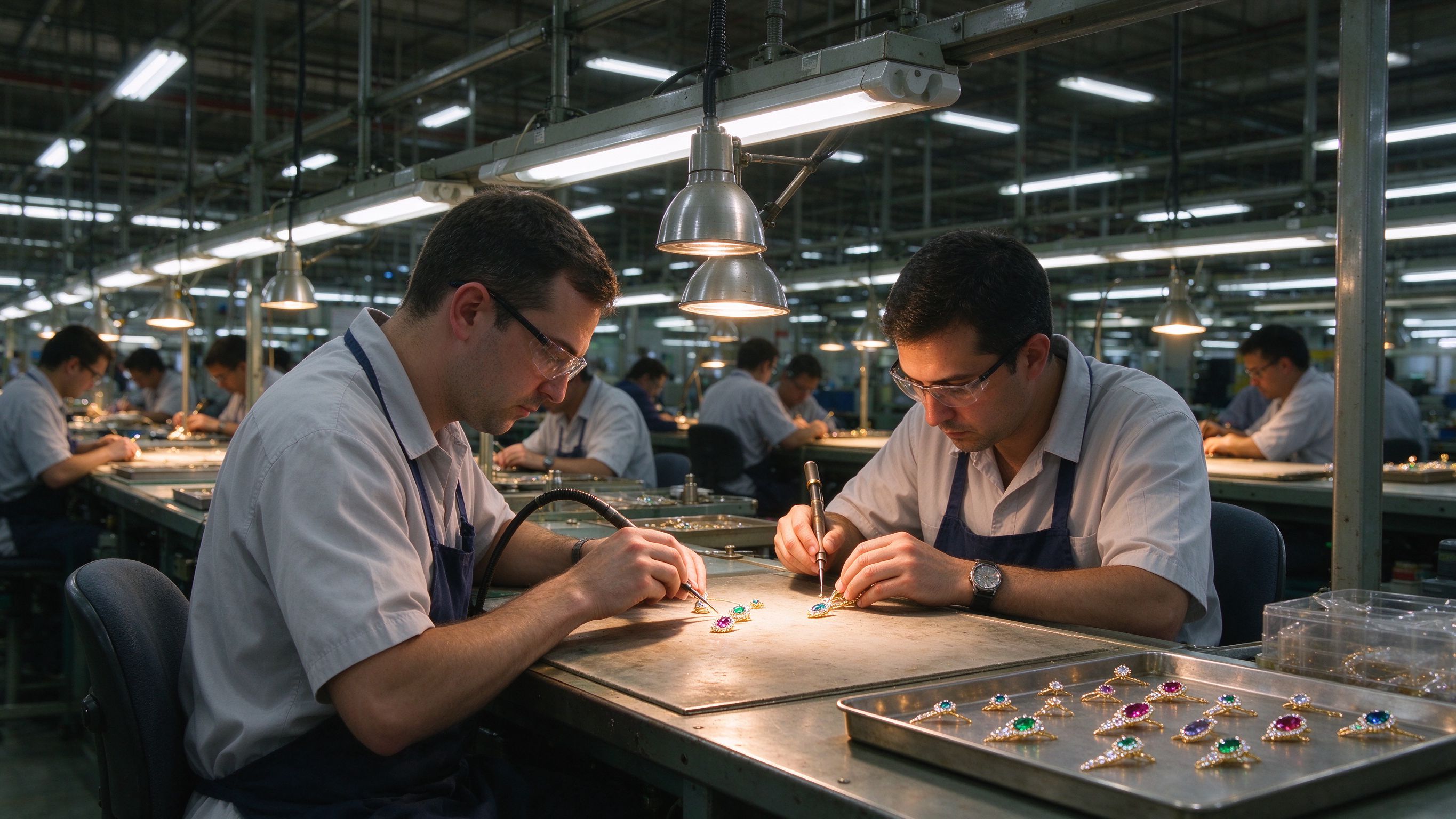
Why Trade Shows Still Matter in the Digital Age
In an era of email, Zoom, and Alibaba, some people question whether trade shows are worth the cost. They are. Jewelry is a tactile product. Buyers need to see the stones in person, compare cuts side by side, and feel the weight of the piece. A website cannot replace that.
Trade shows also compress months of sales work into three days. You meet hundreds of qualified buyers who are already in buying mode. The cost per lead is lower than digital channels for high-ticket B2B.
Which Shows Should You Exhibit At?
For a moissanite wholesaler, the priority shows are:
- Hong Kong Jewellery and Gem Fair (June and September): The best show for Asian and international buyers. Large attendance, good buyer quality.
- JCK Las Vegas (June): The main US show. Bring your best D-color VVS stones. US buyers expect quality.
- Canton Fair (April and October): Budget option. Broad buyer base but lower gem-specific attendance.
- Local or regional shows: If you target a specific country, find the local jewelry show. These are cheaper and more focused.
What Samples to Bring
You cannot bring your entire inventory. Bring a curated selection:
- Your best-selling shapes: round 6.5mm, oval 7x9mm, cushion 7x8mm.
- One of each fancy shape so buyers can see your range.
- A comparison set: D-color vs E-F color, VVS1 vs VVS2, ideal cut vs standard cut.
- Finished jewelry samples (rings, pendants) so buyers can see the stones set.
- Certificates and a loupe so buyers can inspect.
Bring a locked display case. Do not leave stones unattended. Bring twice as many as you think you need; samples walk away or get damaged.
Booth Design That Converts
You do not need a fancy booth. A clean white table, good lighting, and clear signage are enough. Key elements:
- A backdrop banner with your company name, website, and key message (e.g., "Wuzhou Moissanite Factory Direct").
- Bright, color-accurate lighting. Natural daylight bulbs (5500K) show stone color accurately.
- A loupe and a white display pad so buyers can inspect stones.
- Business cards and a one-page catalog.
- A tablet playing a video of your factory cutting process.
Following Up After the Show
The show itself is only half the work. The money is in the follow-up. Within 48 hours of the show ending, send a personalized email to every lead you collected. Reference your conversation, attach the price list, and offer a sample discount.
Most leads will not order immediately. They need time to evaluate. Follow up again after 7 days, then after 21 days. Track which leads convert and which shows produce the best ROI. Double down on shows that deliver.
Trade Show Budget Breakdown
Before you book a booth, understand the full cost. Here is a realistic budget for a mid-sized international show:
- Booth space (9 sqm standard): $3,500 to $6,000
- Booth construction and graphics: $2,000 to $4,000
- Flights (two people from China): $1,500 to $3,000
- Hotel (4 nights): $800 to $1,500
- Food and local transport: $500 to $1,000
- Samples and marketing materials: $500 to $1,000
- Booth staff time: internal cost
Total: $8,800 to $16,500.
At this cost, you need to generate enough leads to justify the spend. If you collect 50 leads at a show, your cost per lead is $176 to $330. If 5 leads convert to first orders averaging $1,500, you have $7,500 in revenue. That does not cover the show cost. But if those 5 customers reorder for the next 12 months, the LTV makes the show profitable.
Booth Staff: Who Should Go
The people in your booth are your sales team. They must know your products, your pricing, and your production capacity. Do not send junior staff who cannot answer questions.
- Send one senior salesperson who can quote and close on the spot.
- Send one technical person who can answer cut quality and certification questions.
- Dress professionally but not stiffly. Business casual is fine for jewelry shows.
- Stand, do not sit. Greet every person who walks past your booth.
- Ask qualifying questions: "What shapes do you currently stock?" "What is your typical order size?"
Post-Show CRM Follow-Up Sequence
The show is over. Now the real work begins. Here is a 21-day follow-up sequence:
- Day 1: Send a thank-you email to every lead. Reference your conversation. Attach your price list.
- Day 3: Follow up with a photo of the stones you discussed. Ask if they want a sample pack.
- Day 7: Send a short case study: "One of our customers started with a $500 sample order and now orders $3,000 per quarter."
- Day 14: Check in: "Have you had a chance to review our price list? Any questions I can answer?"
- Day 21: Final follow-up: "I'll close the file on your lead. If you need moissanite in the future, we are here." This often gets a response.
Track which shows produce the best leads. If Hong Kong generates 10 converting customers and Canton Fair generates 1, reallocate your budget. Shows are expensive; invest where the ROI is.
Frequently Asked Questions: Trade Shows
Q: Which show should a first-time exhibitor choose? A: Start with Hong Kong Jewellery Show. It is accessible from China, attracts international buyers, and is more affordable than JCK Las Vegas.
Q: How many samples should I bring? A: 30 to 50 pieces covering your best-selling shapes and sizes. Bring one finished ring in each style. Do not bring your entire inventory.
Q: How do I get leads to remember me? A: Give them something useful: a one-page cut guide, a stone selector card, or a small sample stone. People keep useful items and remember who gave it.
Q: What if I cannot afford a booth? A: Start by attending as a visitor. Walk the show, meet buyers informally, and learn the market. Many successful exhibitors started as visitors first.
Q: How do I follow up after the show? A: Email within 48 hours. Reference your conversation. Attach your price list. Follow up again at day 7 and day 21. Most orders come from the second or third touch.
Your First Trade Show: A Week-by-Week Prep Plan
If you are exhibiting for the first time, here is a 4-week preparation plan:
- 4 weeks out: Book your booth and flights. Order your booth graphics. Start selecting samples.
- 3 weeks out: Print business cards, one-page catalogs, and price sheets. Pack samples in a hard case. Confirm hotel.
- 2 weeks out: Email your existing customers and prospects. Invite them to visit your booth. Schedule meetings in advance.
- 1 week out: Do a dry run of your pitch. Practice answering common questions. Pack chargers, adapters, a notebook, and extra business cards.
- Show week: Arrive a day early. Set up the booth. Test your lighting and displays. Rest the team before the show opens.
During the show, track every lead. Write a note on the back of each business card: what they wanted, what price they discussed, when to follow up. At the end of each day, enter leads into your CRM. Do not wait until the show is over; you will forget details.
The most successful exhibitors treat the show as a sales marathon, not a vacation. They stand the whole day, greet every visitor, and work the aisles. They do not sit behind the table scrolling on their phone. Your energy attracts buyers. If you look bored, buyers will walk past.
Real Show ROI: Hong Kong June 2025
Here is the actual return on investment from a Hong Kong Jewellery Show we attended in June 2025. The numbers are from our own books.
- Booth cost (9 sqm): $4,200
- Booth build and graphics: $2,800
- Flights for two people: $1,800
- Hotel (5 nights): $1,100
- Food and transport: $600
- Samples and printed materials: $500
Total cost: $11,000.
Leads collected over 4 days: 87 business cards. Sample orders within 30 days: 14. First bulk orders within 60 days: 6. Average first order value: $1,450. Total first-order revenue: $8,700.
That alone does not cover the $11,000 booth cost. But here is the full picture: of those 6 first-order customers, 4 placed a second order within 6 months. Average second order: $2,200. Repeat revenue from those 4: $8,800. One customer orders $3,000 per quarter and has been with us for 18 months. That customer alone has generated $54,000 in revenue.
Total revenue from that show over 18 months: $8,700 + $8,800 + $54,000 = $71,500. Against a $11,000 investment, the ROI is 6.5x. This is why trade shows are worth it despite the upfront cost.
The key metric is not first-order revenue. It is lifetime value. One good trade show customer can cover the entire booth cost.
Key Takeaways
Trade shows are expensive but the ROI comes from long-term customer relationships, not immediate sales. Budget $8,000 to $16,000 per show. Bring 30 to 50 samples. Staff the booth with people who can quote and close. Stand up. Greet everyone.
The show itself is only half the work. The other half is follow-up. Within 48 hours, email every lead. Follow up again at day 7 and day 21. Most orders come from the second or third touch. Do not let business cards sit in a drawer.
Start with Hong Kong if you are new. It is accessible from China and attracts international buyers. Attend as a visitor first if you cannot afford a booth. Walk the floor, meet buyers informally, and learn what competitors are offering. When you are ready to exhibit, you will know exactly what your booth needs. Measure ROI by lifetime value of customers acquired, not by first-order revenue.
Trade show success is not about the fanciest booth. It is about showing up prepared, talking to every visitor, and following up relentlessly. The supplier who works the hardest at the show, not the one who spends the most on the booth, walks away with the best leads.
Before the show, prepare a simple one-page leave-behind: your company name, website, three product lines, and your best price point. Leave this with every lead. People remember the person who gave them something useful. A good leave-behind gets your booth on their desk long after the show ends.
One practical tip: keep a stack of our one-page leave-behinds in your bag at all times. You never know when you will meet a potential buyer at a dinner, a flight, or a coffee shop. Jewelry is a relationship business. Opportunities come from casual conversations, not just booth traffic. Be ready.
Book your booth now. The early bird gets the best location and the best rate. Waiting until the last minute costs you money and prime floor space.
See you at the show. Bring your best samples and your best pitch. We will be there too.
We look forward to seeing you there.
See you there.
Ready when you are.
See you in Hong Kong.