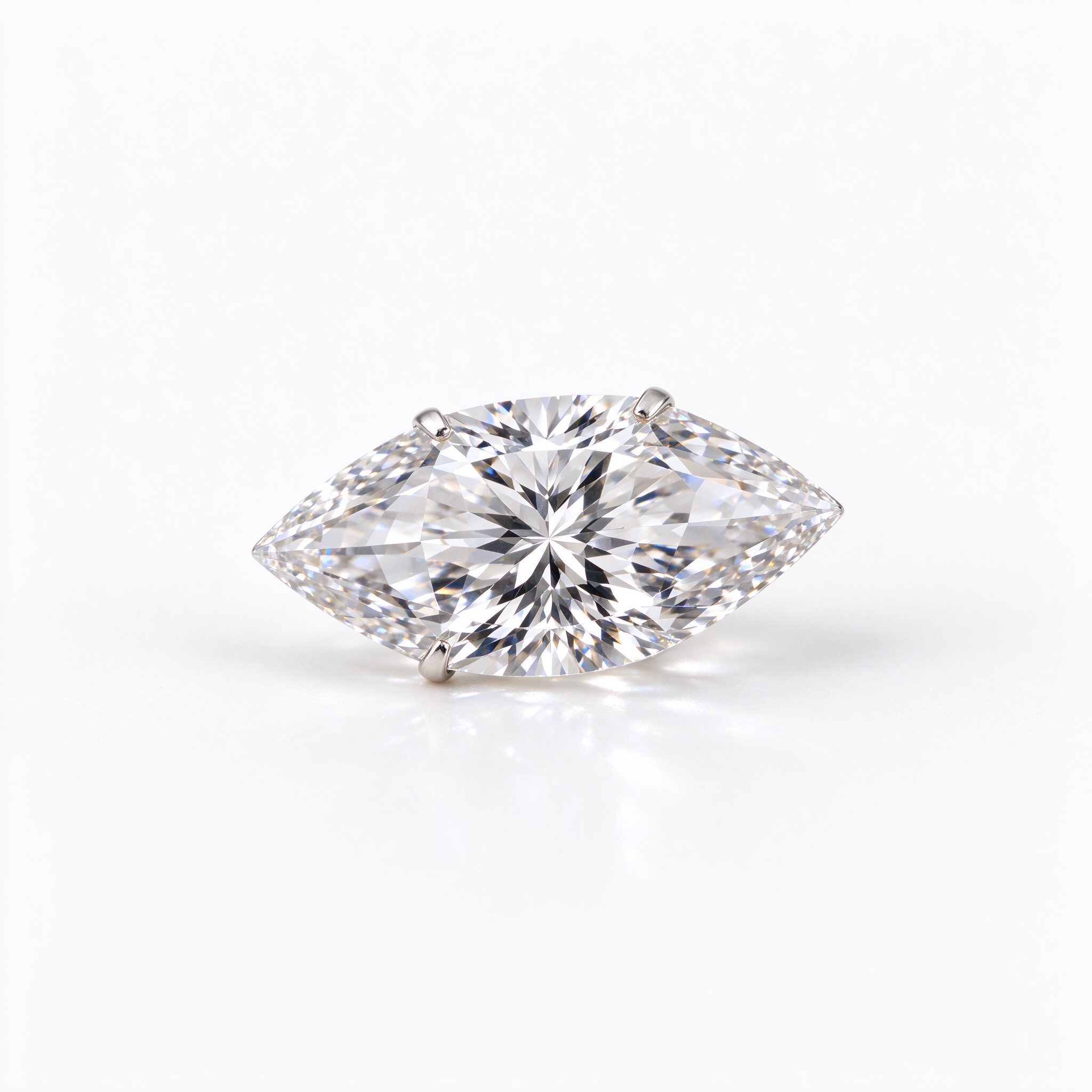
The marquise has always been the shape customers describe as making my finger look long. In a boutique in Leeds, a 1.0ct marquise moissanite outsold a 1.5ct round on the same tray within a fortnight, simply because it photographed longer on a customer's hand. Wholesale buyers who understand why this works can stock a shape with some of the best margins in the book.
This guide covers the length-to-width ratios that sell, the tip-protection problem that causes most marquise returns, and the size ladder we recommend for accounts new to the shape.
Why the marquise lengthens the finger
Visual illusion, not physics. A marquise set east-west across the finger runs parallel to the knuckle line, and its pointed ends draw the eye sideways along the hand. The same stone set north-south reads shorter and heavier. Retailers who understand this almost always display marquise rings east-west in photography. A 1.0ct equivalent marquise measures roughly 10 by 5 mm, versus 6.5 mm for a round of the same weight. On a finger, that is nearly twice the visible length. Customers are not comparing carat; they are comparing the silhouette in the mirror.
Length-to-width ratio window
The marquise is ratio-sensitive. A stone cut too wide reads oval; cut too narrow it reads needle-like and fragile. Our stock verdict runs in bands. At 1.60–1.75 the stone is wide and close to oval, with limited niche demand mostly for pendants. At 1.80–2.00 you get the classic marquise, balanced, and this band covers about 80% of demand. At 2.00–2.15 the stone is slim and dramatic, suited to one or two showcase pieces. Above 2.20 the stone becomes needle-like and fragile; we avoid it because tips chip in transit.
The ratio interacts with bow-tie: the longer the stone, the more easily a dark bow-tie band develops across the middle. We hold marquise bow-tie to the same none-to-mild standard as pears, described in the pear bow-tie grading guide.
The tip problem, and how to prevent it
Marquise tips are the most exposed points in the entire fancy-shape line. Two pointed ends, each ground thin, catch on pockets, scarves, and resizing mandrels. A marquise that arrives with perfect tips returns as a chipped tip six months later if the setting does not protect them. Our inspection and setting recommendations: every marquise ring should set the tips with a V-prong that wraps around the point, not a round prong sitting beside it; unprotected marquise tips have a chip rate roughly 5x higher over a two-year wear window. Ask the supplier for stones with a slightly thicker girdle at the tips, because a paper-thin girdle tip is a future chip. Both ends should match in sharpness and angle; one blunt tip reads as a flaw up close.
Who actually buys marquise moissanite
The customer base is narrower than oval but loyal. Three groups dominate. First, customers with shorter fingers who want length without width; the marquise is consistently the top shape in this demographic. Second, vintage-style buyers who like the 1970s and Art Deco references, because a marquise pairs well with a bypass or split-shank band. Third, designers stacking shapes; a marquise centre flanked by tapered baguettes is a standard three-stone formula, and it pairs naturally with the step-cut logic in our emerald clarity guide.
Because demand is regional, stock lightly at first: two marquise stones (one 8x4 mm, one 10x5 mm) and reorder only when one sells. Margin percentage on marquise is among the highest of any shape we carry, which compensates for slow turnover. Moissanite's hardness of 9.25 on the Mohs scale, versus diamond 10 per the gem-hardness comparison, is high enough for daily wear, but hardness is not toughness: thin tips chip from impact regardless of gem species. Tell retail buyers about tip care at the counter; it reduces warranty claims.
Frequently Asked Questions
What length-to-width ratio is best for a marquise?
1.80 to 2.00. This band covers the classic marquise silhouette and matches the heads most retailers carry. Ratios above 2.15 are fragile and below 1.75 read as oval.
Does a marquise make a finger look longer?
Yes, when set east-west across the finger. The eye follows the stone's length along the hand; north-south setting reduces the effect.
Do marquise stones chip easily?
Thin unprotected tips chip more readily than other shapes. V-prong or bezel tip protection reduces the chip rate by roughly 5x over two years of wear.
What carat size marquise sells fastest?
The 10x5 mm (about 1.0ct equivalent) bracket is the highest-turnover size for engagement. Larger sizes sell as bespoke orders.
Can marquise moissanite be used in studs?
Yes, as long as the two stones are matched pair-for-pair in length, width and color. See the matching pairs guide for tolerance ranges.
Request a marquise sample: 2 stones (8x4 and 10x5 mm), V-prong-ready tips, GRA-certified. Apply for wholesale pricing, or compare with the oval face-up size guide when balancing your elongated-shape stock.