Why a side-by-side beats a catalog
Line sheets organize stones by price and carat. They do not tell you which cut sells to which customer, which one your bench charges more to set, or which one comes back for prong repair by month six. This comparison is built for the buying desk, not the website. Read it against your own sales receipts over the last year and you will see where your inventory is quietly mis-weighted.
Brilliant family: round, oval, cushion, radiant, princess, pear, marquise
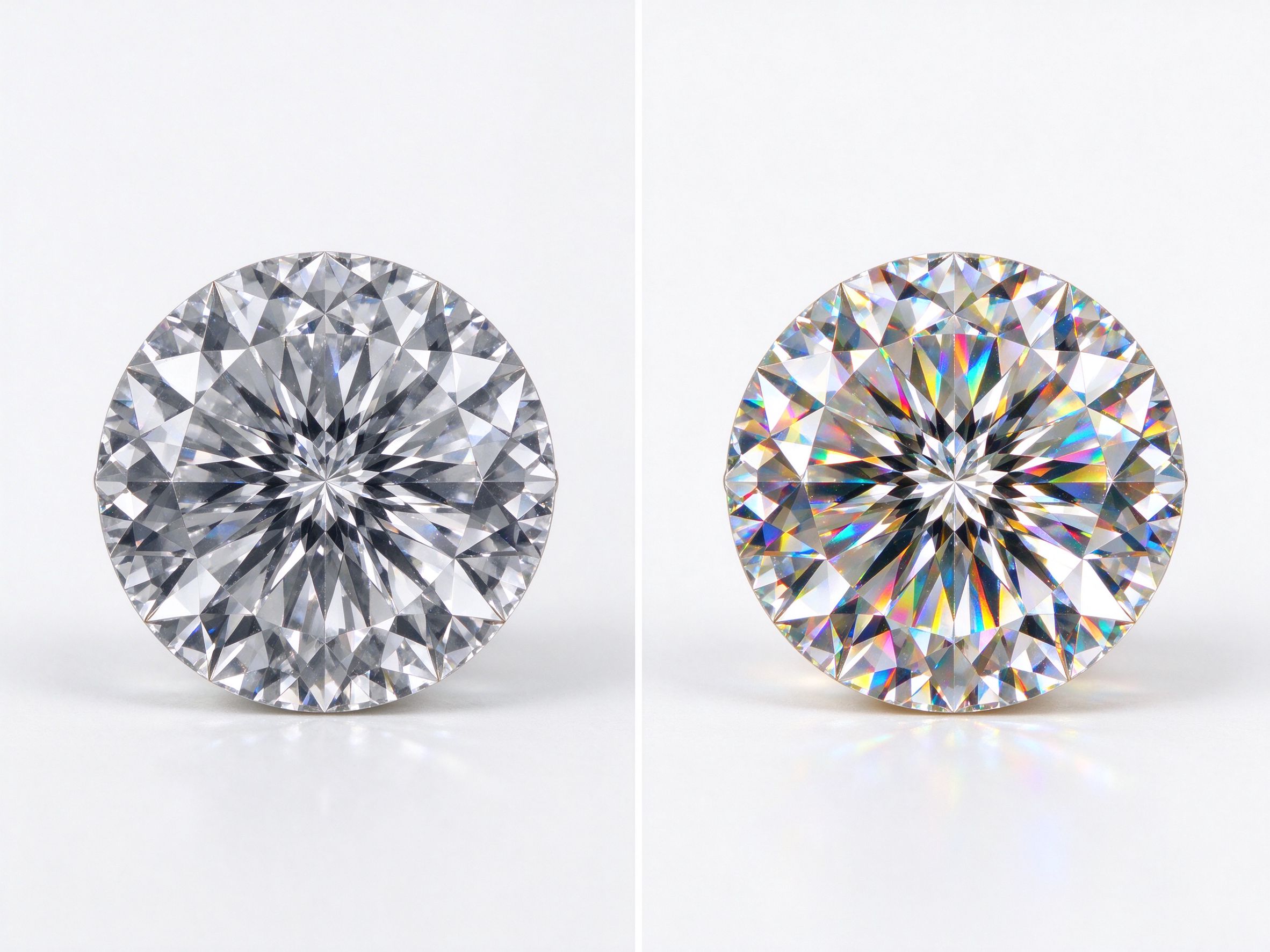
These cuts break light into small, bright flashes. They hide the minor inclusions that natural-diamond graders would dock, and they read as "sparkly" under almost any lighting. The round brilliant is the safest bet and the slowest to leave the drawer during a slow month. The oval stretches that sparkle into a longer face-up shape, which is why it has been the fastest-growing fancy cut for three years running. The cushion trades some sharpness for a softer, warmer look; customers who wear yellow gold tend to prefer it. The radiant splits the difference between step and brilliant — a rectangular shape with brilliant facet behavior — which makes it the default answer when a customer likes the emerald outline but is nervous about visible inclusions. The princess is the high-velocity square, priced below the round and popular with younger bridal buyers. Pears and marquises are fashion cuts: high demand in spring proposal season, slower the rest of the year.
Step-cut family: emerald and asscher
This is where the emerald cut earns its comparison row. Step cuts do not flash; they reflect broad, mirror-like bands of light across a flat table. The effect is architectural, quiet, and very on-trend with the minimalist bridal look. The tradeoff is transparency: step cuts show inclusions and color far more readily than brilliants, so the color grade you buy matters more here than anywhere else on the sheet. Emeralds also have open corners that chip if bumped, which is why they almost always ship in a bezel, halo, or four-corner-prong setting.
The asscher cut is a square emerald with a stepped corner cut and a distinctive central window. It skews vintage — Art Deco, Great Gatsby, estate-jewelry aesthetic. Its buyer is older, more design-aware, and willing to wait for the right stone rather than grab an in-stock SKU. Stock one or two asschers at most; they move on narrative, not volume.
Operational comparison at a glance
- Face-up size per carat: oval, pear, and marquise lead; princess and radiant are mid; round and asscher run smaller for the same weight.
- Price per carat equivalent: round sits at the top of the volume market; fancy shapes are usually 10 to 25 percent cheaper for the same apparent size; asscher and heart often carry a small premium for rarity.
- Setting cost: step cuts and pointed shapes cost the bench more — reinforced tips, bezels, corner guards. Factor 15 to 20 percent into your assembly estimate.
- Return rate: brilliants return least, because customers know what they are getting. Step cuts return most when the customer expected "diamond sparkle" and got glassy reflections.
- Who buys it: round = everyone; oval = bridal 25-35; cushion = yellow-gold lovers; emerald = minimalist/designer buyers; princess = budget bridal; asscher = vintage collectors; pear = fashion-forward; heart = gifting.
Reading the supplier's cut grade before you reorder
Line sheets list cut grade as "excellent," "very good," or a local equivalent. For moissanite, that label is less predictive of appearance than it is for natural diamond, because moissanite is produced to a tighter spec than most mined stones. The numbers that matter more are the actual mm dimensions and the table percentage. On an emerald cut, a table between 60 and 70 percent reads clean; a table over 75 percent starts to show a dark center that customers describe as "dead." Ask for a face-up photo of the exact stone, not a catalog image, before approving a step-cut reorder. A picture costs the supplier thirty seconds and saves you a return.
How to use this on your next order
Take your last six months of loose-stone sales and bucket each sold stone into a family. If brilliants are 80 percent of revenue but 50 percent of your drawer, you are overstocking slow step cuts. If emerald and asscher together have not sold a single stone but take up three slots in your tray, swap one out for another oval. The point is not to eliminate the long tail — it is to keep the long tail small enough that it does not tie up cash you need to reorder rounds. Review this comparison quarterly, not once a year, because the fashion tail moves faster than most buyers assume. For more on how these cuts stack up against the real thing, see moissanite vs diamond.