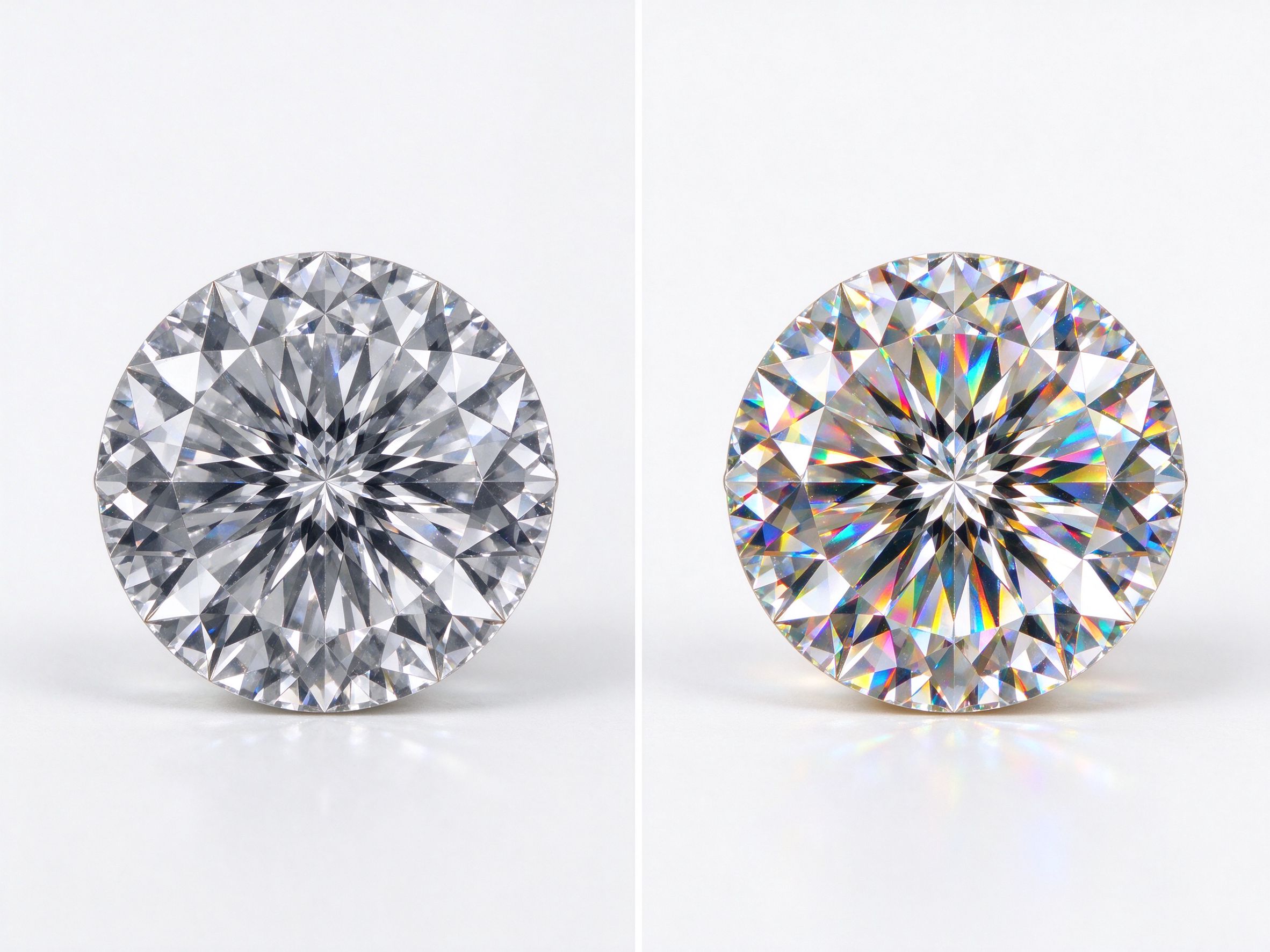
The Three Stone Categories Every Jewelry Buyer Chooses Between
If you run a jewelry store, an ecommerce brand, or a wholesale manufacturing business, you are constantly choosing between three loose stone categories: natural diamonds, lab-grown diamonds, and simulants. Within simulants, the two dominant options are cubic zirconia (CZ) and moissanite. Each has a different cost structure, customer expectation, and margin profile.
This article is not about which stone is "better." It is about which stone makes more sense for your business model. We will compare wholesale cost, retail pricing, customer perception, durability, and operational considerations for each category.
Wholesale Cost Comparison
Let us start with the numbers. Below are approximate wholesale prices for a 6.5mm round equivalent to one carat, sourced at 50-piece quantity in 2026.
| Stone Type | Wholesale Cost (6.5mm) | Typical Retail Price | Markup Multiple |
|---|---|---|---|
| Natural Diamond (1ct VS H) | $2,800 - $4,500 | $6,000 - $10,000 | 2.0x - 2.5x |
| Lab-Grown Diamond (1ct VS F) | $300 - $600 | $800 - $1,800 | 2.5x - 3.0x |
| Moissanite (6.5mm D VVS) | $25 - $45 | $200 - $400 | 6x - 10x |
| CZ (6.5mm AAAAA) | $2 - $6 | $15 - $40 | 5x - 8x |
These are approximate ranges. Actual pricing depends on quantity, cut quality, and supplier. But the structural difference is clear: moissanite offers a much higher markup multiple than diamonds while requiring a much lower inventory investment.
Customer Demand and Market Position
Natural diamonds still dominate the engagement ring market in the minds of traditional buyers. However, that market is shrinking as younger buyers reject the emotional and cost baggage of mined diamonds. Lab-grown diamonds have captured a significant share of the engagement ring market, particularly among buyers who want a "real diamond" at a lower price.
Moissanite occupies a different position. It is not sold as a diamond substitute. It is sold as an alternative gemstone with its own identity. Customers who buy moissanite are choosing it for its fire, its ethical story, and its price. They are not disappointed that it is not a diamond. They are delighted that it is more brilliant than a diamond at a fraction of the cost.
CZ, by contrast, has a perception problem. Most consumers think of CZ as a cheap throwaway stone. It is associated with costume jewelry and fast fashion. This limits the price customers are willing to pay and makes repeat purchases unlikely.
Durability and Wear Performance
For jewelry that is worn daily, durability matters. A stone that chips or scratches easily will generate returns and damage your reputation.
- Diamond: 10 on the Mohs scale. The hardest known natural material. Virtually scratch-proof.
- Moissanite: 9.25 on the Mohs scale. Second only to diamond in hardness. Resists scratching from everyday wear. Can be scratched only by diamond or harder materials.
- CZ: 8 to 8.5 on the Mohs scale. Noticeably softer. Develops scratches and becomes cloudy after 1 to 2 years of daily wear.
For engagement rings, wedding rings, and everyday jewelry, moissanite is a serious product. For fashion jewelry that is worn occasionally and replaced, CZ is acceptable. The durability difference is the main reason moissanite commands a price premium over CZ.
Fire and Brilliance: The Moissanite Advantage
Moissanite actually outperforms diamond in one measurable category: fire, which is the dispersion of white light into spectral colors. Moissanite has a refractive index of 2.65 to 2.69, compared to diamond at 2.42. This means moissanite returns more colored light to the viewer. In bright lighting, a well-cut moissanite flashes with rainbow colors more dramatically than a diamond.
This is not a marketing claim. It is a measurable optical property. When customers compare moissanite and diamond side by side under direct light, the moissanite often appears more colorful and lively. This is the core selling point that drives moissanite repeat purchases.
CZ has a refractive index of about 2.15, which is lower than both moissanite and diamond. It looks bright but lacks the colored fire that makes moissanite distinctive.
Inventory Risk and Cash Flow
One of the most important but least discussed factors is inventory risk. Natural diamonds are expensive. A 50-stone order of one-carat diamonds ties up $150,000 to $225,000 in inventory. If market prices drop or demand shifts, you are stuck with a massive write-down.
Moissanite inventory, by contrast, costs $1,250 to $2,250 for 50 stones at the same size. You can stock multiple shapes and sizes without tying up significant capital. If a shape does not sell, you have not lost much. If a shape sells well, you can reorder quickly because moissanite production lead times are short (typically 7 to 15 days).
This cash flow advantage is why moissanite has become the default choice for startup jewelry brands and independent designers. You can launch a full collection with under $5,000 in inventory.
Returns, Warranties, and Customer Expectations
Returns are the silent killer of jewelry margins. Let us compare return drivers by stone type:
- Diamonds: Returns are rare but expensive. Customers return because the stone does not match expectations or because they change their mind. A diamond return means a full refund of thousands of dollars.
- Moissanite: Returns happen when customers expect a diamond and are surprised by the fire. This is almost always a marketing expectation issue, not a stone defect. Set clear expectations in your product descriptions and returns drop dramatically.
- CZ: Returns are rare but repeat purchases are also rare because CZ jewelry is disposable. Customers buy a $20 ring, wear it for a season, and throw it away.
Moissanite also carries a warranty advantage. Reputable factories offer a limited warranty against cloudiness or discoloration. CZ sellers rarely offer warranties because the stones are expected to degrade.
Which Mix Is Right for Your Business?
There is no single correct answer. The right mix depends on your customer base and your brand position.
If you are a traditional jeweler serving engagement ring customers, keep a small selection of natural diamonds for traditionalists, add lab-grown diamonds for price-sensitive buyers, and introduce moissanite as a modern alternative. This three-tier approach covers every customer.
If you are an online DTC brand targeting millennial and Gen Z buyers, moissanite should be your primary stone category. The margins are attractive, the inventory risk is low, and the ethical story resonates with your audience.
If you are a fashion jewelry brand, CZ may still have a place for low-price, trend-driven pieces. But consider upgrading your premium line to moissanite. The price difference per stone is small, but the perceived quality difference is enormous.