Why a Sample Order Matters More Than You Think
A sample order is not a formality. It is the single most important step in validating a new moissanite supplier. Photos on a website or catalog can be misleading. A stone that looks brilliant in studio lighting may look dull under natural daylight. A GRA certificate that says VVS1 may hide a dark inclusion visible at 5x magnification. The only way to know what you are buying is to hold the stone in your hand.
For wholesale buyers, a sample order costs between $50 and $200 depending on stone size and quantity. Compare that to the cost of receiving 50 poorly cut stones you cannot sell. The sample is cheap insurance.
Step 1: Request the Right Samples
When you request samples, be specific. Do not ask for "your best stones." Tell the factory exactly what you intend to sell. If you plan to sell engagement rings, request 6.5mm round D-color, 8mm oval E-F color, and 7x9mm cushion. These are the sizes and shapes that will become your core inventory.
We recommend ordering 2 pieces of each shape and size. This lets you compare two stones from the same batch to see consistency. If both stones look identical, the factory has good quality control. If they look different, the factory's grading is inconsistent.
Step 2: Understand Sample Pricing
Most factories charge near-retail or wholesale-plus for samples. This is normal. They are not trying to make money on the sample; they are covering the cost of pulling a stone from stock, inspecting it, and shipping it internationally. Expect to pay 20 to 50 percent more per stone than the bulk wholesale price quoted.
Some factories will credit the sample cost against your first bulk order if you proceed. Ask about this upfront. At HOLYCOME, we credit 50 percent of the sample order value toward the first production order.
Step 3: Inspect the Stones When They Arrive
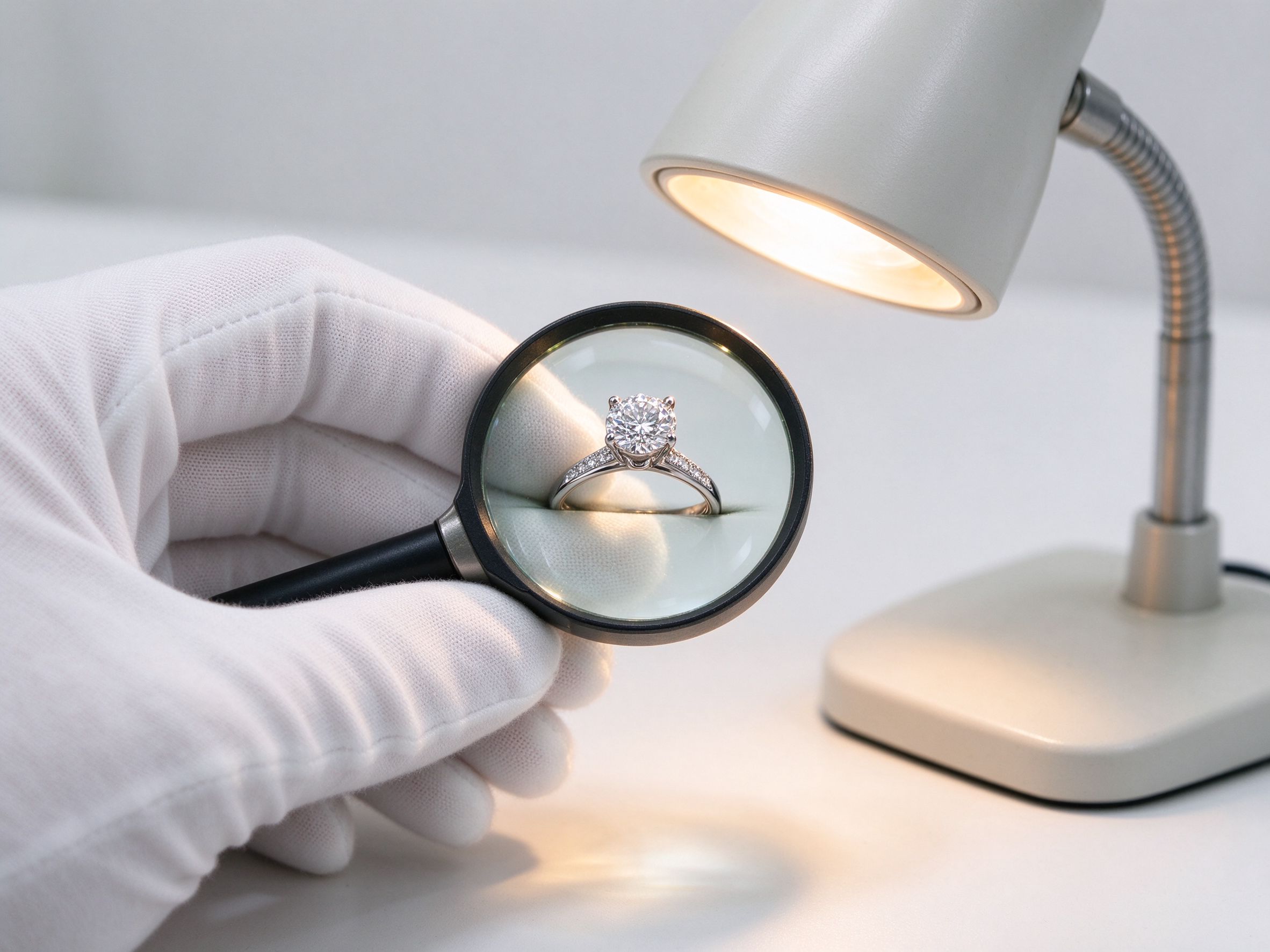
When your sample package arrives, set aside 30 minutes for a careful inspection. You will need a 10x loupe, a white sheet of paper, a pair of tweezers, and good daylight.
Visual Inspection Checklist
- Color tone: Place the stone on a white surface under daylight. Does it look white, or does it show yellow, gray, or brown tint? D-color should appear completely colorless. E-F should show only the slightest warmth, visible edge-on.
- Clarity: Use the loupe to scan the entire stone. Look for black spots, cloudiness, fractures, or growth lines. VVS stones should be almost loupe-clean.
- Cut symmetry: Look at the stone face-up. Are the facets aligned? Is the table centered? Does the outline look balanced? In oval and cushion, check whether the stone looks stretched or squat.
- Fire and brilliance: Tilt the stone under a bright light. Moissanite should show strong colored flashes (fire) and bright white reflections (brilliance). If the stone looks flat or glassy, the cut is poor.
- Bow-tie effect: In oval, pear, and marquise shapes, look for a dark bow-tie shadow across the center. A slight bow-tie is normal. A strong, obvious bow-tie is a defect that customers will complain about.
- Girdle and culet: Check the edge of the stone for rough or chipped girdle. Look at the bottom point (culet) for chips or fractures.
- Measurements: Use a digital caliper to measure diameter and depth. Compare to the GRA certificate. Discrepancies of more than 0.1mm suggest sloppy cutting.
Step 4: Photograph the Stones Honestly
Take photos under the same lighting you will use for your product photography. If you sell on Instagram, photograph the stone in natural window light. If you sell on a website with studio lighting, use your softbox. This tells you how the stone will look to your customers.
Do not rely on the factory's photos. They use the best lighting and the best stone. Your samples are the real representation of what you will receive in bulk.
Step 5: Compare to Your Benchmark Stone
Every jeweler should have a benchmark: a diamond, a CZ, or a known moissanite that you consider the gold standard. Place the sample next to your benchmark and compare side by side under the same light. How does the fire compare? How does the white brilliance compare? Is the color noticeably different?
This comparison removes subjective opinion. If the moissanite looks as good or better than your benchmark under your selling conditions, you have a winner.
Step 6: Use Samples to Negotiate Bulk Pricing
If the samples pass your inspection, you are ready to negotiate. Use the sample results as leverage. Say: "The stones look good. We would like to proceed with an order of 50 pieces. Can you improve the per-unit price if we increase to 100 pieces?" Factories are more flexible on price once they know you have physically inspected and approved the quality.
If the samples fail, be honest with the factory. Tell them exactly what you did not like. They may send a replacement batch for free or at a reduced cost. This also tells you how responsive the factory is to quality issues, which matters for future bulk orders.
Red Flags That Mean Walk Away
Some sample experiences reveal problems you should not ignore:
- The factory delays the sample shipment for weeks without explanation.
- The stones arrive with no GRA certificate or a certificate that does not match the stone.
- The stones have visible chips or cloudiness described as VVS.
- The factory refuses to answer questions about cut proportions.
- The sales representative disappears after you pay for the sample.
Any of these signs suggests operational problems that will only get worse at bulk order volume. There are plenty of reputable Wuzhou factories. Do not settle for one that treats samples as an afterthought.
Building a Sample Library
Over time, you should build a physical sample library of stones from different factories. This lets you compare new suppliers against your known benchmarks and train your staff on quality standards. Store samples in labeled plastic boxes with the factory name, date, and stone details. This library becomes your most valuable sourcing asset.