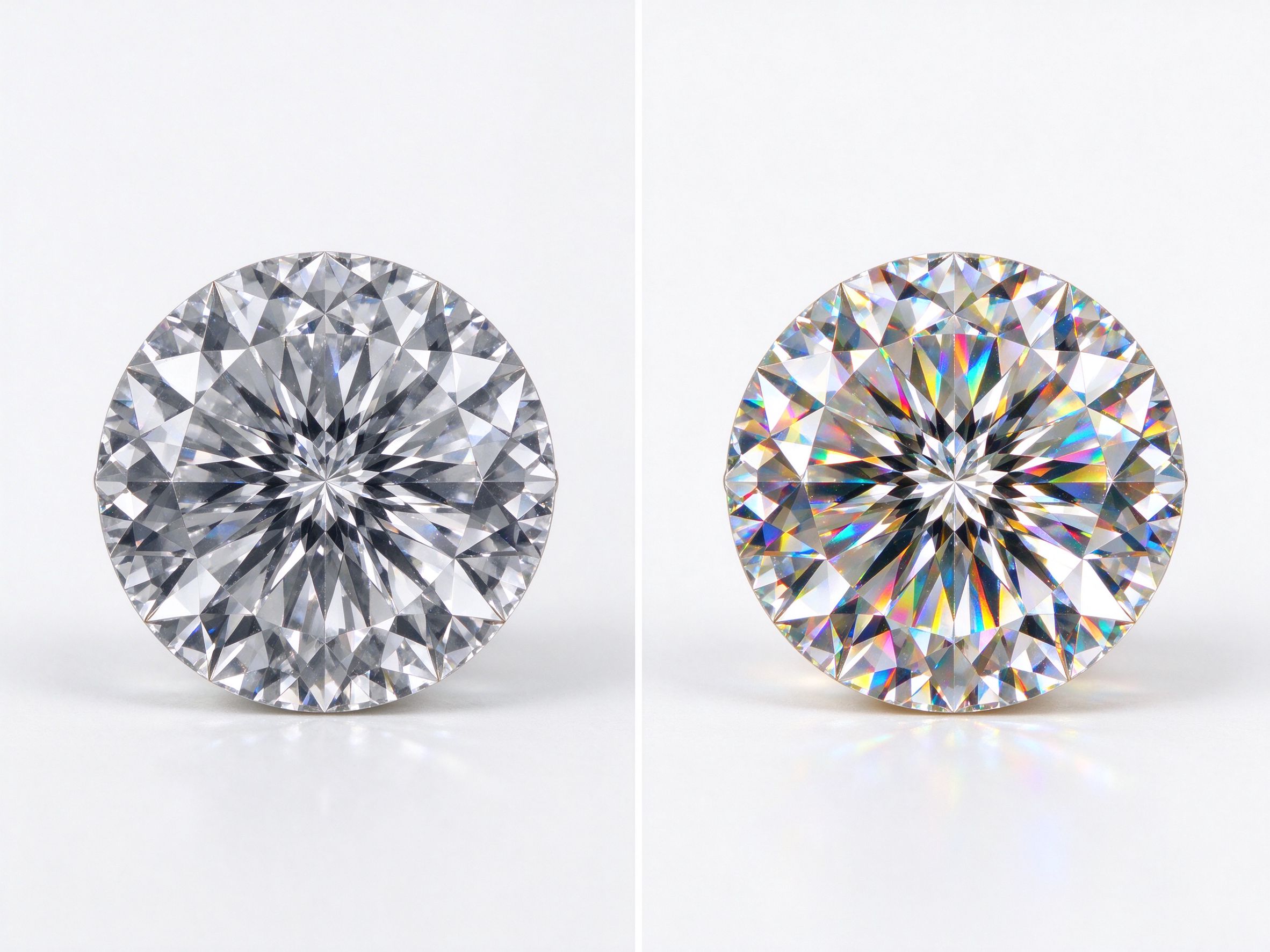
Fire and Brilliance: Two Different Things
People often use the words "fire" and "brilliance" interchangeably, but they describe two different optical effects. Brilliance is the white light that reflects back from the stone. Fire is the colored light (rainbow flashes) that appears when white light enters the stone and splits into spectral colors. A stone can be brilliant without having much fire, or fiery without being very bright.
Diamond is the benchmark for brilliance. Moissanite is the benchmark for fire. Understanding this distinction helps you explain your product to customers and set honest expectations.
Brilliance: How White Light Compares
Brilliance depends on the refractive index and the cut proportions. Diamond has a refractive index of 2.42, which produces a bright, silvery-white return of light. Moissanite has a higher refractive index of 2.65 to 2.69, which should theoretically produce even more brilliance.
In practice, well-cut moissanite does return more white light than a comparable diamond. However, moissanite's brilliance is often masked by its stronger fire. Because the colored light is so prominent, viewers notice the rainbow flashes more than the white brightness. This is why some people describe moissanite as "more colorful" and diamond as "more white."
Under diffuse lighting (such as an overcast day or indoor office light), diamond and moissanite look similar. Under direct light (sunlight, spotlight), moissanite visibly out-performs diamond in colored sparkle.
Fire: Moissanite's Signature Strength
Fire, technically called dispersion, is measured by how much the stone separates white light into its component colors. The numbers are striking:
- Moissanite dispersion: 0.104
- Diamond dispersion: 0.044
- CZ dispersion: 0.060
Moissanite's dispersion is 2.36 times that of diamond. This means when you tilt a moissanite under bright light, you see dramatically more rainbow flashes. The effect is often described as "disco ball" or "rainbow" by customers who first see it.
For some customers, this is the main selling point. They want a stone that sparkles colorfully. For others, the strong fire is a disadvantage because they prefer the subtle, white sparkle of a diamond. This is a matter of taste, not quality.
Scintillation and Light Performance
Scintillation is the pattern of light and dark areas that moves across the stone as you or the light source moves. It is what makes a stone look "alive" when worn.
Diamond produces a classic scintillation pattern: alternating bright and dark facets in a balanced, symmetrical pattern. This is what customers expect from a high-end solitaire.
Moissanite produces a more vivid scintillation with more colored flashes. The pattern is busier and more dynamic. Under a chandelier or in motion, moissanite appears to sparkle more actively than diamond.
For jewelry worn at parties, dinners, and events, this active sparkle is an advantage. For jewelry meant to look subtle and understated, diamond may be more appropriate.
How the Cut Changes the Comparison
These optical comparisons assume both stones are well-cut. A poorly cut diamond will look dull, and a poorly cut moissanite will look glassy. The cut matters more than the material.
At HOLYCOME, we cut our moissanite to proportions that maximize both brilliance and fire. Our round brilliants follow ideal angle guidelines. Our fancy shapes are cut to minimize bow-tie and maximize face-up appeal. The result is a stone that performs the way customers expect a premium gemstone to perform.
What Your Customers Will Notice
When customers compare your moissanite jewelry to diamond jewelry, here is what they typically observe:
- Side by side in bright light: Moissanite shows more rainbow color flashes. Diamond looks whiter and more restrained.
- Under store lighting: Both stones look excellent. Moissanite may appear slightly more colorful.
- On the hand at arm's length: Most people cannot tell the difference without magnification.
- Under a jeweler's loupe: Moissanite shows facet doubling (double refraction). Diamond does not. This is the gemologist's identification test.
Marketing Honestly: What to Say and What Not to Say
It is tempting to say "moissanite is better than diamond" in your marketing. This is not accurate and it attracts customers who then return disappointed. Here is a better framework:
- Say: "Moissanite delivers more fire and sparkle than diamond at a fraction of the price."
- Say: "Our moissanite is colorless and loupe-clean, with a brilliance that rivals diamonds many times its price."
- Do not say: "Moissanite is identical to diamond." It is not. It has a different optical personality.
- Do not say: "Moissanite is a diamond." It is a separate gemstone with its own identity.
Honest marketing builds trust. Customers who buy moissanite because they want the fire and value will be delighted. Customers who expected a diamond lookalike will not. Set expectations clearly and your return rate will stay low.