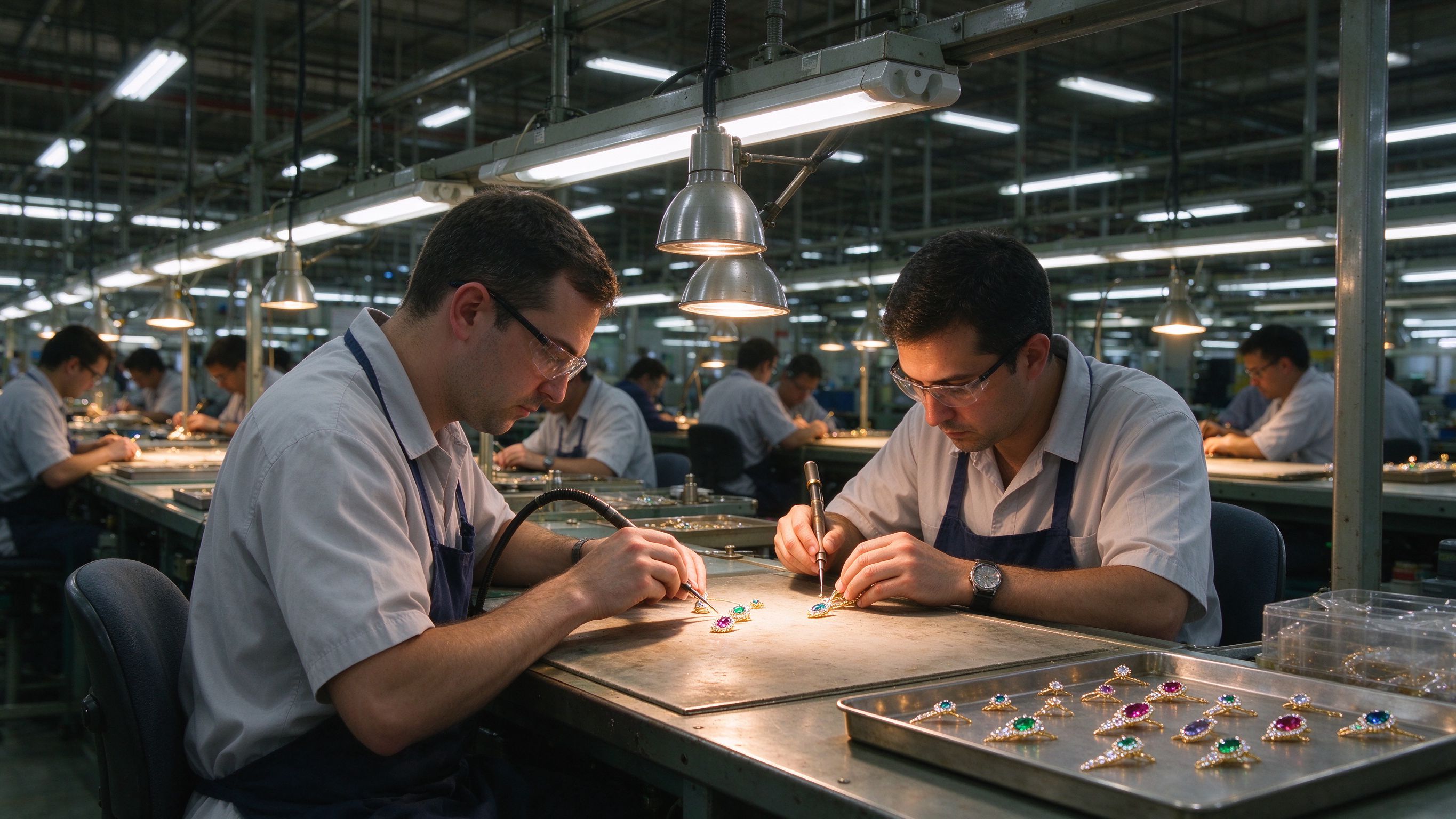
What Is MOQ and Why Do Factories Set It?
MOQ stands for minimum order quantity. It is the smallest number of stones a factory is willing to produce or ship in a single order. Factories set MOQs because cutting, inspecting, and packaging each stone takes time, and there is a fixed cost per order regardless of how many stones are in it. A factory that cuts one stone at a time cannot survive on one-piece orders.
For moissanite, MOQs are typically set per shape, per size, and sometimes per color grade. A factory might require 10 pieces of 6.5mm round D-color, but only 5 pieces of 8mm oval. The MOQ reflects how long it takes to set up the cutting process for that specific shape and size.
The good news for wholesale buyers is that MOQ is almost always negotiable. Factories prefer to keep production lines running and relationships warm. If you approach the conversation strategically, you can often reduce your initial MOQ by 30 to 50 percent.
Understand the Factory's Perspective
Before you negotiate, understand what the factory cares about. A Wuzhou moissanite factory is a small-to-medium business. Its owners care about three things: production efficiency, cash flow, and long-term customer reliability.
If you can frame your request in terms of those three priorities, you will get a better response. For example, instead of saying "I want a lower MOQ," say "I am a new brand building my inventory, and I plan to place quarterly orders as my sales grow. Can we start with a smaller first run to test the market?" This signals that you are not a one-off customer. You are a future account.
Tactic 1: Start with a Sample Order
The easiest way around a high MOQ is to separate your sample order from your bulk order. Most factories will sell 3 to 5 pieces at near-retail price without holding you to the MOQ. Use this sample order to inspect quality, photograph the stones for your website, and validate that the factory meets your standards.
Once you have approved the samples, your bulk order conversation has a much stronger foundation. The factory knows you have already invested time and money in evaluating them, and they are more likely to extend flexible terms.
Tactic 2: Mix Shapes and Sizes Within a Total Volume
Many factories list MOQs per shape, but they will often waive individual shape MOQs if your total order reaches a combined threshold. For example, if the MOQ is 10 pieces per shape, ask whether you can order 5 round, 3 oval, and 2 cushion for a total of 10 pieces instead of 10 of each.
This works because the factory's real constraint is total production volume, not shape diversity. As long as the total order is profitable, they are happy to mix. Frame it as "I am building a starter inventory and want to test which shapes sell."
Tactic 3: Offer a Deposit or Faster Payment Terms
Cash flow is the single biggest concern for small factories. If you can offer a larger deposit, faster wire transfer, or even a partial prepayment discount, the factory will often reward you with a lower MOQ.
For example, if the standard terms are 30 percent deposit and 70 percent before shipment, offer 50 percent deposit on your first order in exchange for a reduced MOQ. This costs you very little in the grand scheme and removes the factory's risk of producing stones you might reject.
Tactic 4: Propose an Annual Volume Commitment
If you are confident you will be a repeat buyer, propose a rolling annual commitment. For example, "I expect to order 200 pieces over the next 12 months. Can we set the first order at 20 pieces and schedule four follow-up orders of 45 pieces each?"
This gives the factory predictable revenue and production planning. In return, they will often give you a lower per-unit price and a lower initial MOQ. Get the commitment and pricing in writing as a simple framework agreement, even if it is not a formal contract.
Tactic 5: Ask About Off-Season or Slow-Period MOQs
Wuzhou factories have busy seasons and slow seasons. The run-up to holiday shopping (September through November) is busy. January through March is typically slower. If you place an order during a slow month, the factory is more willing to accommodate smaller runs because the alternative is idle machines and idle workers.
Timing your first order for January or February can save you 10 to 20 percent on MOQ flexibility. Ask your sales representative directly: "When is your quietest month? I would like to schedule my first production run then."
Tactic 6: Be Willing to Take Existing Stock
Every factory has overstocked sizes or shapes that did not sell well. These are called "stock stones" and they are often available at 20 to 40 percent below regular wholesale price with no MOQ at all.
Ask your factory for a stock list. You might find 7.5mm cushion stones in E-F color that they are eager to clear. Buying stock helps you build inventory cheaply while also giving the factory cash to buy raw material for your custom order. It is a win-win.
Tactic 7: Build a Relationship, Not Just a Transaction
The most powerful long-term negotiation tool is simply being a good customer. Pay on time, communicate clearly, and give honest feedback. Factories remember buyers who make their jobs easier. When you call six months later and ask for a favor, they will say yes.
Conversely, buyers who haggle on every cent, demand rush production, and then delay payment find that MOQs mysteriously go up and lead times get longer. Treat your factory partner the way you would want to be treated as a supplier.
Sample Negotiation Script
Here is a simple script you can adapt:
"Thank you for the quotation. We are a new brand and our initial budget is focused on testing three shapes rather than committing to a large quantity of one. Would it be possible to adjust the MOQ to 20 pieces total across round, oval, and cushion, with a commitment to reorder within 60 days? We can pay 50 percent deposit upfront to confirm the order."
This script works because it is specific, it shows you have thought about the factory's constraints, and it offers something in return.
What to Do If Negotiation Fails
If a factory will not budge on MOQ, you have two options. First, find a different factory. Wuzhou has dozens of moissanite cutters, and MOQ policies vary widely. Second, pool orders with another small jeweler. Two small buyers who combine their order can meet the MOQ and split the stones. This is common in the industry and a great way to build peer relationships.