Why Certification Matters in Wholesale Moissanite
When you sell a loose moissanite to a retail customer, the certificate is not just a piece of paper. It is a trust instrument. It tells the buyer that the stone they are holding has been independently inspected and graded according to recognized standards. It also gives them a story to tell when they resell or insure the piece.
In the diamond world, GIA and AGS certificates are the gold standard. In moissanite, the landscape is different. There is no single globally recognized lab. Instead, several independent gemological organizations issue reports for lab-grown moissanite. The most common is GRA (Gemological Research Alliance), followed by GTC (Gem Testing Center) and a few smaller regional labs.
This guide explains what these certificates actually say, how much you should trust them, and when they are worth the added wholesale cost.
What a Typical Moissanite Certificate Contains
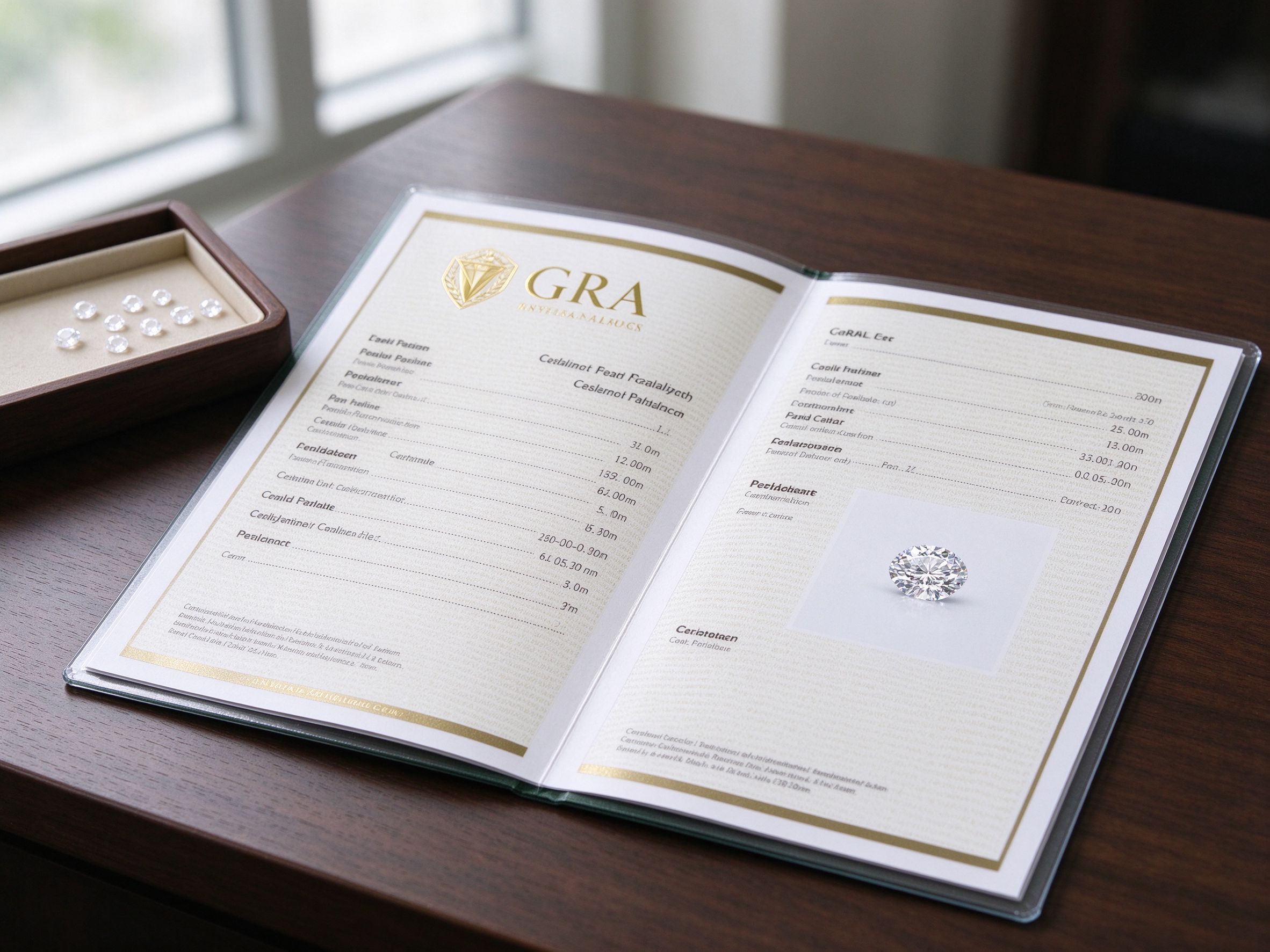
Every moissanite grading report follows a similar format. Let us walk through each field and explain what it means for your buying decision.
Shape and Cut
The certificate lists the stone's shape (round, oval, pear, etc.) and cut style (brilliant, step, mixed). This should match what you ordered. If you ordered an oval and the certificate says "oval modified brilliant," that is fine. If it says "round" when you ordered oval, there is a mismatch.
Measurements
The certificate lists length, width, and depth in millimeters. For fancy shapes, it also lists the length-to-width ratio. You should verify these measurements with your own digital caliper when the stones arrive. Discrepancies beyond 0.1mm indicate sloppy work or a mismatched certificate.
Carat Weight
Moissanite is lighter than diamond, so the carat weight on a moissanite certificate is less meaningful than on a diamond. Most wholesale buyers purchase moissanite by millimeter size, not carat weight. The carat weight on the certificate is informational only.
Color Grade
Moissanite color grades use the same D-to-Z scale as diamonds, but the actual grading standards differ. GRA typically grades commercial moissanite as D, E, or F. Be aware that color grading is somewhat subjective, and two labs may grade the same stone differently. The important thing is that the stone you receive matches the visual appearance of the color grade you expect.
Clarity Grade
Clarity is graded VVS, VS, SI, or I. As mentioned earlier, lab-grown moissanite is almost always VVS because the growth process is controlled. If a factory offers SI or I grade moissanite at a discount, be cautious. It may mean the stones have visible inclusions that the factory is trying to move.
Cut Grade
Some certificates include a cut grade (Excellent, Very Good, Good, Fair). Others do not. Unlike diamonds, moissanite cut grading is not standardized. Treat the cut grade as a reference point, not a guarantee. The actual visual performance of the stone matters more.
Laser Inscription
Many certificates include a laser inscription on the stone's girdle that matches the certificate number. You can read this inscription under a 10x loupe or microscope. This is the best way to verify that the stone in front of you is the stone described on the certificate. If a factory does not offer laser inscription, ask why. It is a standard feature on stones above 6mm.
GRA vs GTC: Which Certificate Should You Prefer?
GRA (Gemological Research Alliance) is the most widely recognized certificate in the Chinese moissanite trade. It is accepted by most wholesale buyers and is the default certificate offered by Wuzhou factories. GRA reports are available online for verification (depending on the lab's database), and the format is familiar to most industry professionals.
GTC (Gem Testing Center) is another common report, particularly for stones exported to certain markets. The grading standards are similar to GRA. There is no significant quality difference between GRA and GTC certificates; they are simply different issuing bodies.
Some factories offer their own in-house certificates at a lower cost. These are generally less trusted because the factory is grading its own product. For engagement-ring stones sold to end customers, insist on an independent GRA or GTC report. For smaller stones used in pav settings, an in-house report or no certificate is usually acceptable.
When to Pay for a Certificate (and When Not To)
Certificates add cost. A GRA report typically adds $3 to $8 per stone depending on size. For a 6.5mm stone, that is a 10 to 20 percent cost increase. So when is it worth it?
Get a certificate when:
- The stone is 6.5mm or larger and will be sold as a center stone.
- You are selling engagement rings or solitaire pendants where the customer expects documentation.
- You are selling to customers who will insure the piece and need a valuation.
- You are building a brand that positions itself as premium and trustworthy.
Skip the certificate when:
- The stone is under 5mm and used as an accent or side stone.
- You are selling fashion jewelry where documentation is not expected.
- You are buying stock clearance stones at a steep discount.
- Your customers do not ask for certificates and price is the main buying factor.
How to Verify a Certificate
Unfortunately, the industry has a problem with counterfeit certificates. Some factories print fake GRA reports to inflate the perceived value of lower-grade stones. Here is how to protect yourself:
- Check the online database: GRA and GTC both maintain online verification databases. Enter the certificate number on the lab's website. If the number does not exist, the certificate is fake.
- Match the laser inscription: Read the girdle inscription under a loupe. It should match the certificate number exactly. If the stone has no inscription, the certificate is unverifiable.
- Compare the measurements: Measure the stone yourself. If the certificate says 6.50mm but your caliper says 6.38mm, the certificate does not match the stone.
- Inspect the paper quality: Genuine certificates use security paper with watermarks, holograms, or UV-reactive ink. Fake certificates are usually printed on plain paper.
- Buy from reputable factories: The best protection is a trusted supplier. Reputable factories like HOLYCOME issue genuine certificates that you can verify online.
Certificate Checklist for Your Next Order
Before you place a bulk order, ask your supplier these questions:
- Are GRA certificates included in the quoted price, or are they extra?
- What is the cost per certificate if we need them on all stones?
- Do you offer laser inscription on the girdle?
- Can we verify certificates online before shipment?
- Will the certificate numbers match the stones in the photos you send for approval?
- What happens if we receive a stone whose certificate does not match? Will you replace it?
Getting clear answers to these questions before you pay avoids disputes after shipment. A supplier who hesitates or gives vague answers about certificate verification is a supplier to avoid.
The Bottom Line on Moissanite Certification
Certification is not a guarantee of quality, but it is a useful tool for building trust with your customers. For center stones, spend the extra $3 to $8 per stone. For accent stones, save the money. Most importantly, verify every certificate you receive. In an industry where counterfeits exist, diligence is your best protection.