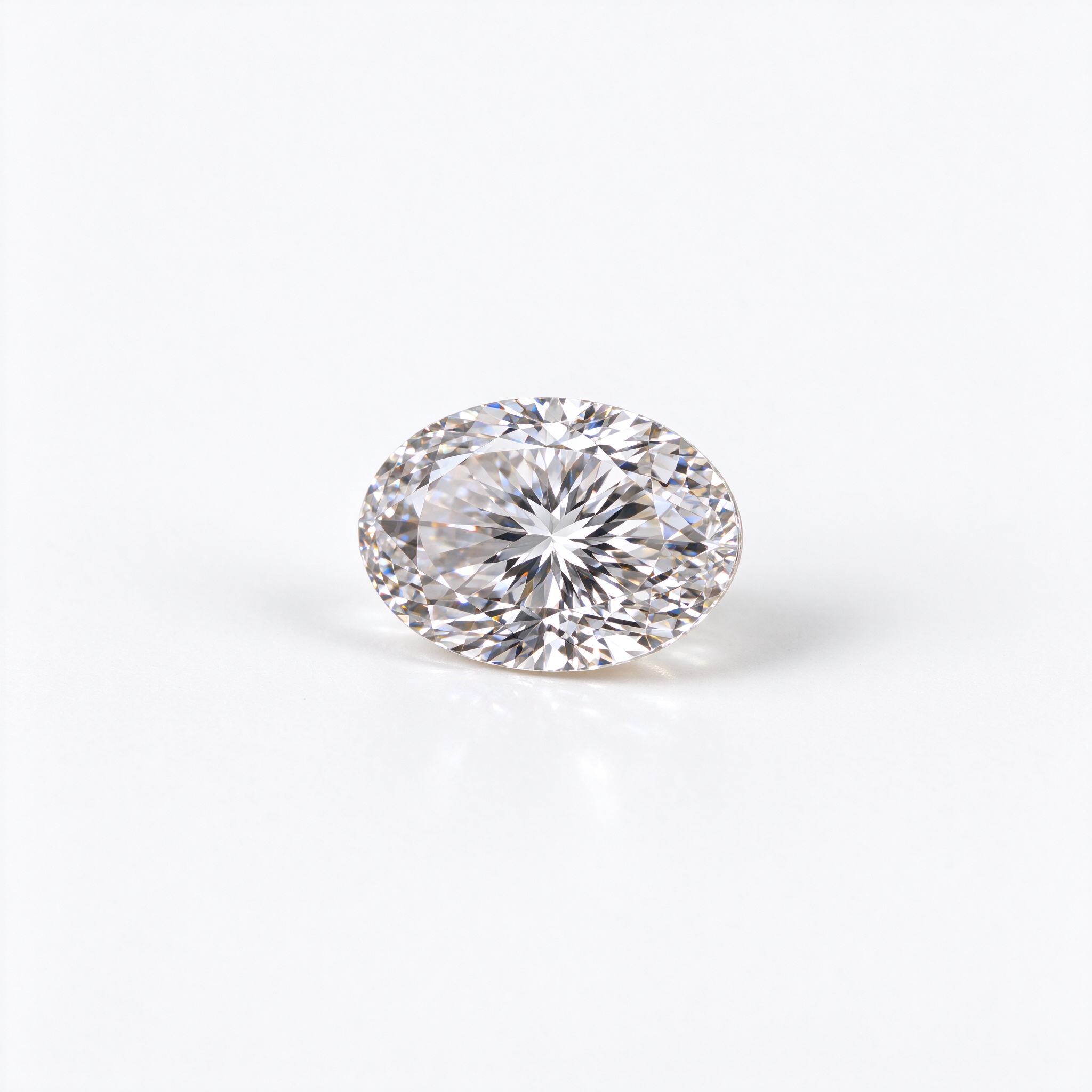
A buyer in Manchester ordered 1.5 carat oval stock and was confused why the stones looked small on the tray. The answer is that oval moissanite is priced and graded by millimetres, not by carat weight, and a shallow-cut 1.5ct oval can measure smaller than a well-cut 1.2ct oval. Retail customers buy the look on their finger; if your parcel is bought by weight, your price per visible millimetre will be wrong.
Oval demand has roughly doubled in our book since 2022 and now sits second only to round brilliant. This guide gives buyers the mm-to-carat mapping, the length-to-width ratio range that sells, and the bow-tie tolerance we hold on oval parcels.
Why face-up size, not carat, decides the sale
An oval spreads weight across its length and width rather than piling it into depth. A well-proportioned 1.0 carat equivalent oval measures about 7.5 by 5.5 mm; a round of the same weight measures about 6.5 mm across. On a finger, the oval occupies roughly 30% more visible area. Customers correctly perceive the oval as bigger, and they shop against the round's price per millimetre whether they say so or not.
The buying implication: order ovals by millimetre dimension, and price them per millimetre of face-up area, not per carat. The mapping we use internally: a 7.0 x 5.0 mm stone is about 1.0ct equivalent, an 8.0 x 5.5 mm stone is about 1.5ct, a 9.0 x 6.0 mm stone about 2.0ct, and a 10.0 x 7.0 mm stone about 3.0ct. Stones that fall more than 0.3 mm outside these dimensions are either cut for weight (deep, dark) or cut for looks (shallow, windowing). Both sell poorly at retail.
The length-to-width ratio sweet spot
An oval that is too squat reads as a round with a mistake; one that is too thin reads as a marquise with a blunt tip. The retail-friendly window is a length-to-width ratio of 1.30 to 1.50. At 1.30–1.40 you get the soft oval, closest to round, preferred by customers who want size without committing to an obvious fancy shape; this band has the highest attach rate on our floor. At 1.40–1.50 you get the classic elongated oval, which reads modern and lengthens the finger. Above 1.55 the shape becomes niche and usually needs a custom head.
Because moissanite's dispersion is high (about 0.104 versus diamond's 0.044, per the moissanite refractive-index data), the extra length in an elongated oval tends to exaggerate both sparkle and any bow-tie. A 1.50 ratio oval with mild bow-tie looks great in photos; the same stone held in hand can show a dark bar across the middle. Inspect every oval in your parcel face-up under soft light before it reaches the tray.
Bow-tie tolerance for bulk ovals
The bow-tie is a dark shadow across the centre of an oval or pear, caused by pavilion facets that fail to reflect light from the viewer's angle. Industry grading usually describes it as none, mild, moderate or strong. Our bulk tolerance: none to mild bow-tie is acceptable for stock, and mild bow-tie disappears in most halo settings. Moderate bow-tie drops sell-through sharply and we replace these before the parcel ships. Strong bow-tie is never accepted.
Ask the supplier for actual photos of each stone face-up, not stock renders. A 10 mm oval with a strong bow-tie can be a beautiful stone in a pendant but a returned ring. Match oval stock to oval ring heads, and keep your pear bow-tie grading standards consistent because the two failure modes overlap.
Size ladder for an opening oval parcel
Oval demand is concentrated in two brackets: the 8.0 x 5.5 mm (1.5ct) and the 9.0 x 6.0 mm (2.0ct). A five-stone opening oval parcel for a new boutique is one stone at 7.0 x 5.0 mm as the entry price point, two stones at 8.0 x 5.5 mm as the fastest mover, one stone at 9.0 x 6.0 mm as the upsell anchor, and one stone at 10.0 x 7.0 mm for the window display. Every stone should arrive with a GRA certificate and laser inscription. For accounts that also carry marquise stock, note that oval heads do not fit marquise stones and vice versa; buy ovals only when you have matching oval heads on the bench or in the work order.
Frequently Asked Questions
Why does an oval moissanite look bigger than a round of the same carat?
Because weight is spread across the face rather than depth. A 1ct oval measures about 7.5 x 5.5 mm versus a 6.5 mm round, so visible area on the finger is roughly 30% larger.
What length-to-width ratio should I stock in ovals?
Stick to 1.30–1.50. This range covers the soft oval and the classic elongated oval and matches the heads most retailers already carry.
Is a visible bow-tie in an oval a defect?
Mild bow-tie is normal and usually hidden by a halo. Moderate or strong bow-tie should be rejected from stock because it drives returns.
Should I price ovals by carat or by millimetre?
Price per millimetre of face-up dimension. Carat weight alone rewards shallow-cut stones that read small on the finger.
What size oval sells fastest?
The 8.0 x 5.5 mm (about 1.5ct equivalent) is the highest-turnover bracket in our order book, followed by the 9.0 x 6.0 mm.
Request an oval sample parcel: 5 stones, mm-certified, bow-tie inspected, D–F color-sorted. Apply for wholesale pricing or compare against the round brilliant best-seller guide when planning your cut mix.