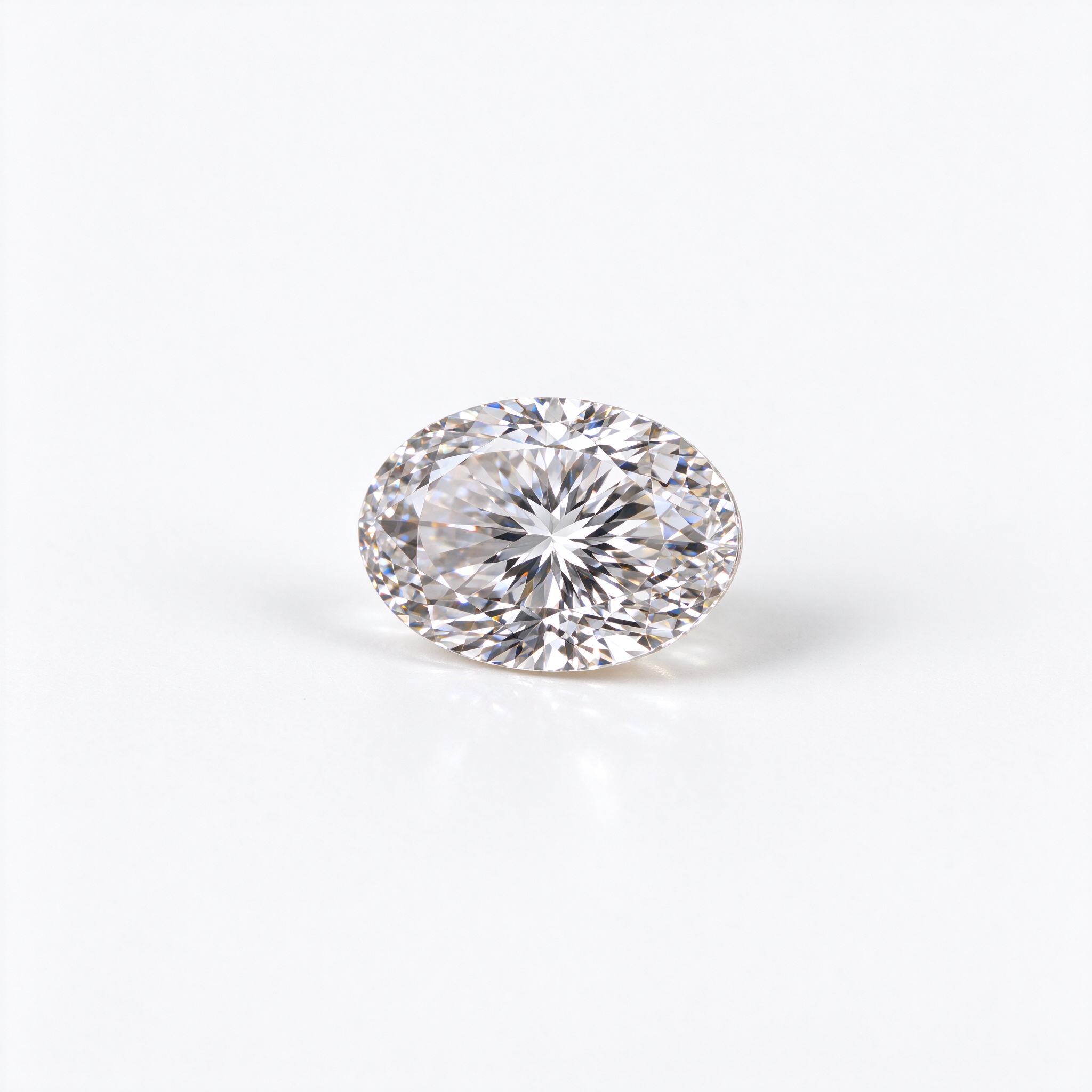
It is the most common first question we hear from new retailers: should I stock oval moissanite or round moissanite? The honest answer is that they sell to different customers, and the smartest boutiques carry both. In this comparison we break down oval vs round moissanite across the factors that actually move the needle for a wholesale buyer: size perception, cost, setting ease, demand and styling.
Face-up size: oval wins
An oval of the same carat weight as a round looks visibly larger on the finger. The oval spreads its mass along a longer axis, so a 1ct oval (around 8x6mm) covers more surface than a 1ct round (about 6.5mm). If your customer base wants maximum look-per-dollar, oval is the shape that delivers it. This is why ovals have grown so fast in engagement rings over the last few years.
That said, the round's compact symmetry has its own advantage: it never looks "unbalanced" on any hand. An oval that is too wide or too narrow can look off, whereas a round always reads cleanly.
Price: round is cheaper per carat
Rounds are easier to cut to good proportions, and they are produced in higher volume, so wholesale price per carat is usually lower for rounds. Ovals carry a small premium because cutting them without a bow-tie takes more hand work. For a margin-focused buyer, that premium is worth it because ovals command a higher retail price per carat.
Setting difficulty
Rounds are the easiest shape to set: even prongs, symmetric galleries, no direction to worry about. Ovals require the setter to decide orientation (long axis up the finger) and to support the two tips. A poorly set oval can show its tips catching on things. If your bench is new to oval setting, start with our 1ct oval as a practice stone before ordering a full run.
Styling and customer profile
- Round buyers: want classic, safe, timeless. Choose them for solitaire studs, tennis bracelets, traditional engagement rings.
- Oval buyers: want modern, elongated, "looks bigger". Choose them for halo rings, east-west pendants, slender-hand clients.
We stock both shapes, and you can compare the full range in the round and oval categories.
Durability and everyday wear
Both shapes are moissanite at 9.25 Mohs, so material durability is identical. The difference is mechanical: the oval's tips are more exposed than the round's even girdle. For a ring that will be worn daily, a well-set oval with protected tips holds up fine, but a naked oval with sharp tips is more likely to chip if knocked hard. Our cut guides cover this in the educational index.
Which should you stock first?
If you can only choose one, choose round. It is the safe volume SKU that every customer understands. Then add ovals once your engagement-ring line has traction. Many of our retail partners open with rounds, then reorder ovals within two months because the elongated shape trends strongly on social media.
Quick FAQ
Which looks more expensive? A well-cut oval often reads more high-fashion; a round reads classic. Perceived value is subjective to the customer.
Do ovals show more color? The points of an oval can show slight warmth. For white metal, choose D-F; our color grading guide explains the tiers.
Can I mix both in one ring? Yes, an oval center with round side stones is a classic combination we cut matched sets for.
The margin difference in practice
On paper, ovals cost slightly more per carat. In practice, they often earn more. Customers who choose an oval are buying a specific look, not comparing price per carat. They will pay more for the elongated, larger-face-up appearance. Rounds, by contrast, are bought comparatively; customers know exactly what a 1ct round should cost. This means ovals usually carry a healthier margin even though the wholesale price is a touch higher. Most of our retail partners discover this within two months of adding ovals.
Setting ovals without losing the look
An oval needs its long axis aligned with the finger. A crooked oval in a solitaire looks wrong the moment it is worn. Your bench should center the stone so the table sits straight. For halo ovals, keep the halo an even width all around; an uneven halo emphasizes any tilt. We supply ovals with enough girdle for secure setting; mention your mounting when you order. The sizes we stock are listed on the oval page.
How customers decide
Watch how customers compare. Round buyers ask "is it a classic?" Oval buyers ask "does it look big?" If a customer keeps mentioning their fingers looking slim, steer them to oval. If they mention timeless and safe, steer them to round. You do not need to push one; just describe the trade-offs and the right shape becomes obvious. For more optical detail, read fire and brilliance; for the full shape range, the cut guide has it all.
How customer demographics decide the shape
Over time we notice clear patterns. Younger bridal buyers and social-media-driven shoppers lean oval; traditionalists and older clients lean round. Urban boutiques sell more ovals; suburban and rural stores sell more rounds. Neither is wrong. Carrying both lets you serve whichever walks in. If your data shows a strong oval trend, lean into it; if not, rounds are the safe default.
Pricing ovals without leaving margin
Ovals cost a little more wholesale, but they retail higher. Price the oval ring as a modern elongated design, not as a round with a surcharge. Customers choose the oval for the look and will pay for it. Compare your cost against the oval engagement ring market, not against rounds. Our pricing strategy walks through the math.
How to stock both without guessing
The safest way to decide is to stock a small amount of each. One 1ct round and one 1ct oval as display pieces. Watch which one customers reach for. Within two months your sales data tells you which shape to expand. This test costs almost nothing and removes the guesswork. Our selection guide explains how to read that data. Start from the round and oval pages.