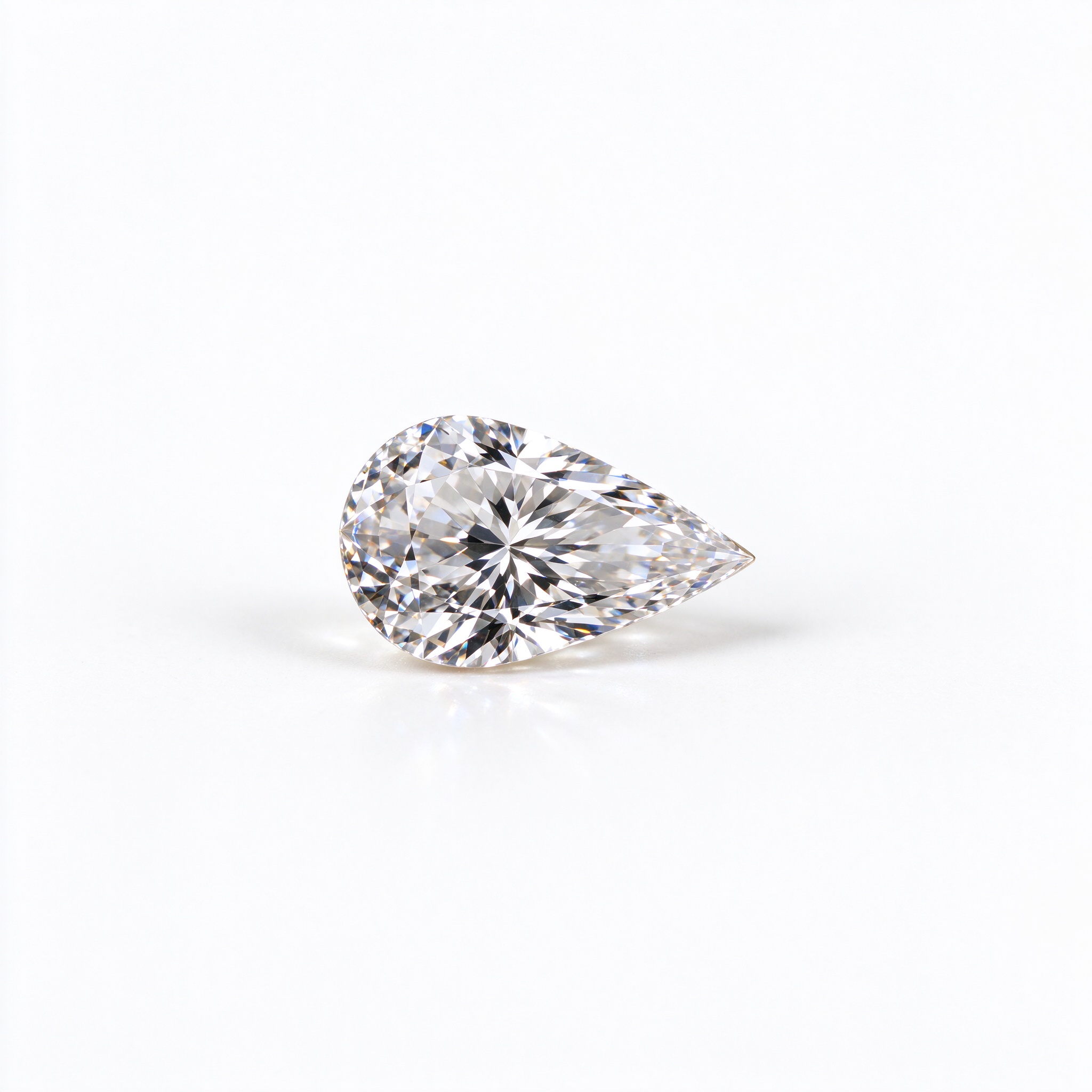
A single pear-cut moissanite is a stone. A pair of pear-cut moissanite earrings is a matched set, and the matching is the product. Wholesale buyers who buy two loose pears at the same carat weight and call them a pair will be wrong more often than they expect. Drop earrings read on two ears at once, and the eye compares left to right.
What "Matched" Actually Means
A pear is a teardrop: a rounded head and a tapered tip. For earrings, the two stones must be mirror images, not copies. Four dimensions have to line up.
- Carat weight - within about 3 to 5 points for a pair; bigger gaps are visible on the lobes.
- Length-to-width ratio - both pears should share the same ratio, usually 1.45 to 1.65. A fat pear and a slim pear hung side by side look mismatched.
- Color - because the stones hang separately, any body color difference between the two is immediate. Color-match them on a white tray, not on the cert.
- Tilt and table alignment - the table on each stone must sit level, and the tip must hang straight down. A pear with a tilted pavilion spins in its setting.
The Left-Right Mirror Problem
A pear cut is directional. When it hangs from an ear, the tip points down and the rounded head sits up. But the stone has a left and a right side; one edge is slightly fuller than the other. For a pair, the two stones need to be oriented so the fuller edge faces outward on both ears - a left stone and a right stone, mirror images. Buyers who order "two identical pears" often get two stones that both favor the same side, so one ear looks rotated the wrong way.
When ordering from a supplier, specify that you want a matched pair, oriented for earrings, not two singles. A supplier who handles earring stock regularly will pull a true pair; a supplier who sells loose stones by the carat will not.
Why Pairs Cost More Than Two Singles
A matched pair carries a premium - typically 15 to 25 percent over two loose stones of the same weight. That premium is justified. To pull a pair, the supplier has to go through inventory, hand-match on proportion and color, reject stones that tilt, and hold the pair together rather than selling them off individually. Wholesale buyers who try to save by matching two loose parcels themselves spend bench time and often still come up short. The pair premium pays for itself in fewer returns.
Grading Pairs on Arrival
When a pair arrives, do not judge it on the certs. Lay the two stones on a white tray, tip down, an inch apart. Look for:
- Same apparent size and shape silhouette - squint; the outlines should blur into one.
- Same color face-up under daylight.
- Both tips hanging straight, no twist.
- Mirror orientation - fuller edge outward on both.
If any of these fail, send the pair back. Earrings are the category most exposed to close comparison, because clients wear both at once.
Pricing and Stocking
Stock pairs in the sizes that actually sell for drop earrings: 6x4mm through 10x7mm. Above that, pairs are special order and slow. Below 5x3mm, matching becomes unrealistic because the differences are below retail notice - at that point, near-matches are acceptable and cheaper. Most wholesale earring programs run 7x5 to 9x6 pairs as the core SKU, with one colorless tier and one near-colorless tier.
For buyers building moissanite rings and earring programs together, note that pear-cut rings and pear-cut earrings can share stock in a pinch - but a pair intended for rings should never be pulled apart for earrings. Keep matched earring pairs in a separate, labeled tray. Mixing trays is how pairs get split and lost.
Storage and Handling Once Paired
Matched earring pairs get split far more often by poor storage than by poor sales. Once a pair is pulled, it should be stored together in a divided tray or a marked pouch - never loose in a general stone bin. A pear sold to a ring client from the earring tray leaves its orphan partner, and the orphan is unsellable as a pair. Wholesale buyers who lose pairs this way lose the 15 to 25 percent pair premium twice: once on the orphan, once on the replacement pair they have to re-match.
Mark the pair with a matched lot number on the parcel sheet. When one earring sells, the second is flagged as a single and moved into a singles tray for rings or pendants, rather than left waiting for a partner that will not come. This keeps the earring tray clean and the pairs intact.
The pear earring is a product about symmetry. Buy the match, store the match, and sell the match - not just the stones.