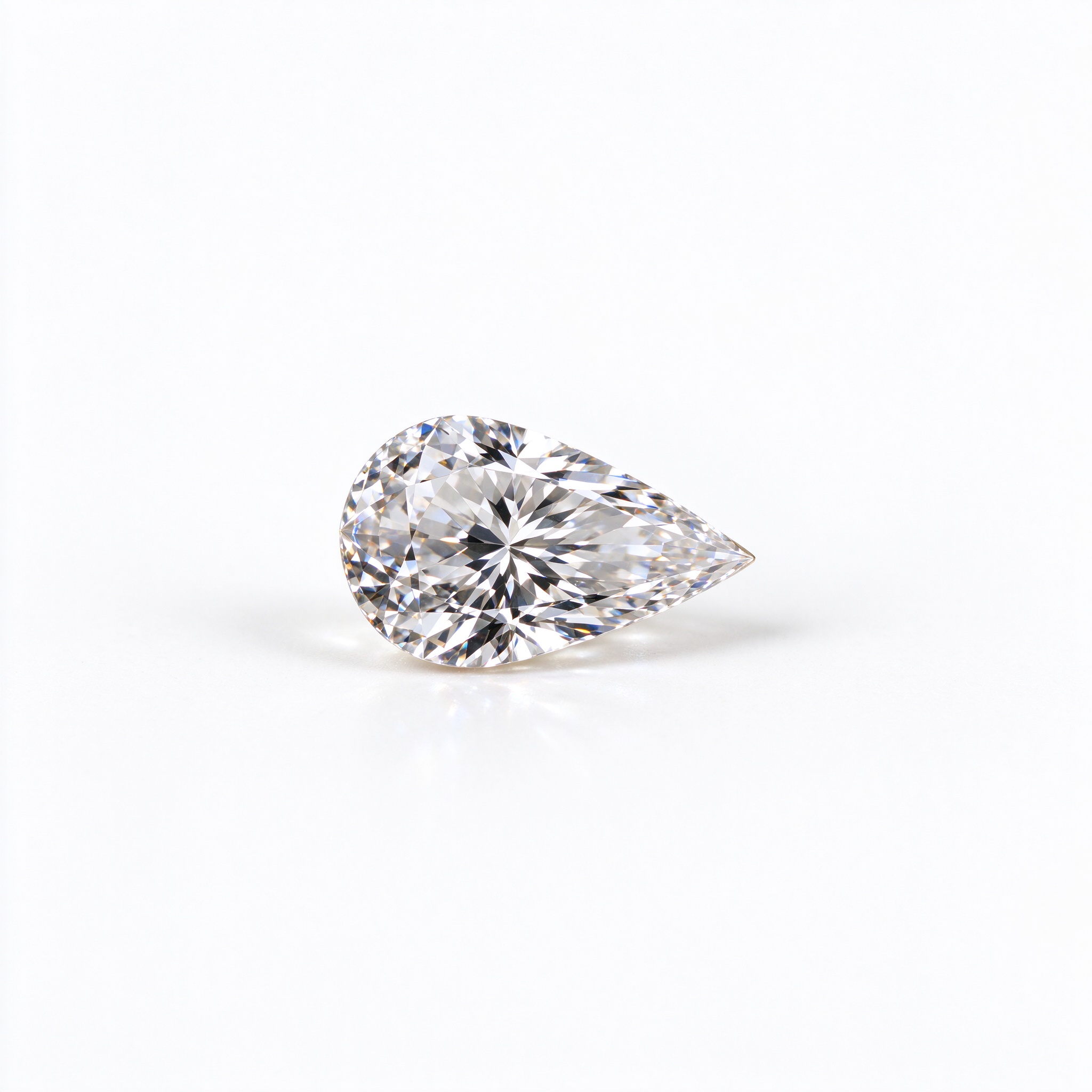
A handmade jewelry seller on a US marketplace listed ten pear-cut moissanite studs and got three returns in a fortnight. Two buyers complained the stones faced left on one earring and right on the other, and a third said the tip looked crooked under a loupe. Pear is the shape most likely to come back for orientation and symmetry reasons, because it is asymmetrical by design — and "asymmetrical" is not the same as "balanced." A vendor checklist built for pear cuts catches these defects before they reach a customer.
What actually goes wrong with bulk pears
Three defects account for almost all pear complaints: a tip that sits off the central axis, two halves that do not mirror, and left/right orientation that was never controlled. For earrings, the buyer needs a mirrored pair — one stone pointing left, one right. A parcel of identically oriented pears cannot make that pair, and a seller who tries will get returns.
| Defect | How it shows up | Action on incoming inspection |
|---|---|---|
| Off-center tip | Tip leans instead of sitting on axis | Reject if visible at arm's length |
| Unequal halves | One shoulder higher than the other | Reject over 5% asymmetry |
| Wrong orientation pair | Both stones face the same way | Reserve only mirrored pairs |
| Pronounced bow-tie | Dark shadow across the belly | Reject dark, accept soft |
The specs we hold on pear parcels
Every pear ships at Mohs 9.25, DEF color, eye-clean clarity, GRA certified with a matching girdle inscription. Shape-specific standards:
- Length-to-width ratio held between 1.45 and 1.65, the range that reads as a balanced pear rather than a skinny teardrop or a fat oval.
- Tip alignment checked on a rotating fixture; stones where the tip drifts off axis are pulled before packing.
- Earring lots pre-sorted into mirrored left/right pairs, matched within 0.05 carat and 0.03 ratio.
- Pavilion depth logged so a reorder reproduces the same belly fullness a client approved.
About 18 percent of bulk pears from untuned suppliers fail one of these four checks on first pass, which is why we inspect each stone individually rather than sealing parcels by lot weight. We also photograph every flagged stone under a loupe and attach the image to the packing note, so you can dispute an RMA with evidence rather than a verbal description.
For photography, pears read best on a flat lay with the tip pointing toward the upper corner; a stone shot straight-on often looks stubby in the listing. Sellers who shoot the pear at its natural diagonal report higher click-through than those who center it upright, because the shape's elongation only reads at the angle.
How different buyers should stock pears
A small-batch seller moving into pears should order 20 singles for pendants first, where orientation does not matter, before touching earrings. Pendants are the forgiving lane and let the buyer learn how the shape photographs.
A bridal boutique should stock the 1.00 to 1.50 carat range in pendants and request a mirrored pair set for stud and drop work. Pear pendants outsell pear solitaires in most US markets because the shape flatters a wider range of necklines and finger widths. Our DDP export program covers US and EU addresses, and a reorder on an approved ratio ships in five business days against the 20-piece MOQ.
Private-label buyers can request a fixed silhouette locked across runs, so a pendant and a ring bought in different seasons match. That lock removes the orientation guesswork and usually pushes defect returns below 1 percent for pear-specific SKUs.
Frequently Asked Questions
How do I tell a left-facing from a right-facing pear?
Hold the stone with the tip pointing up. The curved shoulder that swings further to one side defines the direction. Earrings need one of each, not two facing the same way.
What length-to-width ratio is safest to stock?
The 1.45 to 1.65 range is the safest seller. Narrower reads as a teardrop pendant; wider collapses toward an oval and loses the pear identity buyers came for.
Do pears show a bow-tie like ovals?
Yes, but usually softer and near the belly rather than the center. A faint shadow is normal; a dark, defined one should be rejected on the incoming inspection.
Can I sell loose pears as earring pairs?
Only if the supplier pre-selected mirrored pairs within a tight carat and ratio spread. Mixed-orientation lots should be sold as singles or pendants, never as a set.
What is the MOQ for a pear test order?
20 pieces in one carat band opens the opening rate. Mirrored earring pairs carry a four-pair minimum and are flagged as such on the packing list.
What to take away
- Pear complaints are almost always symmetry or orientation, not hardness or color.
- Buy pendants before earrings; orientation only matters for pairs.
- Demand pre-sorted mirrored pairs and reject off-center tips on sight.
- Lock the silhouette for private-label reorders across seasons.
Request a pear sample parcel with mirrored pairs flagged: MOQ 20 pcs, ships in 5 business days. See the pear cut collection, read the symmetry checklist, or open a wholesale account for loose pear DDP pricing.