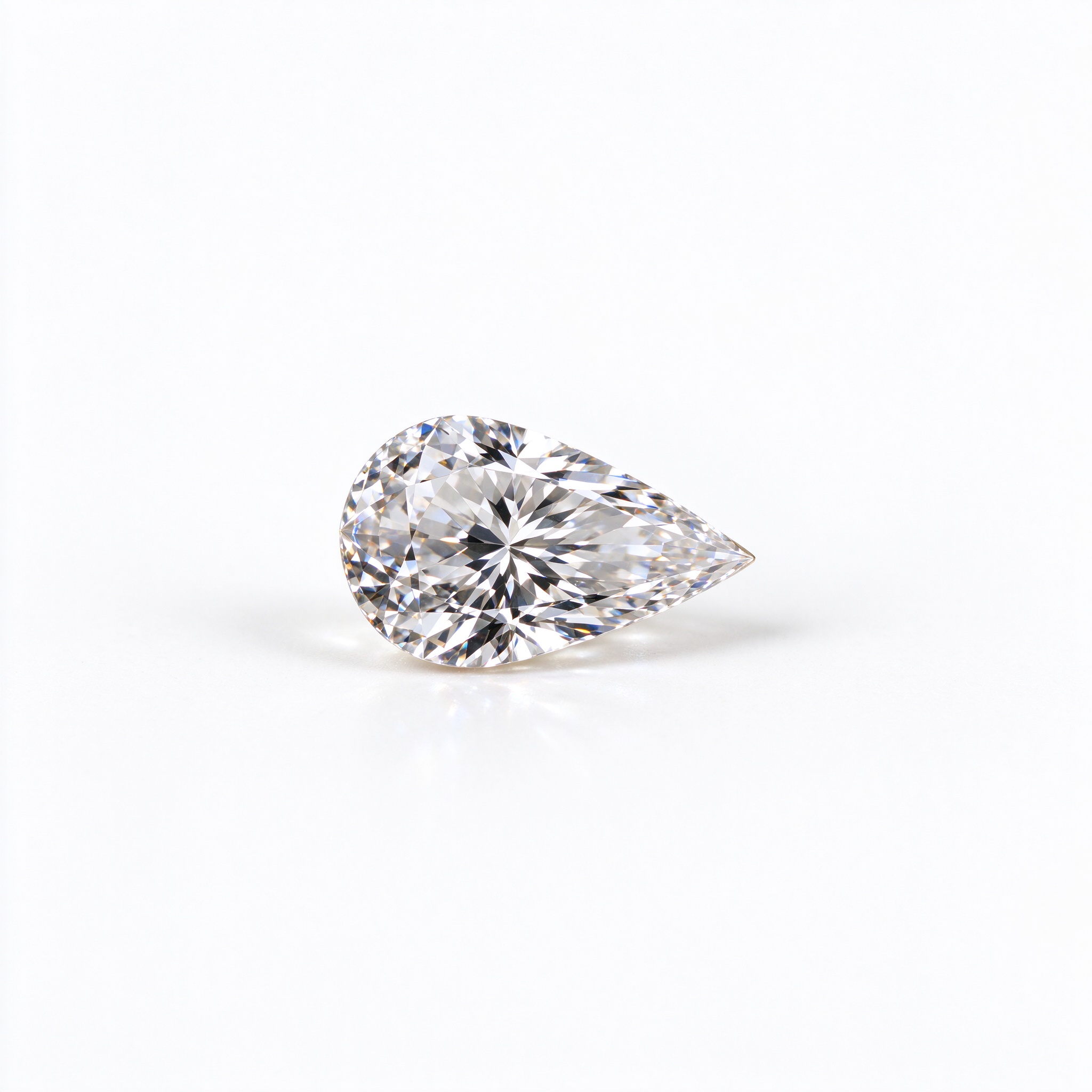
A bridal store in Portland returned three pear solitaires within a month: the stone looked straight from the front, but once mounted, one wing sat higher than the other and the tip leaned off the shank's center line. The stones came from a supplier who graded pears "eye-clean" without measuring symmetry. Wholesale pears fail on symmetry, not on sparkle. Here is what we inspect on every pear we ship, and what you should ask any supplier before you place a first order.
Where pears go wrong, in numbers
A pear is two curves joined at a tip and a rounded end. The retail failure modes are predictable:
- Wing mismatch: one shoulder rounds out faster than the other; visible once mounted, invisible in a tray.
- Off-center tip: the point sits to the left or right of the stone's central axis by more than 2%.
- Bow-tie shadow: a dark band across the center, worse in pears than ovals because the facet geometry pulls light horizontally.
- Soft tip: the point isn't crisp, which reads as a "worn" stone even when new.
Open-market pear parcels we have sampled run around 15–20% with at least one of these flaws visible at 30cm. Our incoming pear rejection rate is about 6% — we pull the asymmetry stones before they are listed.
Our pear grading sheet, stone by stone
| Parameter | Industry norm | Our wholesale standard |
|---|---|---|
| Wing symmetry | Visual check | Measured; offset ≤2% |
| Tip alignment | Visual | On-axis; off-axis >1.5% rejected |
| Bow-tie | Not listed | None to slight only |
| Tip sharpness | Soft acceptable | Crisp point, no rounding |
| Length-to-width | Mixed | 1.4–1.6 listed as classic |
Every pear ships with a GRA cert and a laser-inscribed girdle, plus an internal QC slip noting wing offset and bow-tie grade. Tip protection is a separate conversation: because the point is the thinnest part of the stone, we ship pears in divided trays with the points seated in foam slots, not loose in a pouch.
What to ask a pear supplier before you order
For a boutique opening a pear tray
Ask for the symmetry sheet, not just the cert. A GRA cert confirms the stone is moissanite and near-colorless; it does not document wing offset. Reject any supplier who cannot show you a per-stone symmetry measurement. Start with 1.0 and 1.5ct classic pears (1.4–1.6 ratio); those read most universally on a hand.
For a high-end bridal account
Ask for matched sets: pear center stones with tapered baguette or pear-side accents cut from the same batch. We supply these as a matched lot so the facet pattern and color align in the mounting. Also ask about tip-protected settings — we recommend V-prongs or a bezel cap for the point, and we include that guidance with the parcel.
For a private-label brand
Lock a production run of pears in one ratio band (classic 1.5 or fashion 1.7). We hold the cut-sheet archive so reorders match your existing mount inventory. Tip protection in packaging is non-negotiable at this volume; we ship divided trays by default.
Packaging is part of the spec, not an afterthought. A pear shipped loose in a pouch arrives with the tip bouncing against the girdle of the neighboring stone; over a trans-Pacific shipment that translates into micro-chips you only notice once the stone is mounted and returns start. We ship pears in divided foam trays tip-down in their own slot, and we recommend boutiques keep them that way on the bench rather than pouring them into a shared display tray.
Frequently Asked Questions
What is the MOQ for wholesale pear moissanite?
Opening MOQ is 10 pears, mixed across sizes. Bulk and private-label runs start at 50 pieces per size band.
Do pears chip at the tip?
Moissanite at 9.25 Mohs resists chipping well, but the thin pear tip is the most exposed point in a setting. We recommend V-prongs or a bezel cap and ship every pear in tip-protected trays.
What ratio reads best for engagement rings?
The classic 1.4–1.6 length-to-width ratio reads most universally and lengthens the finger without looking skinny. Fashion 1.7+ pears are a statement SKU, not a tray staple.
Do your pears come with certificates?
Yes, every pear ships with a GRA certificate and laser-inscribed girdle, plus our internal symmetry QC slip. IGI-graded parcels are available on request.
How do you handle bow-tie in pears?
We grade bow-tie as none, slight, medium. Only none-to-slight pears are listed at wholesale; medium bow-tie stones are pulled from retail parcels.
Takeaways
- Pears fail on symmetry — wing offset and tip alignment, not on color or clarity.
- Require a per-stone symmetry sheet; the GRA cert alone does not cover it.
- Ship pears in tip-protected trays and set them in V-prongs or a bezel cap.
- Request a pear sample parcel: MOQ 10 pcs, ships in 5 business days.
View our pear moissanite range, read the cut symmetry guide, or see pears set in engagement rings. Boutiques can request a pear sample directly.