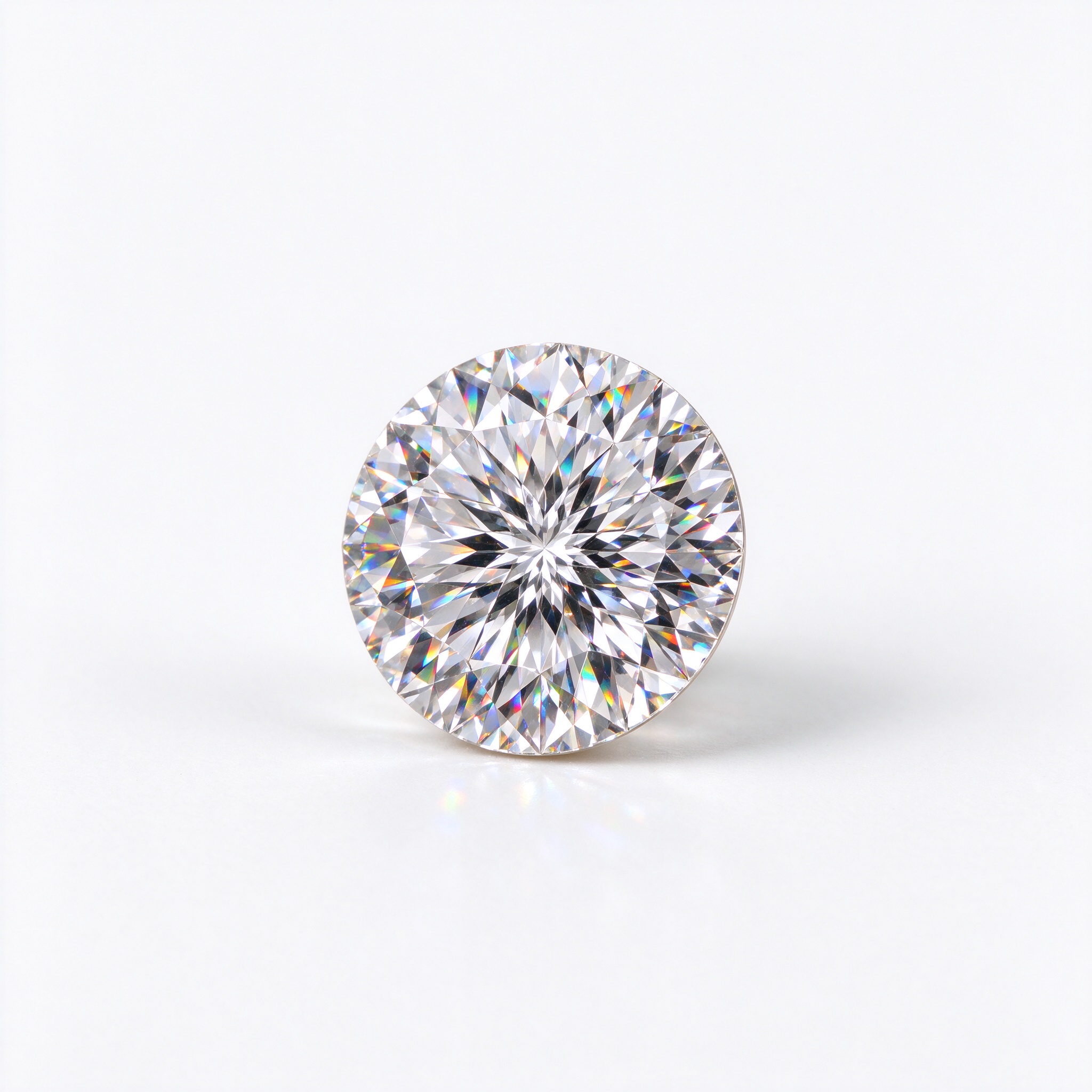
The round brilliant is the most-shopped cut in wholesale moissanite, and it is also the cut most often misrepresented in photos. A 57-facet brilliant built on ideal proportions is engineered to throw contrast and return light straight back to the viewer. When a listing shot flattens that performance, the stone reads as dead glass; when the shot is over-tweaked, it reads as a diamond on steroids and the return rate climbs once the parcel arrives. Getting the round brilliant to look like itself is a studio craft, not a filter problem.
Why the round brilliant is unforgiving on camera
Round brilliants concentrate all their visual energy in the center. The pavilion angles are shallow enough that any light source above the table shows up as a specular hotspot, and moissanite's higher refractive index (2.65 versus diamond's 2.42) means it scatters more spectral color than a typical diamond at the same size. In practice, that means two failure modes: a single hot ring light blowing out the table into a white disc, or ambient room light turning the whole stone into a gray mush with no contrast. Neither sells the stone.
The baseline setup
Most wholesale houses we work with settle on a small softbox, a black or white acrylic sweep, and a 100mm macro lens. Aperture around f/9 to f/11 keeps the whole table and crown in focus without softening the culet reflection. The key light sits at about a 45-degree crown angle, roughly level with the stone, and a fill card on the opposite side knocks down the deep black in the pavilion. A ring light directly overhead is the single worst choice for round brilliants; it flattens the table and kills the starburst that buyers actually want to see.
- Background: matte black for white-metal settings, off-white for yellow or rose gold, so the halo of light spill stays consistent.
- Surface: a lightly textured acrylic or a velvet pad; a mirror surface doubles the stone and confuses buyers about carat.
- White balance: lock it. Moissanite ranges colorless to near-colorless, and a drifting white balance will make an F-grade stone look blue or yellow between shots in the same listing.
Angles that move inventory
Four shots do most of the work for a round brilliant listing. Straight down onto the table shows the symmetry of the facets and the size of the culet. A 45-degree crown angle shows depth through the pavilion and communicates that the stone is not flat. A three-quarter shot inside the setting shows how the prongs grip and how much light escapes through the side. A hand or finger scale shot next to a coin removed from frame gives the buyer a real size read, because a loose stone on a sweep tells you almost nothing about how a 1.2ct round reads on a size 6 finger.
Common mistakes and the fix
Over-saturating fire is the first mistake. Buyers who buy round brilliants buy them for steady return of light, not for rainbow disco; a shot that looks like a prism in a nightclub signals "treated" or "over-coated" stone. Pull saturation back and let the facet contrast carry the image. The second mistake is shooting every stone at the same distance regardless of carat. A 3ct round and a 0.5ct round photographed identically look the same size, which is fine for a spec sheet but bad for a PDP. Reference objects and consistent framing let buyers compare across the row.
Color calibration across a row
One detail buyers miss is that round brilliants from the same parcel can read differently under the same light if one is slightly more yellow than another. When you shoot a row of rounds for a catalog, the color drift between stones becomes obvious, and it makes the parcel look inconsistent. Shoot each stone under the same white balance, with a grey card reference in the first frame of the shoot, and keep the grey card in the frame for every stone. Pull the same color temperature across the row in post. This one step prevents half the "these don't match" complaints from customers who buy two stones for a pair of studs or a three-stone ring.
What to ask your supplier
When you open a wholesale account, ask whether the supplier can ship a reference set of three known stones (0.8ct, 1.5ct, 3ct) so you can calibrate your camera against stones you have already vetted for color and cut grade. Keep that set on the bench and reshoot it every time you change a light or a background. If you are building a private-label line, also ask whether the supplier's in-house photography is available for a small per-SKU fee; most mid-tier factories now shoot every parcel on a grey sweep and release the rights to wholesale accounts. Pair that with your own on-model shots for the PDP, and you get consistent catalog imagery plus lifestyle context. Ask whether the supplier can also ship the stones with a small printed size card so your scale shots are consistent across the catalog; that is a tiny ask that pays off every time a customer compares two listings side by side.
For buyers sourcing across cuts, our moissanite rings collection shows how the same setup reads differently once you move off the round. Treat the round brilliant as the control, and every other cut becomes easier to shoot once you have calibrated against it.