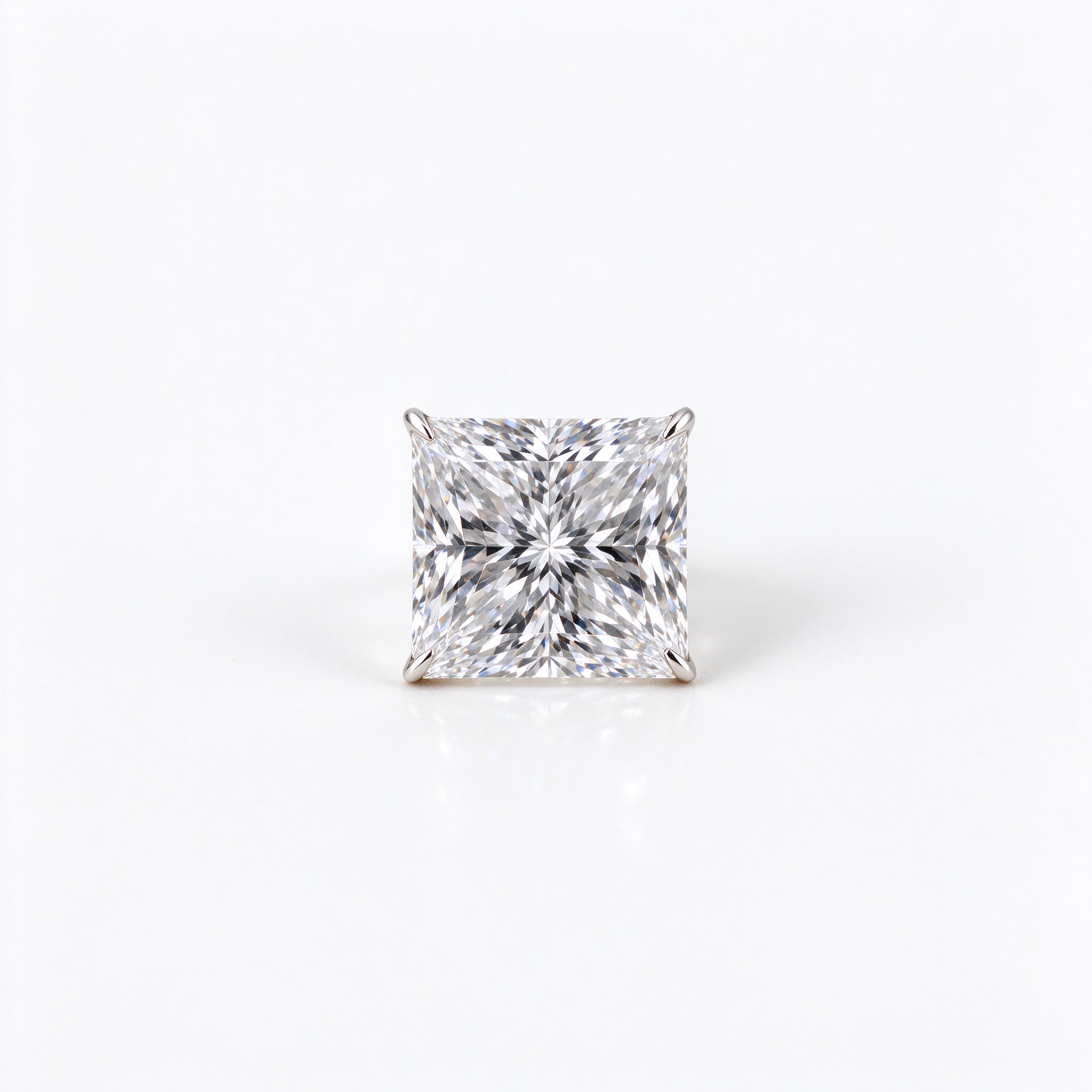
A Seattle retailer lost three princess-cut rings in two months: each had a chipped corner point returned within a year. The stones were certified, the price was fine, and the setting was a standard four-prong solitaire. The problem was that the supplier shipped without any point protection guidance, and the prongs sat on the sharp corners rather than over them. This is what a responsible princess moissanite bulk supply should include—and why the stone is not the whole story.
The princess point problem
A princess cut is a square with brilliant-style facets and four sharp, exposed corners. Those corners catch knocks in daily wear. Moissanite’s 9.25 Mohs hardness is high, but a sharp corner is still a stress point—a direct knock can chip it. The fix is two parts: a well-cut stone with slightly protected corners, and a setting that seats prongs over the point rather than beside it.
| Princess spec | Typical bulk lot | Our standard |
|---|---|---|
| Corner sharpness | Sharp points, no note | Slightly modified corners, checked |
| Square symmetry | ‘Square’ claimed | 90° corners verified, equal sides |
| Color face-up | Color grade loose | Whiter D–F, corners not gray-tinted |
| Point protection note | None supplied | Mounting note with every parcel |
Inside our princess bulk QC
We ship princess cuts as true squares with equal sides and verified 90-degree corners—a lopsided princess reads as a cheap cut instantly. Color is held at D–F near-colorless, because the four corners can read gray if the color drifts. Each corner edge is inspected under the loupe for pre-existing chips before setting. We modify corners slightly (a small ‘cut corner’) to reduce chip risk, and include a mounting note telling your setter to seat prongs over each point. Every stone above 3mm ships with a GRA certificate.
- Shape: true square, equal sides, 90° corners.
- Color: D–F near-colorless, corner tint checked.
- Clarity: VS–VVS; VVS for solitaires.
- Corners: slightly modified, edge-checked for chips.
- Mounting note: prong-over-point protection included.
Princess buying by your channel
Opening a princess line: Start at 10–15 stones, 1.0–1.5ct. Princess cuts appeal to clients who want modern, angular design. Stock true-square silhouettes; avoid the ‘square-ish’ cheap lots. MOQ 10 pieces.
Boutique with steady bridal demand: Lock a lot and hold corner modification across reorders. Princess buyers comparison-shop heavily; a chipped corner on a reorder ring costs the trust built on the first sale. We reserve lots per account.
Private label / OEM: We supply princess cuts set in four-prong or bezel mounts with protected corners, DDP to US/EU, GRA documentation, and a third-party-audited process running since 2016. RMA window 30 days for any corner chip or symmetry defect.
Frequently Asked Questions
Do princess cut moissanites chip easily?
The four corners are exposed, so chip risk is real but manageable. Slightly modified corners and prongs seated over the points reduce chip returns to under 2% in controlled programs.
What is the difference between princess and cushion?
Princess is a sharp, angular square with brilliant facets; cushion is a rounded square with clipped corners. Princess reads modern and geometric; cushion reads soft and vintage.
What carat works best for princess cuts?
1.0–1.5ct is the bridal sweet spot. Princesses face up slightly larger per carat than rounds, so they give good value at the mid weights.
Can princess cuts be used as side stones?
Yes, matched small princess cuts are popular as side stones in three-stone rings. We match by weight and symmetry from the same lot.
Does princess cut moissanite come GRA certified?
Every princess stone above 3mm ships with a GRA certificate confirming carat, cut, color and clarity. IGI documentation is available for high-jewelry accounts.
Which weights actually move
Princess buyers tend to cluster in two weights, and stocking outside them ties up cash. The 1.0–1.2ct tier is the everyday bridal seller—affordable, modern, and large enough to read on a solitaire. The 1.5–2.0ct tier is the upgrade buyer who specifically wants the square look. Below 0.8ct, princesses look small and the corners disappear in the setting; above 2.5ct, the price crosses into territory where clients reconsider an oval or a cushion. We recommend stocking the mid tier heavily and keeping one or two statement stones on hand. Because princesses face up large for their carat, you can market a 1.1ct stone as the equivalent visual weight of a 1.3ct round—a useful margin story that does not require overselling. Track your sell-through by weight at the end of each season and cut the slow tier the following year. A well-stocked princess case turns over the mid tier fastest, so resist the urge to buy large stones just because they photograph well—they sit.
Takeaways
- Demand true-square symmetry—lopsided corners read as cheap.
- Insist on modified corners and point-protection setting notes.
- Hold D–F color; corners show gray tint.
- Lock a lot so corner treatment stays consistent.
Request a sample parcel: MOQ 10 pcs, ships in 5 business days. Explore the princess cut collection, read the princess buying guide, or check bulk pricing.