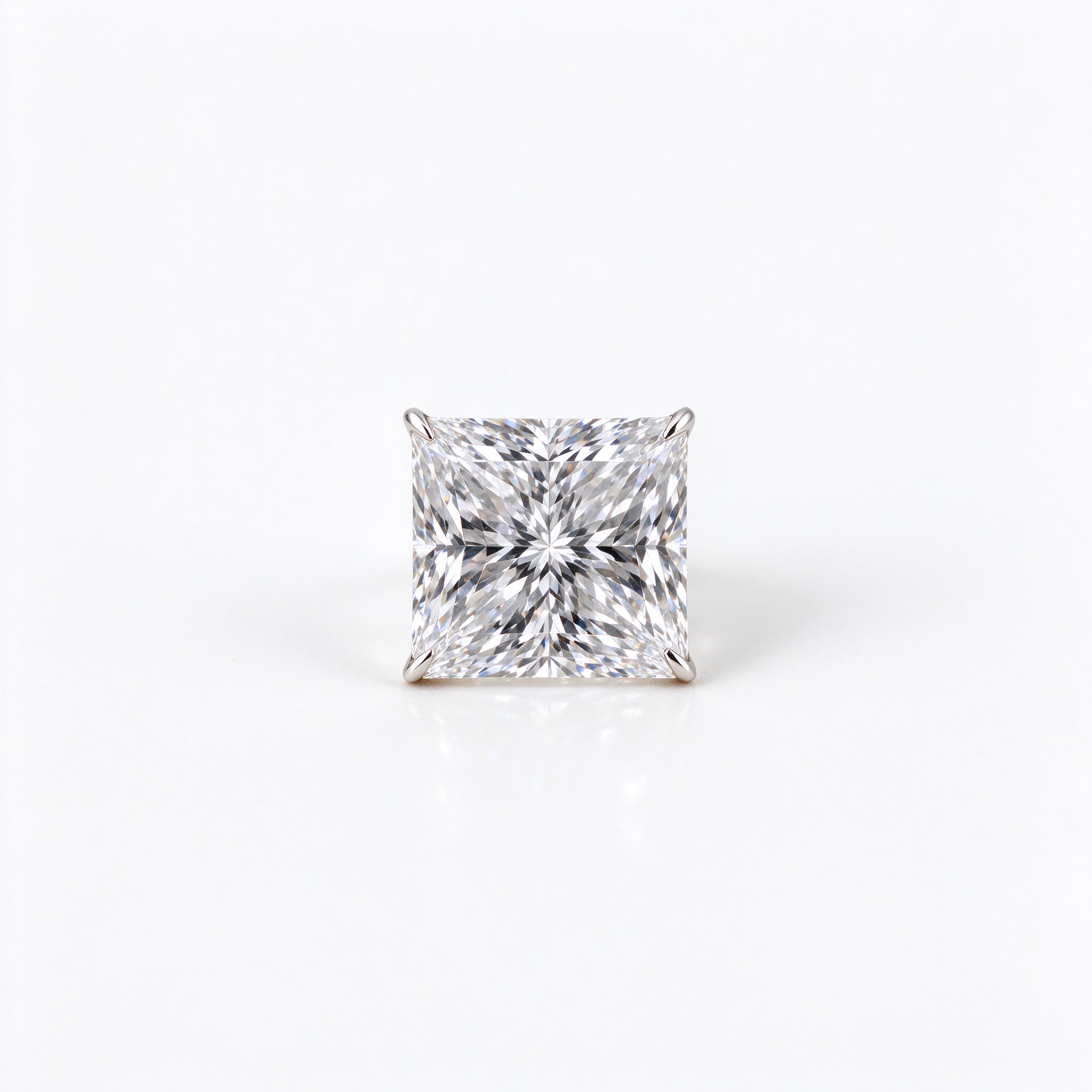
The princess cut is not the 2000s princess
Princess cut moissanite spent several years as a clearance category. It was associated with a specific 2000s bridal look, and boutiques wrote it off. That has reversed. The modern buyer coming in for a princess cut is not shopping her mother's ring; she wants a square, structural, slightly geometric stone that photographs sharply and sits cleanly on a slim band. Wholesale buyers who still treat princess as a slow mover are missing a real recovery.
The demand is driven by two visual trends. First, the return of squared, architectural engagement styling on social media, where a square stone reads cleaner than a round in flat-lay photos. Second, a price-driven buyer who wants the sparkle of a brilliant cut in a square outline, without paying for the faceting cost of a fancy shape. Princess cut moissanite hits both.
Face-up size perception
Princess cut moissanite is a deep cut, and that depth works against its face-up size. A 1.5 carat equivalent princess measures around 7 mm square, which is noticeably smaller on the finger than a cushion or radiant of the same weight. Customers often say it feels smaller than they expected, which is the leading cause of post-purchase hesitation on princess stock.
Wholesale buyers should lead with mm dimensions on the sales floor. A 7.5 mm square princess sells better than a "1.5 carat" princess, because the customer can picture the mm on her finger. For customers who want the square look with more presence, a princess on a thin pavé band or with a thin halo adds visual width without changing the stone. Avoid pairing a princess with a wide band, which makes the square look smaller still.
Metal and setting pairing
Princess cut moissanite is a brilliant cut, so it takes to the same metals as a round: platinum, white gold, and sterling silver all read cleanly. Yellow gold on a princess can look warm and 1990s, which some buyers now want deliberately, but most modern stock goes white. Rose gold is a niche, driven by customers who want a softer bridal look; it sells but slower.
Settings should protect the corners. Princess corners are sharp and unprotected, and a plain solitaire head risks chipping at the tip during everyday wear. A V-prong on each corner is standard. Three-stone princess mounts with round side stones still sell, but the modern move is a single princess on a slim east-west band or a bezel-set princess in a signet-style ring, which suits both women's and men's inventory.
Inventory pitfalls
The main pitfall is buying cheap princess moissanite that looks gray in the corners. Because the cut is deep, light leakage at the pavilion corners shows as dark tips, and moissanite's refractive index makes those tips look darker than a diamond would. This is a cut-quality issue, not a color issue, and it is the most common complaint on princess returns.
The second pitfall is depth. Deep-cut princesses look smaller and darker; shallow-cut princesses look bigger but leak light through the pavilion edge. Wholesale buyers should ask for depth percentages and stay in the middle band. Avoid stocking princesses below 1 carat equivalent for engagement; the square look needs size to read, and sub-1 carat princesses look like small squares rather than intentional stones.
The price point also helps. Princess cut moissanite is cut to a brilliant pattern in a square outline, so the wholesale cost sits below oval or cushion for the same mm size. This makes it a strong value play for the buyer who wants a square shape without paying the fancy-shape premium. Wholesale buyers can position it as the accessible square, which opens the category to customers who would otherwise default to a round.
The princess also layers well. A square stone sits cleanly next to a straight wedding band, and because the cut is a brilliant, it sparkles in a stack without clashing. This makes it a good anniversary and stacker seller, not just an engagement stock. Wholesale buyers who treat princess as engagement-only miss the repeat stacker business that the square shape supports.
Who buys, and what to stock
The modern princess buyer is usually 25 to 35, shopping an engagement ring that is not a solitaire round, and often wants a square that reads modern rather than vintage. The other buyer is a man shopping a signet or pinky ring, where the princess cut's structure reads cleanly. Wholesale accounts should stock a depth of 1 to 2 carat equivalent princesses in white-toned mounts, keep a couple of yellow-gold pieces for the revival buyer, and avoid overstocking sizes above 2.5 carat equivalent, which sell but slowly.
Ask the supplier for corner-treatment photos and depth data before ordering a parcel. A princess that looks clean face-up in soft light is the one that reorders. Tie the princess stock into your moissanite engagement rings line, and train staff to lead with mm rather than carat; that single change removes most of the "it feels smaller" returns.