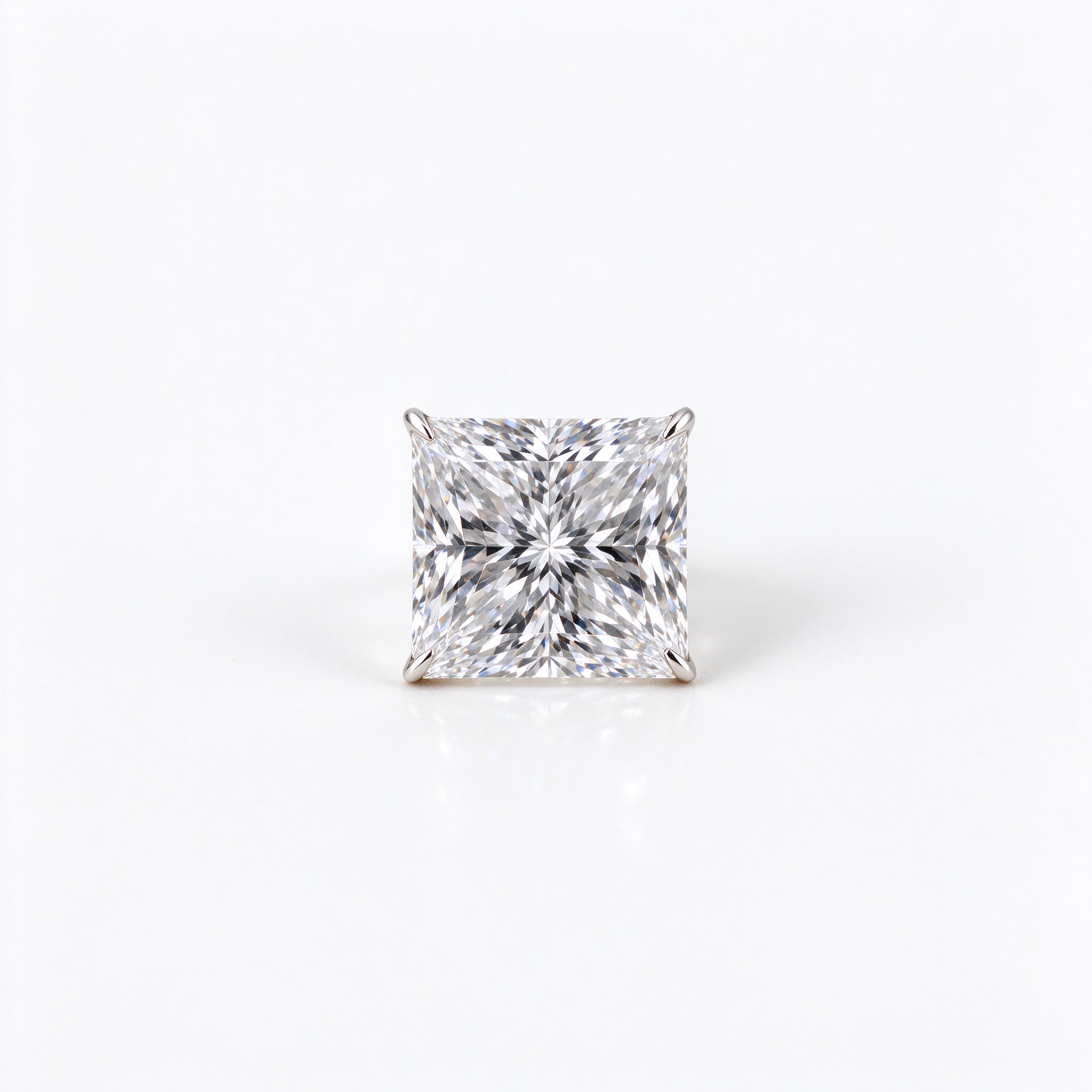
A jewelry store in Tampa bought princess cut moissanites at a bargain per-carat price and discovered the hard way that some princess cuts go dark in the center. The stones looked bright loose under a jeweler’s lamp but turned flat and gray once set in a white-glove window. The cause was a poor cut ratio and a non-standard facet arrangement — the princess cut’s version of the oval bow-tie. Princess cut pricing looks simple on a price list, but the real variable is light performance, and that is where the unexplained price gap lives. Below is our princess spec and the price ladder behind it.
Why princess cuts vary so much
The princess is a square brilliant with pointed corners. Two variables drive its light return:
- Facet arrangement. The classic 4:4 princess (four bezel facets, four pavilion facets) returns light evenly. Variations that add or remove facets can leak light through the center and read dark.
- Ratio. Princesses cut slightly rectangular (1.1–1.2 L:W) read more elongated; square princesses (1.0–1.05) read classic. A tray of mixed ratio looks unfinished.
Princess cuts also have pointed corners that need corner prongs, the same way cushions do.
| Variable | Industry bulk norm | Our princess parcel |
|---|---|---|
| Facet arrangement | Mixed, not documented | Standard 4:4; light-return tested |
| Ratio | Mixed square/rectangle | Square and elongated trays labeled |
| Center brightness | Not measured | Rejected if center reads dark under face-up light |
| Color | D–H mixed | D–F sorted |
The princess spec we publish
We hold princess cuts to the following tolerances, about 20% tighter than bulk suppliers:
- 4:4 facet standard: every princess is cut to the classic 4:4 arrangement, which gives the most even light return. We reject variations that produce a dark center.
- Light-return test: each stone is examined face-up under neutral overhead light. Any princess that reads gray or dark through the center is rejected — this is the single test that stops the “looks flat in the window” complaint.
- Ratio sorting: square princesses (1.0–1.05 L:W) and elongated princesses (1.1–1.2 L:W) ship in separate trays.
- Corner protection: pointed corners are inspected at 10x and tagged with a corner-prong setting note.
- Certification: GRA on every princess with facet arrangement and ratio noted. IGI documentation for US high-jewelery accounts on request.
How to buy by account type
Boutique adding princesses
Start with 20 square princesses in the 1.0–1.5ct bracket, D–F. Square princesses are the classic engagement silhouette and sell well into clients who want a square shape but prefer sparkle over step-cut mirroring.
Full-line bridal store
Carry square and elongated trays. Elongated princesses (1.15 L:W) read modern and pair with bypass settings. We supply matched small princesses for channel-set wedding bands.
Private-label / OEM
We cut princesses to your facet and ratio spec, carded under your brand. Minimum 50 stones per ratio bracket. Export documentation covers EU and US DDP shipping with full customs paperwork.
Frequently Asked Questions
Why do some princess moissanites look dark?
A dark center usually comes from a non-standard facet arrangement or a mis-cut pavilion that leaks light. We reject any princess that reads dark face-up, so the stones we ship return light evenly across the square.
Square or elongated princesses — which to stock?
Square princesses are the default engagement silhouette and outsell elongated roughly two to one. Stock elongated princesses if your clientele leans modern; otherwise keep square as the core.
What MOQ applies to princess parcels?
Opening MOQ is 20 princesses in one ratio and carat bracket. Reorders start at 10. Private-label programs require 50 stones per bracket.
Are princess moissanites durable?
Yes, with corner prongs. The pointed corners chip if left unprotected, so we tag every princess with a corner-prong setting note. Moissanite’s Mohs 9.25 handles daily wear well once the corners are protected.
How long do stock princesses take?
Stock princesses ship in 5 business days. Custom-ratio or private-label parcels run 15–20 business days, DDP to US and EU addresses.
How princess pricing compares to squares and cushions
Princess cuts sit between rounds and cushions on our price ladder: roughly 5–10% above a round of the same carat, and about 10% below a well-matched cushion. The retail upside is that a princess reads as a modern square shape to clients who have ruled out step cuts for being too quiet. For a boutique that already carries rounds and wants to extend the square-shape story without stepping into emerald territory, the princess is the natural next SKU to add.
When you compare quotes, ask specifically whether the 4:4 facet standard is included. A supplier quoting a lower per-carat number is often shipping a non-standard facet mix that returns dark in the window; once you account for the re-cut or the markdown, that lower quote usually lands higher than ours on the mid tier.
Takeaways
- Require the standard 4:4 facet arrangement on every princess PO.
- Reject stones that read dark through the center face-up.
- Keep square and elongated ratios in separate trays.
- Tag pointed corners for corner-prong settings.
Request a princess sample parcel: 20 square princesses, 1.0–1.5ct, D–F, ships in 5 business days. Browse the princess collection, read our square-cut guide, or apply for wholesale pricing. Finished princess rings are listed under engagement rings.