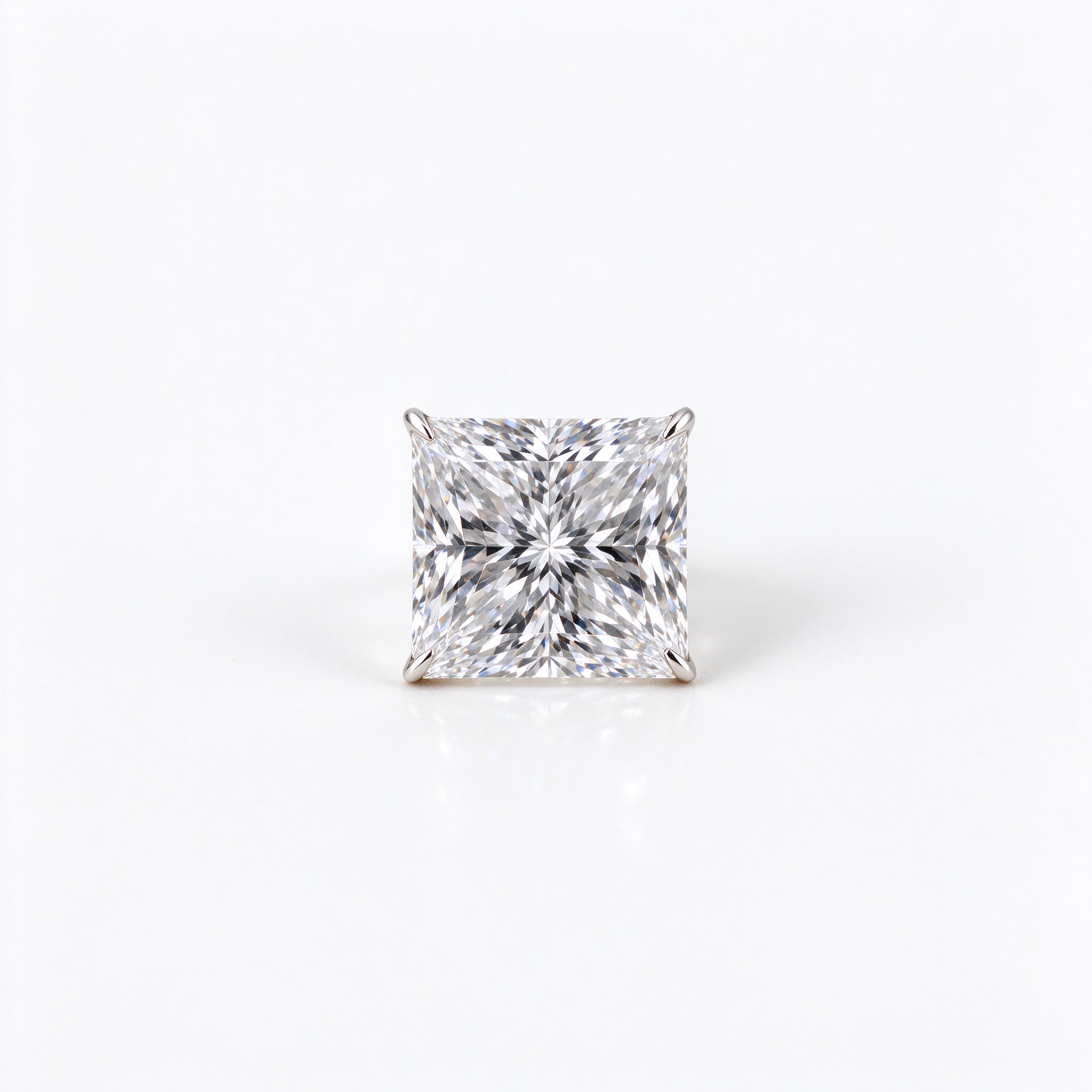
The princess cut is the square brilliant, and it is the most setting-dependent of all the mainstream cuts. A well-cut 1.5ct princess moissanite can crack or chip in a badly chosen head, while the same stone survives for decades in the right one. Wholesale buyers who treat the head as an afterthought get returns, resize damage and corner chips on the bench. The cut itself dictates the hardware.
Why the Princess Cut Dictates the Head
A round brilliant is round all over; its weakest point is the girdle, which a standard four- or six-prong head covers easily. A princess has four sharp 90-degree corners, and those corners are the thinnest, most exposed part of the stone. Moissanite hardness sits at 9.25 on Mohs, which is exceptional, but hardness is not toughness. A corner hit at the wrong angle still cleaves or abrades. About 80 percent of princess-cut damage we see on returns traces back to an unprotected corner rather than a flawed stone.
The job of the head is therefore to hold the corners without covering the face. That is a narrower design problem than a buyer might assume.
V-Prong vs Bead Prong
A round stone held with round bead prongs will sit fine. A princess held with the same round bead prongs lets the corner poke past the prong tip, exposed. The fix is the V-prong (also called a claw or corner prong): a prong shaped like a V that cups the outside of each corner. Four V-prongs, one per corner, is the industry default for a princess solitaire. Six-prong versions exist for larger stones (1.5ct and up) where two prongs share the load at each corner.
Avoid heads designed for rounded fancy shapes - pear, marquise, oval - being pressed into princess service. Their prong spacing does not line up with square corners, and the stone rattles or tilts.
Head Sizes and Basket Depth
Princess moissanite is cut with a fairly thick girdle, and the basket under the head needs to sit deep enough that the pavilion does not rub the finger. When buyers order heads to match a stone, the two measurements that matter are the seat diameter (the square across-flats dimension) and the basket depth. A seat that is slightly too small is better than one too large; too large and the stone shifts under load.
Stock heads in the common princess sizes: 4x4mm through 8x8mm in 0.5mm steps for the bulk of retail sales. Anything above 9x9mm is usually special order because retail clients buying that size want a custom head anyway.
Setting Styles That Work
- Cathedral solitaire - the arched shoulders lift the stone and let two of the four corners tuck under the metal, adding corner protection without a halo.
- Hidden halo - a ring of pavé sits under the stone rather than around its face; popular for clients who want sparkle without changing the square silhouette.
- Trellis or split-shank - open shoulders keep the face visible while the four V-prongs carry the stone.
- Partial bezel - a four-corner partial bezel is the most protective option and suits clients with active lifestyles.
Settings to Be Cautious With
Full bezels that wrap the entire perimeter are risky on a princess. The square corners press against the metal, and a slight sizing change can exert pressure on the corner that chips it. Thin solitaire heads with round prongs marketed as "fits any shape" should be avoided; they are built for rounds. Tension settings are also out for princess - the corner is the first point to fail under tension.
Sizing and Resize Damage
Sizing a princess ring down or up changes the stress on the corners. When a ring is sized down, the shank is tightened, and that tension travels up the shoulders to the head. A poorly supported princess corner takes the brunt of that squeeze. Bench jewelers know to stretch the head slightly during sizing rather than forcing the shank closed, but that is a skilled step, not a default. For wholesale buyers, this means the head on a princess piece should be sized at the factory before the stone is set, whenever possible. Setting the stone after sizing removes the resize-tension problem entirely.
If a princess solitaire must be sized after the stone is set, flag it to the bench. A quick check after sizing - looking at each corner under a loupe for new cracks - prevents a chip from being passed to the retail client.
What to Ask Your Supplier
Before committing to a parcel, ask the supplier three things: whether the heads are specifically cut for square princess seats, whether V-prongs are standard on their princess line, and what return policy applies if a stone chips within the first 90 days. A supplier confident in their head design will answer all three plainly. Ask also whether they size the head before setting; factories that size-then-set have lower princess return rates than shops that set-then-size.
For buyers assembling a moissanite rings program, matching stone size to head size before soldering is the single biggest step to reducing bench returns. The princess cut, for all its sparkle, is a hardware problem as much as a stone problem.
The princess cut rewards buyers who plan the head first. Pick the head, size the stone to it, set the stone after sizing, and the cut does the rest.