Princess cut moissanite has a returns problem that has nothing to do with the stone itself and everything to do with the setting. A boutique in Cologne reported a cluster of chipped corners on princess rings returned within six months of sale. The settings used round prongs placed beside the corners instead of V-prongs wrapping them. The stones were fine; the mounting was wrong.
Princess cuts are the highest-margin square shape in a moissanite catalog. This guide covers the corner-protection rules, the proportion data to buy by, and the QC steps that prevent the return cluster.
Why princess corners fail
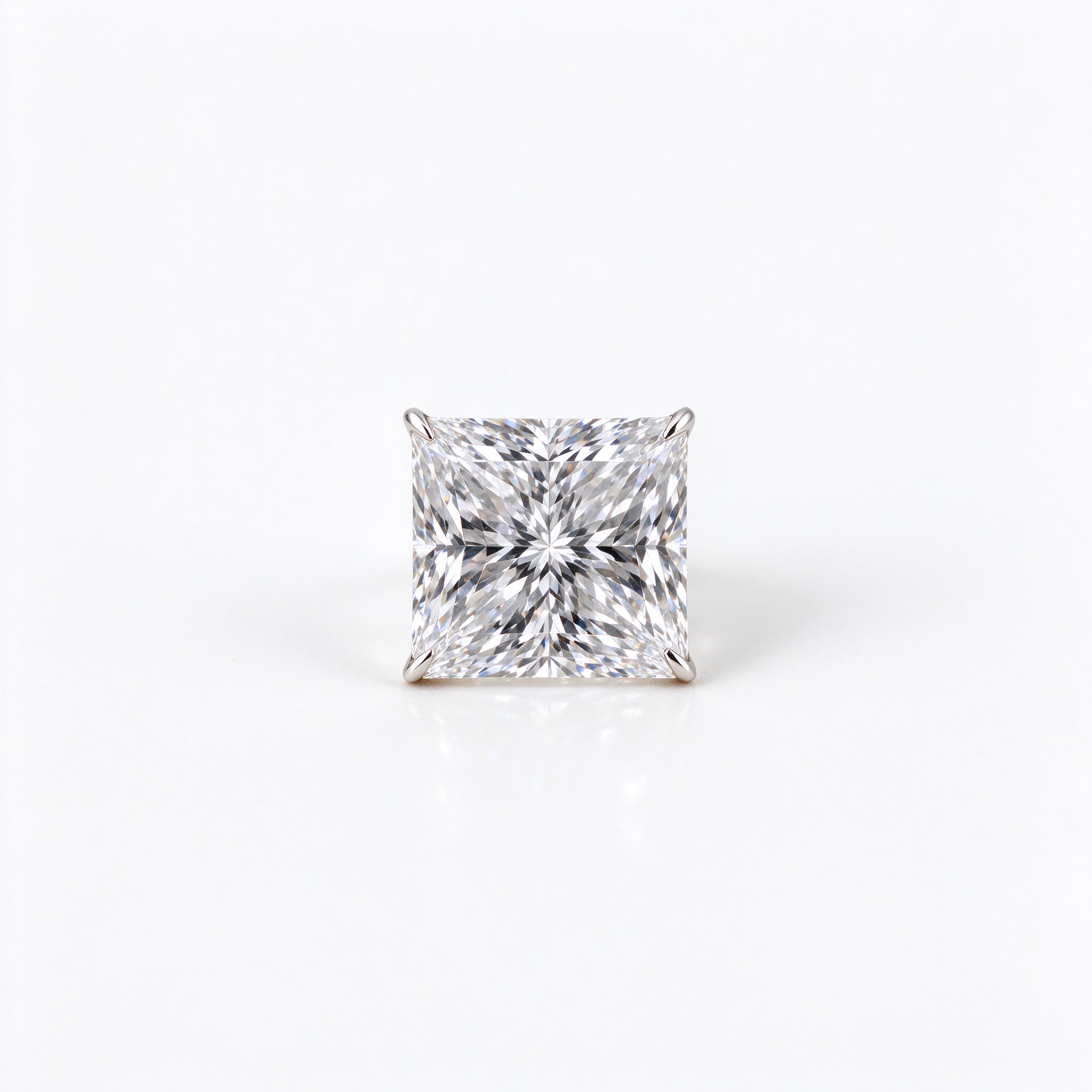
A princess cut is a square brilliant with facets running down the pavilion in a V-pattern. Its four corners are sharp points with a thin girdle. Two failure modes dominate. Chips during resizing happen when a ring mandrel presses against the corner; without a V-prong wrapping the point, the corner cracks along the facet line. Impact chips in wear happen because a square corner catches on flat surfaces, while round brilliant edges roll off and princess corners do not.
The fix is setting discipline, not a different stone. Every princess ring should use V-prongs, also called claw prongs, that cup each corner from two sides. A round prong placed beside the corner, however well seated, leaves the point exposed. We estimate that unprotected princess corners chip at roughly 4x the rate of V-pronged corners over a two-year wear window. Moissanite's hardness of 9.25 on the Mohs scale, versus diamond 10 per the gem hardness data, means the stone scratches less than most alternatives, but hardness does not prevent impact chipping at thin edges. Tell this to retail customers at the counter; it sets warranty expectations correctly.
Facet patterns and light performance
Modern princess cuts use one of two pavilion patterns. The four-sided V-pattern has clean straight facets, strong contrast, and the classic princess look, with higher fire and slightly more visibility of inclusions. The criss-cross or modified pattern has more facets, denser sparkle, and better ability to hide minor inclusions, with slightly less contrast.
Both sell. The four-sided pattern is preferred for the minimalist square look; the criss-cross pattern sells as the sparkly square alternative. Stock one of each in an opening princess parcel; do not assume princess means one look.
Proportion tolerances for princess parcels
Princess cuts are proportion-sensitive. The length-to-width ratio should stay 1.00–1.05; an off-square stone reads as a rectangle, not a princess. Depth should be 65–75%; too shallow gives a dark centre and too deep looks small. Table should be 65–75%; a large table means less fire and a small table looks dark. The girdle at corners should be slightly thick; paper-thin corners chip in transit.
A 1.0ct equivalent princess measures about 5.5 mm square, smaller face-up than a round of the same weight. Customers should be told this: the princess is a look shape, not a size shape. A 1.5ct princess at 6.5 mm square is the sweet spot for engagement demand. Every stone should be checked off-square; a 2% deviation is visible on the finger and drives returns.
QC checklist for incoming princess stock
Before a princess parcel ships from us, each stone passes four checks. Wholesale buyers should apply the same list. Corner chip inspection under 10x magnification: any existing chip is rejected before the parcel ships, not after the customer returns it. Square alignment measured across diagonals, with a difference under 1%. Eye-clean from 30 cm, because princess inclusions show more than round inclusions since facets run straight to the corners. Girdle finish must be finished, not bruted, because a rough girdle reads as a gray ring around the square.
Pair princess stock with cushion cuts for customers who want square geometry but softer corners, and with radiant cuts for customers who want square lines with step-cut fire. For staff explaining the legal side, the FTC jeweller guide (16 CFR Part 23) is the reference for accurate moissanite disclosure at the point of sale.
Frequently Asked Questions
Do princess moissanite stones chip easily?
Sharp, thin corners chip more readily than round edges. V-prong settings that cup each corner reduce chipping by roughly 4x versus round prongs placed beside the corner.
What setting is best for a princess cut?
A solitaire with four V-prongs, one per corner. Cathedral heads work if the prongs are V-shaped; standard round-prong heads should be avoided for princess centre stones.
Why does a princess look smaller than a round of the same carat?
Princess cuts are cut deeper than rounds. A 1ct princess measures about 5.5 mm square versus a 6.5 mm round. Customers shopping for visible size prefer ovals; customers shopping for geometry choose princess.
What L/W ratio is acceptable for princess stock?
1.00 to 1.05. Off-square stones read as rectangles and return; reject anything beyond 1.05.
Can princess moissanite be used in studs?
Yes, as matched pairs. Corner protection in stud settings is less critical than in rings, but pair symmetry must be within 1% on the diagonal measurement.
Request a princess sample parcel: 3 stones (5.5, 6.5 and 7.5 mm square), corner-checked, GRA-certified, V-prong-ready. Open wholesale terms for tiered square-shape pricing, or read the Asscher square step-cut guide for the step-cut alternative.