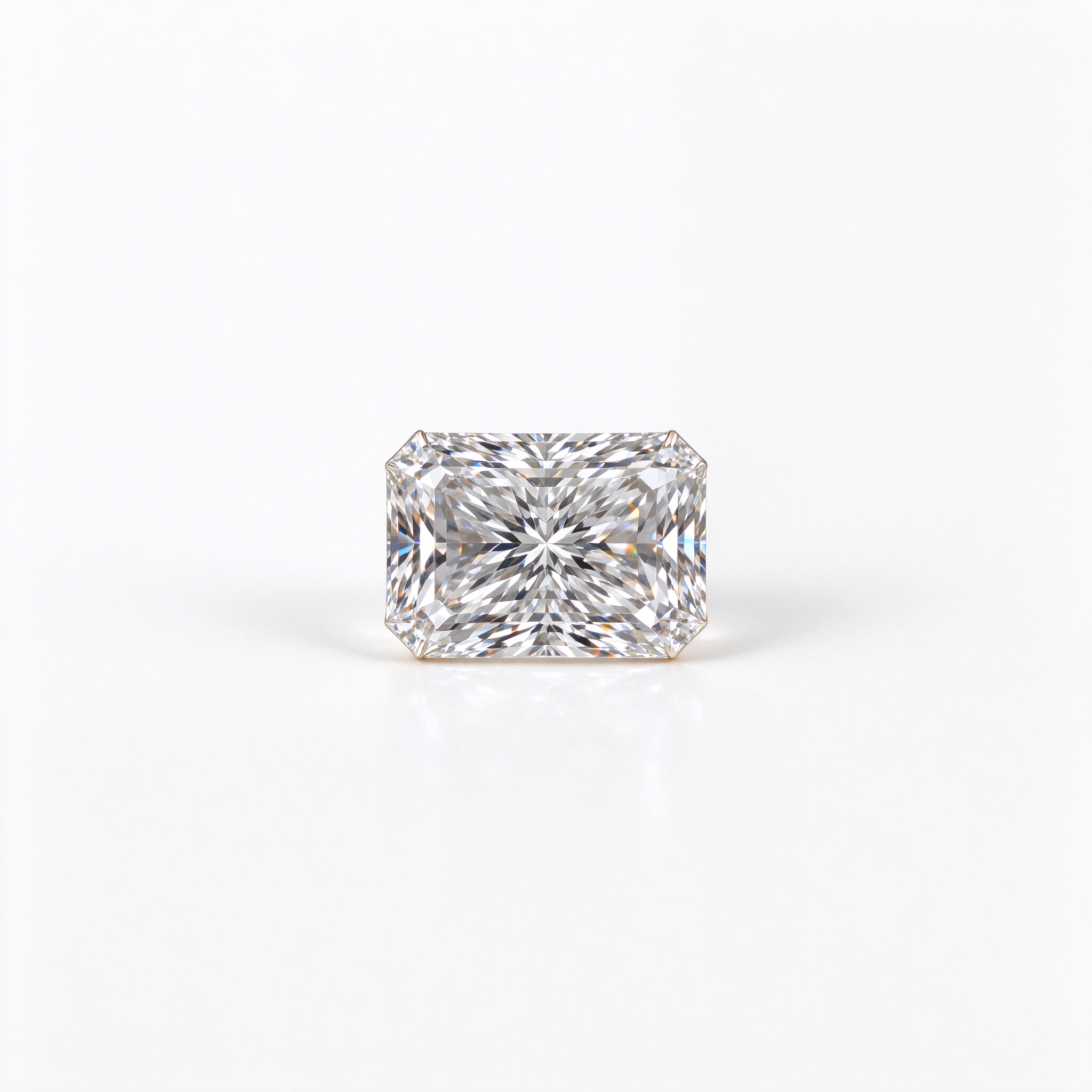
A fancy shape at a brilliant price
Radiant cut moissanite is the value story in the fancy shape category. It has the cropped-cornered square or rectangular outline that reads like an emerald or cushion, but it is cut with a brilliant facet pattern underneath, so it sparkles like a round. The customer perceives a premium fancy shape; the wholesale buyer pays a price closer to a round brilliant. That gap is where the margin lives.
The retail demand is steady rather than viral. The radiant buyer is usually shopping an engagement ring and wants something that is not a round, not a cushion, and not an emerald. They have narrowed down to a cut that has sparkle but also a clean square outline. This buyer is comparison-shopping, and the radiant wins on value because it looks larger and more expensive than its price suggests.
Face-up size perception
Radiant cut moissanite spreads well. A 1.5 carat equivalent radiant measures around 7.5 mm square, which reads larger than a princess of the same weight and close to a cushion. The cropped corners mean the face-up stone looks wider than a sharp-cornered square, and the brilliant facets keep it bright even in lower light. This is why customers say the radiant "looks like a 2 carat" when it is a 1.5: the spread and the sparkle combine.
The perception pitfall is the rectangular radiant. Long rectangular radiants read elegant but smaller, because the eye follows the length rather than the area. For most boutique stock, the square or near-square radiant at 1 to 1.5 carat equivalent is the sweet spot. Reserve long rectangles for customers who specifically want an east-west or elongated look.
Metal and setting pairing
Radiant cut moissanite is a brilliant cut, so it takes to white-toned metals cleanly: platinum, white gold, and silver all suit it. Because it also has the cropped-corner geometry, it pairs well with both brilliant and step-cut side stones. Round melee in a halo adds width; baguettes on the side extend the rectangular line. The radiant is the most flexible fancy shape for setting, which is why custom designers like it.
A solitaire on a slim band is the cleanest look. A thin pavé band adds sparkle without crowding the stone. Bezel settings on a radiant read modern and protect the cropped corners, which is useful because the corners are sharp enough to chip in an unprotected head. Avoid a wide bulky band, which fights the square geometry.
Inventory pitfalls
The main pitfall is buying radiants that look too much like cushions. A poorly cut radiant has cushion-like soft facets and loses the clean square outline that justifies the price. Wholesale buyers should ask for facet-pattern photos; a radiant should show a crisp star pattern on the table and clear cropped corners, not a fragmented cushion look.
The second pitfall is depth. Deep radiants look smaller and leak light; shallow radiants window. Moissanite's double refraction makes shallow radiants show a gray cast through the table. Stay in the middle depth band and ask the supplier for depth percentages. The third pitfall is corner chipping during resize; always order with protected corners or plan for a V-prong setting.
Radiant also works well in matching sets and anniversary stackers. The cropped-corner square nests cleanly next to a round band, and the brilliant sparkle means it layers with other stones without clashing. This makes radiant a good add-on seller: a customer who buys a round solitaire will often add a radiant stacking band, which lifts the average ticket without requiring a separate marketing push.
Radiant also appeals to the buyer who wants a square shape but finds the princess too small. The radiant's spread and brilliant facets give it more presence on the finger than a princess of the same weight, which is why customers who try on a princess and feel underwhelmed often settle on a radiant. Wholesale accounts that stock both shapes capture that comparison sale rather than losing it to the next boutique.
Who buys, and how to stock it
The radiant buyer is a 25 to 40 engagement shopper who wants a square shape with sparkle, and the custom designer building a three-stone or halo piece. Wholesale accounts should stock a depth of square radiants at 1 to 2 carat equivalent in white-toned mounts, keep a few rectangular radiants for elongated-look customers, and avoid going above 3 carat equivalent unless ordered. The radiant is a steady reorder, not a seasonal peak, so it works as core inventory rather than campaign stock.
Ask the supplier for both face-up and side-angle photos, and compare the spread mm against the carat weight before ordering. The value play only works if the stone actually spreads. Tie radiant stock into the loose moissanite range for designers, and keep finished rings for the off-the-shelf bridal buyer; the two channels move at different speeds and both need stock.