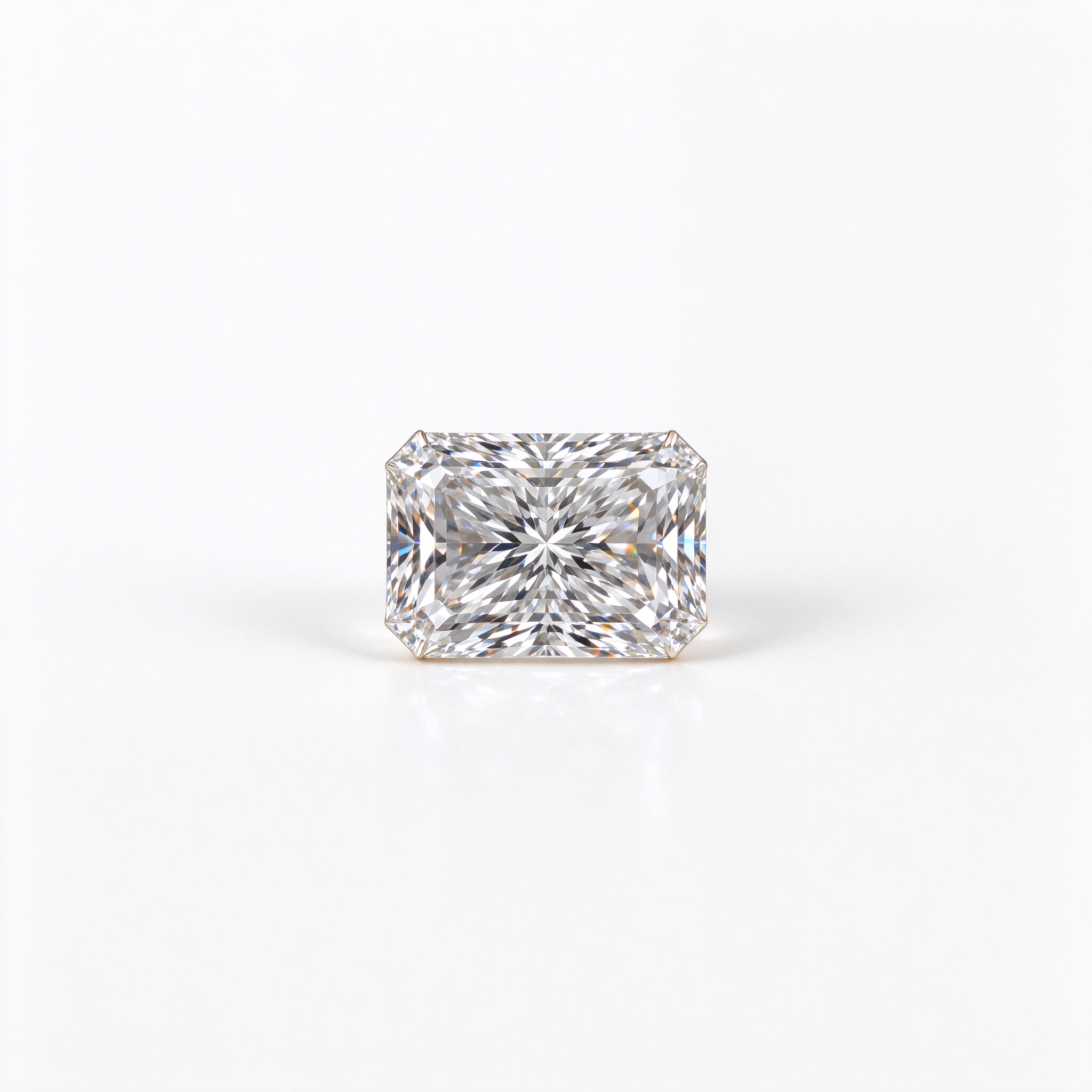
A boutique in Chicago told us their cushion tray was sitting, but clients kept asking for "something square that actually sparkles." They swapped half the cushion tray for radiant cuts and turned the section in six weeks. The radiant cut is the modern square: it has the clipped corners of an emerald with the brilliant facet pattern of a round, so it reads as a step-cut shape but fires like a round. Wholesale radiant moissanite is where square-cut demand is moving in 2026, and most trays are understocked. Here is the ratio ladder we ship and how to position it.
Why radiant is gaining on cushion
Cushion cuts trade sparkle for a soft, vintage read. Emerald cuts trade sparkle for clean architectural lines. The radiant cut was built to have both: clipped corners (so no sharp princess point to chip) plus a brilliant facet pattern (so it fires like a round). For a client who wants a square shape without the dull step-cut face-up look, radiant is the answer. In our accounts, radiant pull-through has roughly doubled over the last 18 months while cushion demand has flattened.
| Cut | Shape read | Sparkle | Corner risk | Typical price vs round |
|---|---|---|---|---|
| Radiant | Square / soft rectangle | High (brilliant) | Clipped, low | 10–20% below |
| Cushion | Square pillow | Medium | Rounded, low | 15–25% below |
| Emerald | Rectangular step | Low (mirror) | Clipped, low | 20–30% below |
| Princess | Square sharp | High | Sharp corner, high | 15–25% below |
The ratio ladder we stock
Radiant cuts come in square and rectangular. We hold both, sorted by ratio:
- Square radiant (1.0–1.1): the modern square; strongest engagement demand, pairs with halo and solitaire settings.
- Soft rectangle (1.2–1.3): lengthens the finger; the most popular radiant ratio for east-west and three-stone settings.
- Elongated (1.4–1.5): a fashion statement; reads almost emerald-like but still fires.
Every radiant ships with clipped corners inspected for symmetry, D–E–F color, and a closed culet. Because the corners are already clipped, radiant stones don't need the V-prong treatment princesses do — standard prongs seat cleanly, which is part of why they're a lower-return SKU.
How to stock radiant by scenario
Boutique swapping a slow cushion tray
Convert half your cushion stock to square and soft-rectangle radiants. Keep one cushion tray for the vintage client. Radiants out-sparkle cushions, so the same square-shaped clientele picks them over a duller cushion when both are displayed.
High-end bridal
Stock square radiant solos plus elongated radiant three-stones. The clipped-corner rectangular radiant with tapered baguettes is a strong design-led SKU that reads luxury without the emerald's low-sparkle problem.
Private-label / manufacturer
Lock a ratio band (square 1.0–1.1 or soft rectangle 1.2–1.3) across a bulk run. Radiants set cleanly in standard prongs, so automatic tooling works without corner protection. We hold cut-sheet archives for reorders.
Pricing positions radiant between cushion and round, and that is where the margin lives. A client who wants the square shape but balks at the cushion's softer sparkle will pay near-round pricing for a radiant, because the sparkle is near-round. The accounts that win on radiant are the ones that display it next to a round and a cushion and let the comparison do the selling — the hybrid sparkle reads immediately side by side.
On price, radiant sits close enough to round that clients who start on a round trade up to a radiant when they see it in the case. The accounts that grow fastest are the ones that carry both: a round tray for the default client, a radiant tray for the client who wants something slightly different, and a cushion tray for the vintage client. That three-tray split covers square and round demand without overcommitting to slow step cuts.
Frequently Asked Questions
What is a radiant cut?
A radiant cut is a square or rectangular stone with clipped emerald-style corners and a brilliant-cut facet pattern. It combines the architectural shape of an emerald with the sparkle of a round.
Do radiant cuts need special prongs?
No. Because the corners are clipped, standard prongs seat cleanly. Unlike princess cuts, radiants don't require V-prong corner protection, which makes them a lower-return SKU.
What ratio sells best?
Square 1.0–1.1 and soft rectangle 1.2–1.3 are the workhorse ratios for engagement. Elongated 1.4+ radiants are a design statement, not a tray staple.
How does radiant price compare to round?
Radiants typically run 10–20% below rounds per carat, priced between cushion and round. The hybrid sparkle makes them closer to round in retail appeal than cushion.
What is the MOQ for wholesale radiant?
Opening trays start at 10 pieces. Bulk runs of 100+ pieces per ratio band qualify for locked pricing and cut-sheet archiving.
Takeaways
- Radiant is the rising square cut: step-cut shape with brilliant sparkle, and no corner-chip risk.
- Convert slow cushion trays to radiants; the same square clientele picks the sparklier option.
- Stock square 1.0–1.1 and soft rectangle 1.2–1.3 first; elongated is a design SKU.
- Request a radiant sample: MOQ 10 pcs, ships in 5 business days.
View our radiant cut moissanite, read the square cut comparison guide, or see radiants set in engagement rings. Boutiques can request a radiant sample directly.