A retailer in Lyon walked into a trade show looking for something that sells like a round but looks like a square. The answer they came back with was radiant moissanite. The radiant is the shape that combines step-cut corner lines with brilliant-cut fire, and after oval it is the fastest-growing fancy shape in our book. The first decision buyers must make is not supplier; it is square versus rectangular.
This guide covers the ratio window for each, the customer who picks each, and the margin data behind the decision.
What a radiant cut actually is
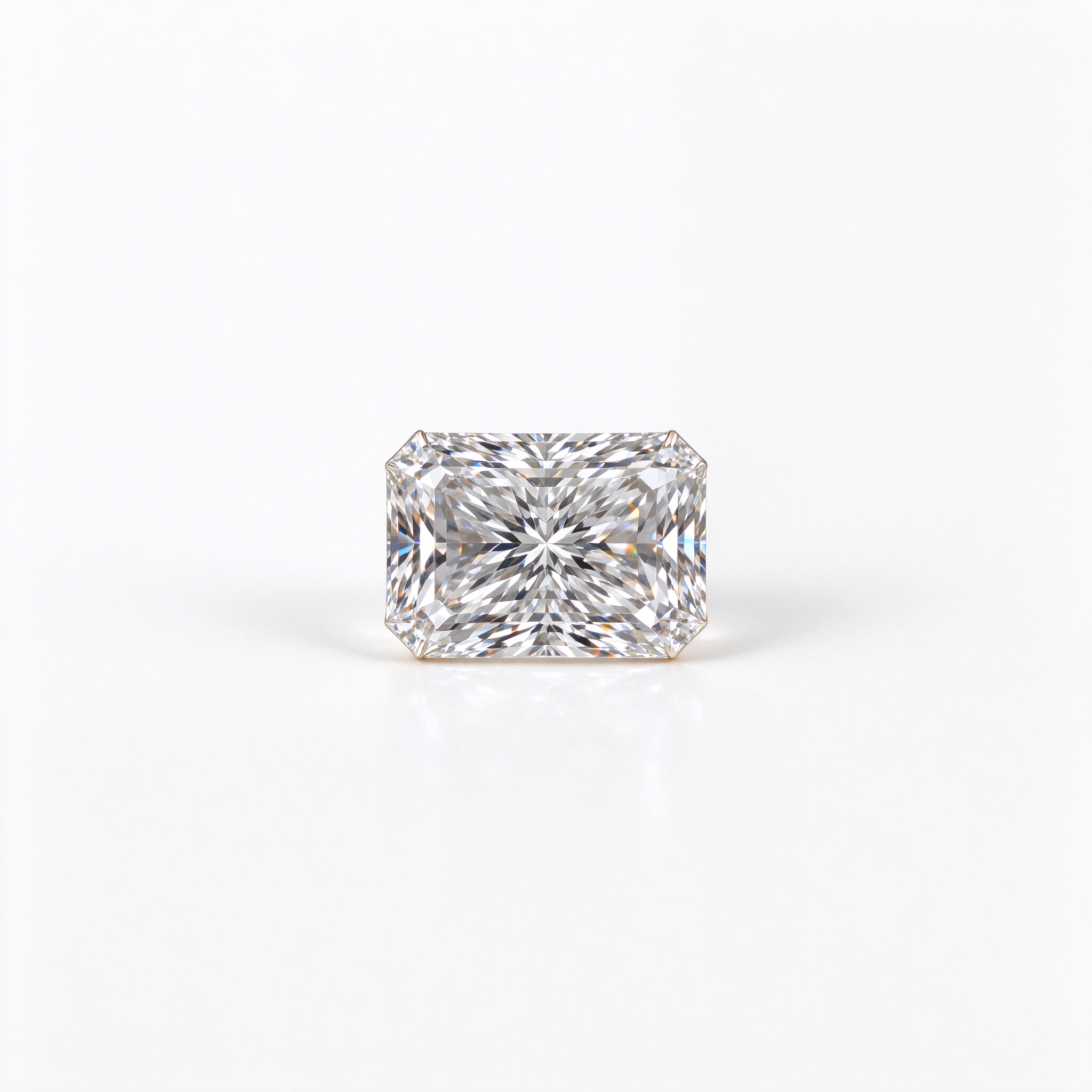
The radiant cut has a square or rectangular outline with clipped corners, and a pavilion that mixes step facets near the girdle with brilliant facets toward the centre. Typically 65–70 facets. The result is the square geometry of an Asscher with the fire of a round: the stone reads modern, angular and sparkly in the same glance.
That combination makes the radiant the bridge shape in a jewelry store. It sells to customers who want the rectangular look but do not want the step-cut quiet of an emerald. Because moissanite dispersion is high (about 0.104, per the moissanite reference), the radiant's mixed facet layout flashes colour along the step lines and sparkle in the centre, which most customers read as richer than a plain round.
Square vs rectangular: the ratio decision
Radiant stock splits into two merchandising categories. The square radiant, with a length-to-width ratio of 1.00–1.05, is the modern bridal and halo buyer's stone, and it fits standard square heads and pavé. The rectangular radiant, at 1.15–1.35, is the emerald-curious and elongated buyer's stone, and it suits east-west mounts and baguette sides.
Our book shows the square radiant moving about 60% faster than the rectangular version. The reason is setting compatibility: most retailers already stock square halo and pavé heads, and a square radiant drops straight in. The rectangular radiant needs a dedicated head and a customer who already wants an elongated shape. For a first-time radiant buy, start two square stones for every one rectangular. Reorder based on local demand; in coastal and metropolitan accounts, the rectangular share climbs to 40–50% within a year.
Proportion and corner tolerances
Radiant cuts carry the same corner-protection logic as princess and cushion. Our parcel inspection holds square alignment within 1% (an off-square radiant reads as a rectangle, confusing the customer who expected the square variant), depth at 60–70% (shallow radiants window and deep ones look small), clipped corners present but not extreme (the corner clipping is what separates a radiant from a princess; too little clipping reads princess-like and too much reads octagonal), and eye-clean from 30 cm (mixed facets hide more than step cuts but less than rounds). A 1.5ct equivalent square radiant measures about 6.5 mm square; a rectangular 1.5ct measures about 8.0 by 6.0 mm. Price by millimetre, not by carat, for the same reason as ovals: face-up size is the product.
Where the radiant fits in the cut mix
The radiant is a sell-up shape, not a base shape. Merchandise it between round brilliants for customers who want more geometry than a round but are not ready for step cuts, between emerald step cuts for customers who like rectangular lines but worry about step-cut quiet, and between chunky cushions for customers who want soft corners instead of clipped ones.
Margin-wise, radiant parcels sit between rounds (fast turn, narrow margin) and step cuts (slow turn, wide margin). Most boutiques that add a radiant line see attach rate climb within a few months, because the shape answers a customer question the shop could not previously satisfy. Every radiant stone ships GRA-certified; for US-facing accounts we can add IGI documentation alongside, which helps staff explain moissanite versus lab-grown diamond at the counter.
Frequently Asked Questions
What is a radiant cut?
A square or rectangular cut with clipped corners and a mixed pavilion: step facets near the girdle, brilliant facets toward the centre. It combines step-cut geometry with round-style fire.
Square or rectangular radiant, which should I stock first?
Square. Square radiants fit standard halo and pavé heads and move about 60% faster than rectangular versions. Add rectangular stones as reorders prove demand.
What L/W ratio is acceptable for radiant stock?
Square 1.00–1.05, rectangular 1.15–1.35. Outside these bands the shape reads as a different cut (princess, emerald, or off-square).
Do radiant stones need corner protection?
Clipped corners are less fragile than princess corners, but V-prong protection is still recommended for ring settings to prevent chipping during resizing.
How does a radiant compare to a cushion?
Radiants have crisp clipped corners and step-brilliant mixed facets; cushions have rounded, softer corners. The radiant is the modern angular alternative, the cushion the vintage soft alternative.
Request a radiant sample parcel: 3 stones (2 square, 1 rectangular), 1.0–1.5ct equivalent, GRA-certified. Apply for wholesale pricing, or read the Asscher square step-cut guide if you also want to add a pure step-cut square.