The round brilliant is the shape most first-time moissanite buyers still default to, which is exactly why the solitaire head you build around it matters so much. A round stone in a four-claw head and the same round stone in a six-claw head are two different products at two different price points, and a lot of wholesale buyers only figure this out after their first reorder. This guide walks through the tradeoffs between four-prong and six-prong round moissanite heads so you can stock both on purpose rather than by habit.
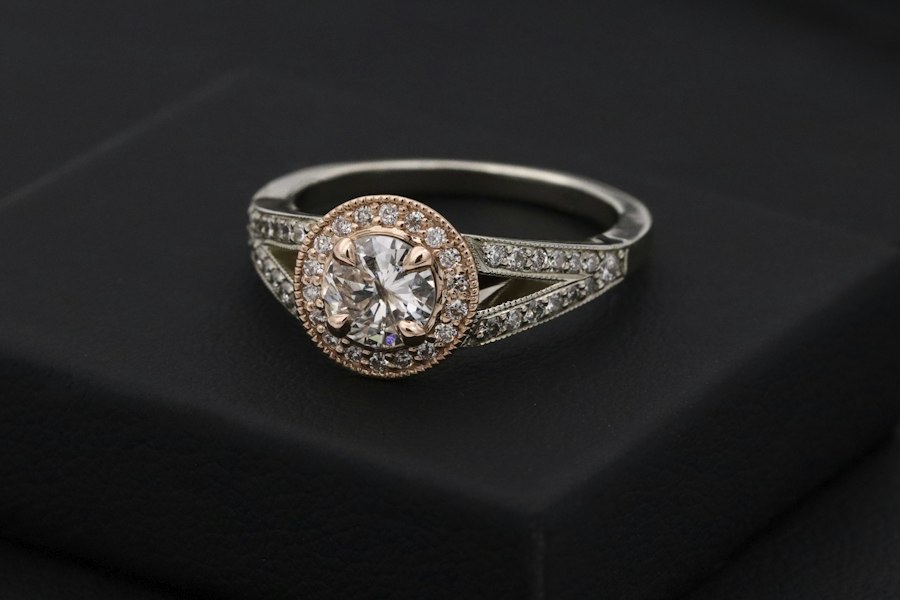
Start with the stone itself. Lab-created moissanite ranks around 9.25 on the Mohs scale, second only to diamond, so a well-set round brilliant rarely cracks from everyday wear. What does fail on the bench is not the stone, but the claws gripping it. A claw that loosens lets a 6.5 mm round spin in its seat, and a spinning stone is a warranty ticket waiting to happen. That fact should frame the whole prong-count decision.
What four prongs get you
A four-prong head leaves more of the crown open to light. Less metal means more face-up brilliance and a slightly larger apparent size, because the eye reads the whole girdle rather than six interruptions. It also uses noticeably less gold or platinum per piece, which is why four-claw solitaires are the standard entry-point solitaire on price-conscious lines. The tradeoff is security: four points of contact put more stress on each claw, and a prong that catches on a sweater thread or a door handle bends more easily when it is doing the work of one-and-a-half claws.
For a round brilliant, four prongs work best when the head is sized tightly to the girdle and the claws are rounded and sturdy rather than long and needle-thin. A delicate talon claw on a four-prong head looks premium in the catalog photo and comes back bent in the first quarter. Spec medium or heavy claws in your production notes, and your after-sales rate drops immediately.
What six prongs get you
Six prongs spread the retention load across more points. Each claw bears less, loosens less, and survives an active lifestyle better. That is why six-claw heads dominate the durable, everyday-wear segment and the higher-margin bridal rebuilders. The cost is real: roughly 15 to 25 percent more metal in the head depending on karat and design, plus slightly more bench time to align six claws evenly.
The visual tradeoff is softer too. Six claws cover more of the girdle, so the stone reads a touch smaller and a touch quieter face-up. Buyers who compare photos side by side often describe the four-prong as "sparklier" and the six-prong as "safer and more solid." Neither is wrong; they target different customers.
How to price and tier the two heads
Most profitable wholesalers run both heads on the same core stone size rather than forcing one choice. Stock your staple round sizes—around 5 mm, 6.5 mm, and 8 mm—in a four-prong head for the value tier and a six-prong head for the premium tier. The same 6.5 mm DEF moissanite goes into both, so you are not doubling your loose-stone inventory, only your head tooling and casting. Read more on how that mm-based stocking logic works in our round moissanite wholesale buying guide.
When you quote, separate the stone cost from the setting cost on your sheet. Retail partners can then upsell a customer from the four-prong to the six-prong build by framing it as a durability upgrade, not a bigger stone. That upsell path is where the margin lives.
Design details that separate a good head from a cheap one
- Basket and seat: a grooved bearing seat holds the girdle true. A stone sitting on a flat disc wobbles and polishes unevenly.
- Claw finish: rounded, polished claw tips catch less fabric and read more refined than sharp needle points.
- Shoulder flow: shoulders that taper smoothly into the shank look intentional; abrupt, soldered-on heads look like kit parts.
- Girdle clearance: the head should sit just below the girdle edge so the stone can be cleaned underneath, not trapped.
Which way to stock for your market
If your retail customers skew toward everyday-wear stacking and active lifestyles, lean heavier on six-prong. If they sell mostly dress-up, gifting, and budget engagement, the four-prong moves faster and ties up less metal. One practical move is to start with four-prong stock across your size ladder and add six-prong heads only in the sizes that reorder fastest, usually 6.5 mm and 7.5 mm. That avoids sinking metal into slow-moving large heads before you know demand.
Moissanite’s high refractive index means round faces up bright no matter the head, so you are not sacrificing brilliance by choosing the durable build. You are choosing where the metal budget goes. Pair either head with sensible wholesale pricing tiers and you give your retailers a clean, repeatable story: the same stone, two levels of everyday confidence.