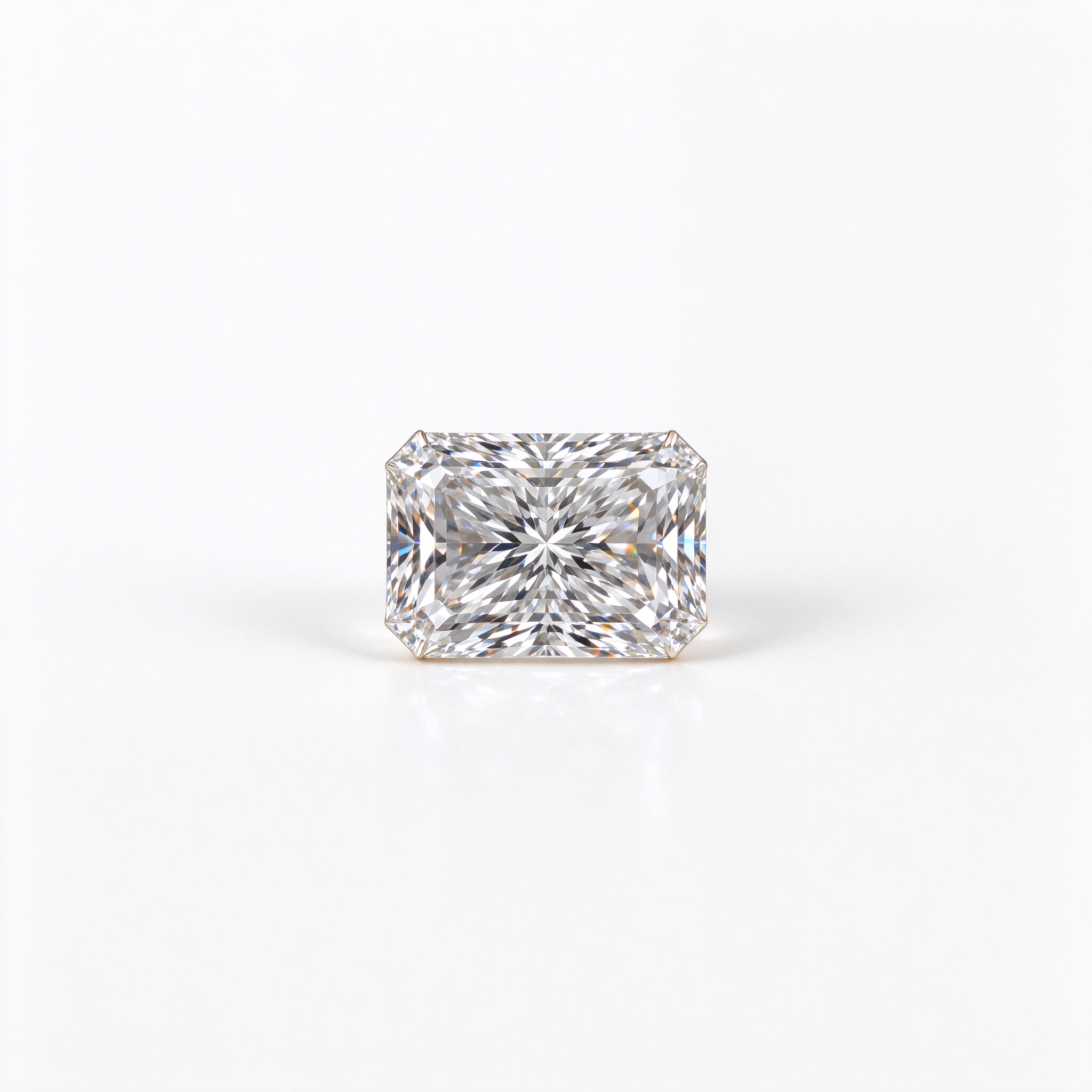
"Sparkle" is three different effects
When a customer says they want the sparkliest stone, they are describing one of three things, and no single cut wins all three. Brilliance is the white light reflected back from the table and crown. Fire is the rainbow-colored dispersion that breaks white light into spectral flashes. Scintillation is the moving pattern of light and shadow as the stone — or the light source — moves. A cut that maximizes one often trades away another, and that trade is the whole sales conversation.
The brilliance leaders: round and radiant
The round brilliant is the historic benchmark for white-light return, and it still wins on pure brilliance in side-by-side testing. But the radiant cut, which pairs a rectangular outline with a full brilliant-style facet set on the crown and pavilion, comes surprisingly close. Because the radiant borrows the round's facet geometry and stretches it into a rectangle, it keeps most of that white flash while offering a shape customers perceive as more modern. For shoppers who want the rectangular silhouette but worry the emerald will look flat, the radiant is the answer — and it is usually the most sparkly rectangular cut on the sheet.
The princess cut also performs strongly on brilliance, because its square crown uses a modified brilliant pattern. It tends to flash harder and whiter than the cushion, which softens the same square into warmer, broader reflections.
The fire leaders: cushion and pear
Fire — the rainbow flashes — is strongest in cuts that hold light in the pavilion long enough to split it. Cushion brilliants, particularly the crushed-ice style, throw colored flashes in a way that reads as warm and lively under warm store lighting. Pears and marquises also show strong fire because their pointed ends concentrate light. Customers who describe their ideal stone as "colorful" or "alive" are usually asking for fire, not brilliance, and the cushion is the first shape to hand them.
The step cuts: architectural, not sparkly
Here is the point most new buyers get wrong. Emerald and asscher cuts are not supposed to sparkle like brilliants. Their long, flat step facets produce broad mirror reflections — a "hall of mirrors" effect that changes as the hand moves. It is elegant and quiet, and it is the look customers mean when they say "Gatsby" or "minimalist." If a customer complains an emerald cut "doesn't sparkle," you have likely shown it to the wrong person. Match step cuts to buyers who value presence over flash.
Lighting changes the answer
Cut performance is not independent of the room. Brilliants come alive under direct, bright light — sunlight, a focused spotlight. Step cuts look best under soft, diffused light where their reflections can move gently. Moissanite's higher refractive index (around 2.65, compared with diamond's 2.42) means every cut performs slightly livelier than its diamond equivalent, but the ordering between shapes stays the same. A radiant in low light still out-sparkles an emerald in the same room.
Moissanite's edge over diamond on sparkle
Worth knowing on the sales floor: moissanite's refractive index is higher than diamond's, which means every cut on this list performs slightly more lively than its diamond equivalent under the same light. Fire, in particular, reads stronger. Customers who compare a moissanite radiant side by side with a diamond radiant often describe the moissanite as "more colorful" or "more alive." That is not a defect — it is the material. Acknowledge it honestly rather than trying to match a diamond expectation. The customers who want a quieter, more diamond-like look are steered toward step cuts; the customers who want extra sparkle are delighted by what moissanite already does.
One practical note for the case: brilliance is best judged in motion, not at rest. Spin the stone under the spot and watch how the flashes move. A well-cut radiant flashes evenly across the whole table; a poorly cut one goes dark in the center. This thirty-second spin test is the fastest way to sort the good radiants from the mediocre ones without a scope.
What to put in the customer's hand
Ask whether they want the stone to flash under party lights or look calm and expensive at a meeting. If they say flash, hand over a round, radiant, or princess. If they say calm, hand over an emerald or asscher. If they cannot decide, the radiant is the compromise: it has the rectangular silhouette that reads as design-forward, and the brilliant sparkle that reads as lively. It is the cut most customers end up choosing once they hold it next to the alternatives. When in doubt, default to the radiant — it is the safest way to give a customer a shape they will still like in five years. See the full range at radiant moissanite rings.