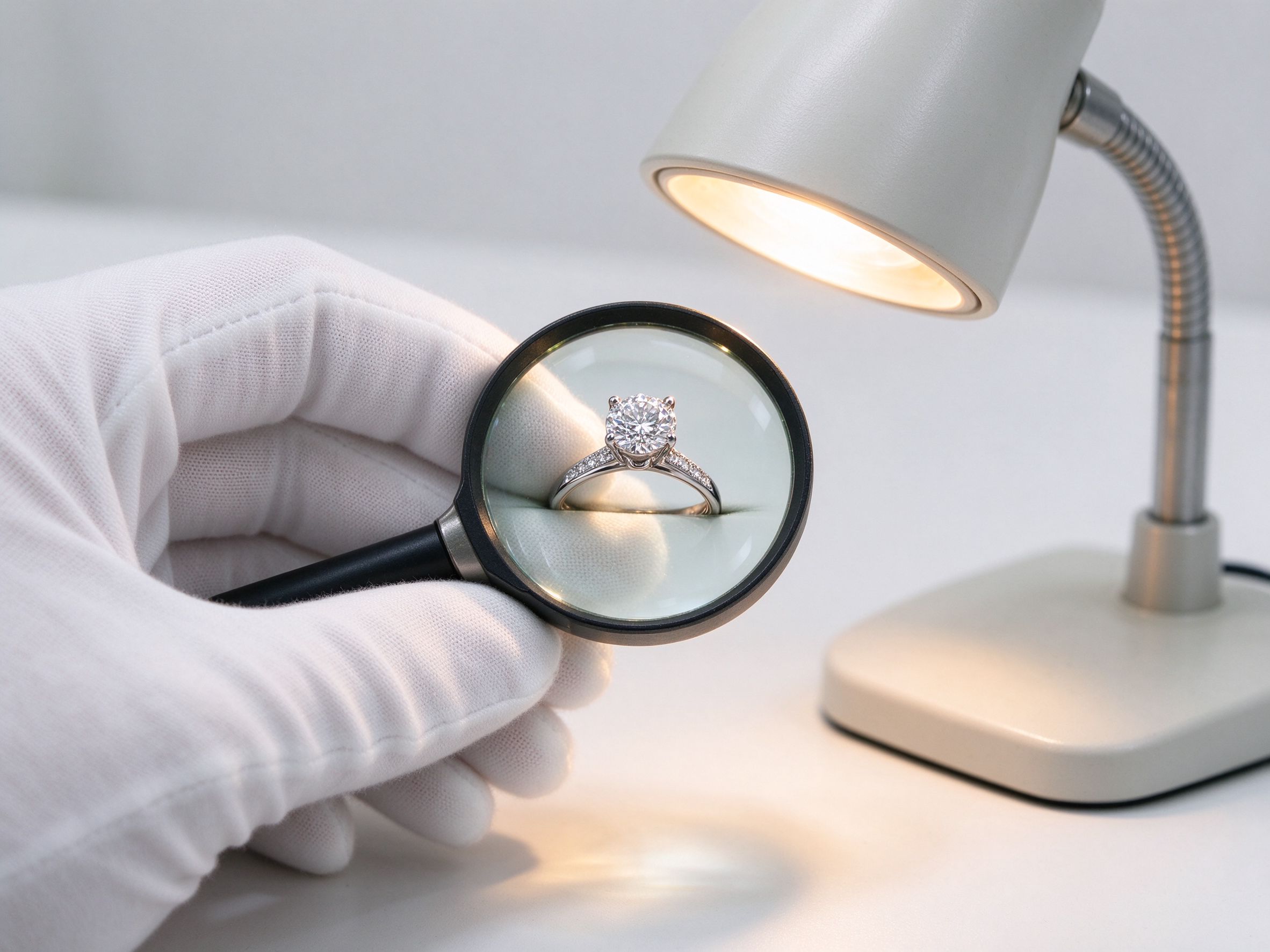
A new boutique owner priced a 6.5 mm D-F VVS moissanite at retail and was surprised when the same customer compared it to a G-H VS stone from a competitor and bought the cheaper one. The retail customer could not see the difference at 25 cm. The boutique had paid a 40% wholesale premium for the VVS grade and could not pass it on. That mistake comes from not understanding how wholesale moissanite pricing actually steps across color and clarity tiers.
Moissanite wholesale pricing is not a single number. It is a ladder built from three variables: color grade, clarity grade, and carat equivalent. Each step up the ladder costs more per carat, but the retail selling price does not rise in lockstep. The buyer who knows where the margin breaks chooses the tier that sells, not the tier that grades best.
How the color ladder moves price
Moissanite is graded on a color scale that roughly maps to the diamond scale: D, E, F are colorless; G, H are near-colorless; I, J and below show a faint warm tint. In moissanite, the D-F bracket typically runs 25–40% more per carat than G-H at the same clarity and size. The reason is demand: bridal customers expect "colorless," and D-F is marketed as the bridal grade.
But the visible difference between a D-F and G-H moissanite at 6.5 mm is small — most customers cannot tell them apart side by side in store lighting. The moissanite reference on color notes that moissanite is naturally near-colorless, and the G-H range is the sweet spot for price-sensitive buyers. We cover the demand split in D-F vs G-H bulk stock.
How the clarity ladder moves price
Clarity grades run FL (flawless), VVS1–VVS2, VS1–VS2, SI1–SI2, I1–I3. In moissanite wholesale, VVS runs about 20–30% more per carat than VS. FL is a niche grade that costs roughly double VVS and sells almost only to collectors. For a retail boutique, VS1 is the practical eye-clean grade for most cuts, and VVS is the premium for white-gold bridal settings where contrast is high.
The combination of color and clarity creates six common wholesale tiers:
- D-F VVS — top tier, bridal premium, highest margin but slowest turnover.
- D-F VS — the workhorse bridal tier, sells at a near-premium price with lower cost.
- G-H VVS — value bridal, good margin, fast mover for price-sensitive customers.
- G-H VS — the everyday tier, studs and pendants, fastest turnover.
- G-H SI — budget tier, small sizes and men's bands.
- I-J — niche, estate-style yellow gold, slow mover.
We cover the carat-size interaction in carat weight pricing tiers and the retail markup math in retail margin formula.
Where the margin actually sits
The highest retail margin is usually in the D-F VS tier, not the D-F VVS tier. Customers pay nearly the same retail for D-F VS as for D-F VVS, but the wholesale cost is 20–30% lower. The VVS premium is a wholesale cost that retail customers do not fully reimburse. Stock D-F VS as your bridal hero and keep a small D-F VVS tray for customers who specifically ask for "flawless."
The size dimension changes the tier math as well. At 6.5 mm and below, the color difference between D-F and G-H is small enough that most customers cannot tell them apart, so G-H VS gives you the best margin. At 8 mm and above, the larger face shows body color more readily, and D-F earns its premium because customers shopping at that price point expect colorless. For studs and pendants under 5 mm, color is nearly invisible, and G-H SI is a perfectly good value tier. Match the tier to the piece you are building, not to a single blanket rule.
What wholesale moissanite price range should a boutique expect per carat?
As a rough guide, G-H VS at 6.5 mm runs a fraction of a natural diamond per carat, and D-F VVS runs roughly 30–50% more. Exact numbers move with supply; request our current price list.
Is the VVS premium worth it for round stones?
Partly. Round brilliants show inclusions more than cushions, so VVS earns its premium on rounds above 7 mm. Below 6.5 mm, VS is eye-clean.
How does moissanite wholesale price compare to lab-grown diamond?
Moissanite typically undercuts lab-grown diamond wholesale by a wide margin. See moissanite vs lab-grown tiers.
Do wholesale prices move with diamond Rapaport?
Moissanite pricing is tied more to production cost and supply than to diamond Rapaport sheets. It is more stable quarter to quarter.
Order from HOLYCOME. We publish a quarterly wholesale price list across D-F VVS, D-F VS, G-H VVS, and G-H VS tiers, 3.0 to 10.0 mm round and major fancy shapes. Apply for a wholesale account and request the current tier price list — minimum order 20 stones, mixed tiers allowed.